跳到正文 · Skip to content
内容
关于与合作
订阅与会员
★ 查看会员权益
外观与设置
外观
主题色
版本 · 深色 / 减动搜索⌘K
草稿预览·这篇还没发布,不会出现在列表和 RSS 里。review 完后把 frontmatter 的 draft: true 改为 false 即可。

Why My Core Holdings Are Broad ETFs, Not Stock Picks

I spend hours researching individual stocks—but I put most of my money into something that requires no stock research at all. This isn't a contradiction. It's my most honest admission of how much skill I actually have.

2026.02.238 min原创
Why My Core Holdings Are Broad ETFs, Not Stock Picks
资产配置MINTOVIEW2026.02.23

"Asset Allocation" series · Final piece of the asset layer. Framework: see master outline. The previous five pieces dismantled cash, bonds, gold, Bitcoin, and overseas. This one dismantles the real core of most people's portfolios—how to hold equities.

1. An Apparent Contradiction

Let me start with a fact about myself that seems contradictory—

I spend a huge amount of time researching individual stocks (I've written dozens of company breakdowns), but the majority of my core holdings go to something that requires no stock research at all—broad-based ETFs (S&P 500, total market index, etc.).

Many people find this contradictory—if you have the research skills and can understand companies, why don't you overweight your hand-picked picks, instead of buying a "mediocre, everything-including" index?

It's not contradictory. It's the most honest admission I've ever made about "how much ability I actually have."

And the logic behind this admission is the single most important yet most counterintuitive lesson in all of asset allocation—admit that the market is smarter than you most of the time, and hand over the bulk of your money to it; only in the very few places where you truly have conviction should you trust yourself.

2. Index as Core: Three Unassailable Reasons

Why do broad-based indices work as a "core" (60-80% of the portfolio)? Three reasons, nearly unassailable (I wrote about them in detail in the Bogle and Malkiel pieces; here I tie them back to allocation).

First, the vast majority of active stock-picking underperforms the index over the long term. This is a repeatedly verified statistical fact—more than 80% of active management funds underperform their benchmark indices over the long run (remember Bogle). If most professional fund managers can't beat the index, what makes an amateur investor think they can? Admitting this isn't shameful; it's evidence-based humility. Handing your core to the index is acknowledging that "in most cases, the market's average level already beats my selective efforts."

Second, the index has a "self-renewing" mechanism that individual stocks lack. This point is severely underrated (remember the Siegel piece). An index is not a static basket of stocks—it automatically eliminates declining companies and includes rising ones. Fewer than half of the companies in the S&P 500 in 1980 are still in it today. By buying the index, you automatically benefit from a mechanism that "kicks out losers, brings in winners." Your hand-picked 10 stocks lack this mechanism—once a company you picked falls (creative destruction is inevitable—remember Schumpeter), your portfolio declines with it, unless you actively rotate (and you'll probably get that wrong). The index's "self-renewal" is a moat that a personal portfolio can never give you.

Third, the index lets you "almost never trade"—and trading is a killer of returns. The ideal state for a core position is "buy and hold, let compounding work" (remember Laozi's "wu wei" and Buffett's "just sit there"). An index is perfect for this—you don't need to monitor any single company's earnings, judge buy/sell points, or worry about one company blowing up. You reduce "the urge to trade" to nearly zero—and that exact urge is the root of most people's losses.

Combine these three reasons—the index is something that "has a high probability of outperforming your stock-picking, renews itself, and requires almost no action." For the goal of a "core position" (seeking stability, long-term compounding, and avoiding major mistakes), it's near-perfect.

3. So What's the Point of Researching Individual Stocks? Satellites, Not Core

At this point you might ask—then why spend so much time on individual stocks? What's the point?

The answer is—individual stocks belong in the "satellite," not the core (remember the core-satellite framework, and the three-layer structure).

My structure looks like this:

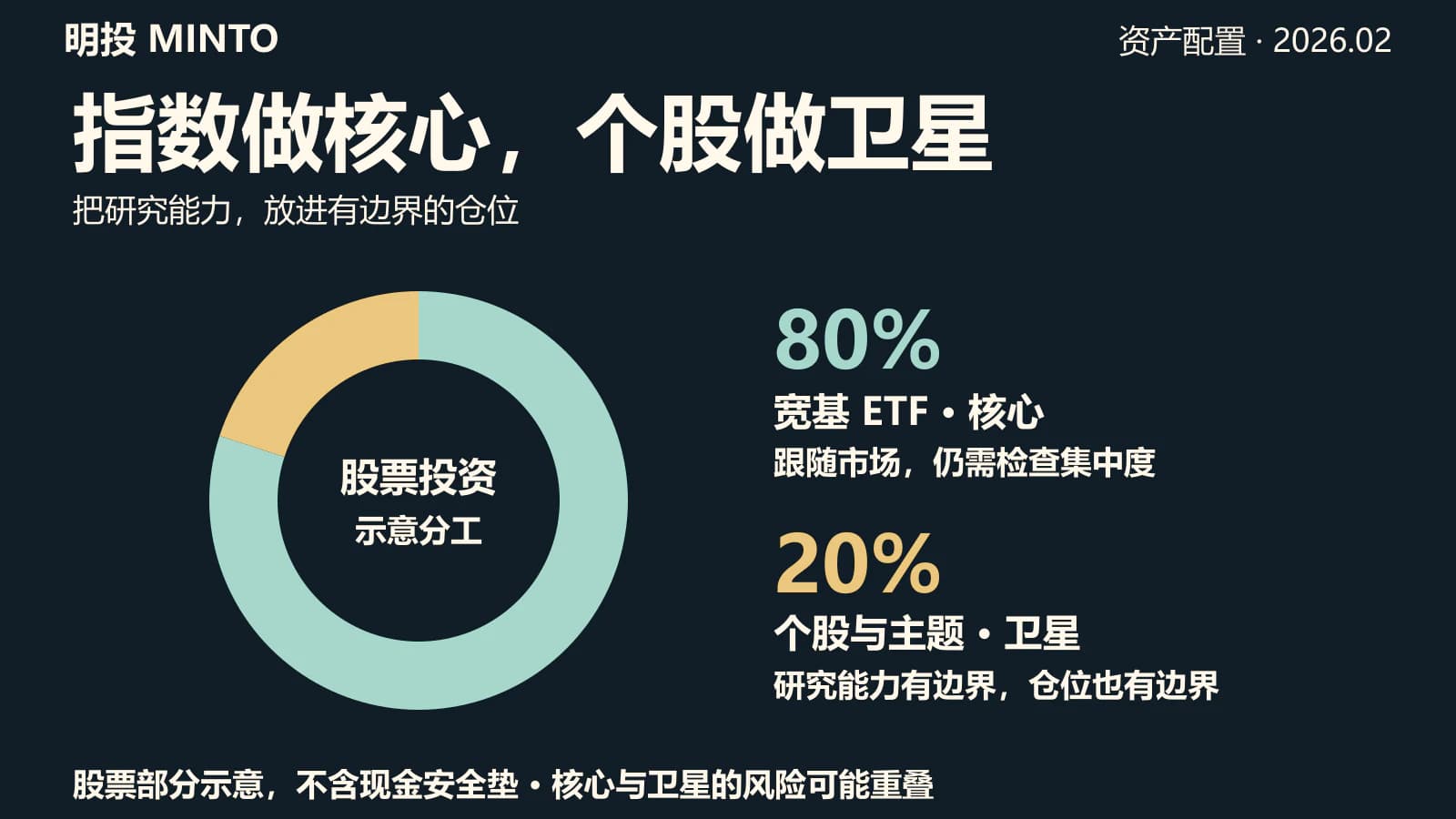
Core (70-80%) = Broad-based ETFs. This part aims to "track the market, compound long-term, and stay put." I hand it to the index, admitting the market is smarter than me.

Satellite (roughly 20%) = My hand-picked stocks + themes. This is where my research ability actually gets used—concentrated bets on the few companies and sectors I truly understand, where I have a proprietary view, aiming for excess returns.

This division is based on an honest self-assessment—I admit I have no edge in "most companies/most of the time" (so the core goes to the index), but I believe I have genuine insight in "a very small number of areas I've deeply researched" (so the satellite is my own work).

This echoes the "circle of competence" I've talked about many times (Munger, Buffett)—a circle of competence is not about being as big as possible; it's about having as clear a boundary as possible. Handing the core to the index is admitting my circle is narrow; only using stocks in the satellite is focusing my efforts within that narrow circle. Clearly knowing "what I can't do (hand it to the index) vs. what I can do (do it myself)" is a dividing line more important than picking any single stock right.

So the value of my stock research is not to "replace the index with stocks as the core," but to—in that 20% satellite, do better than the index; and at the same time, stay connected to what the index actually holds, so I'm not disconnected (remember Lynch—maintain market perception).

4. Where I Differ from Both Extremes

There are two extremes around "index vs. stocks," and I disagree with both.

One extreme: "You can only get rich with stocks; buying an index is timid." This is the faith of many retail investors—they look down on the index's "average" returns, dreaming of hitting it big on a stock pick. But the data is cold: the vast majority of those pursuing "stock-picking riches" underperform the index they disdain, over the long term. They mistake the low-probability fantasy of "I can pick the next Nvidia" for a reason to overweight stocks. That's overconfidence (remember Kahneman). My attitude toward the core: abandon the fantasy of "getting rich quick" in exchange for the certainty of "high probability of beating active + self-renewal + no worries."

The other extreme: "100% index; researching stocks is a complete waste of time." This is the faith of extreme passive camp (some Bogle disciples). I don't fully agree either—because it denies the value of active work in the few areas where you truly have a circle of competence. Someone who is 100% passive gives up the potential for excess return from that 20% satellite, and risks becoming disconnected from the market (if you never study any company, you have no idea what's happening in the world that makes up your index). My stance is 80% passive + 20% active—use passive to protect the bulk, and use active to fight for a small edge within my circle.

My entire position sits in the middle of these two extremes—neither dogmatic about stocks (the core is the index) nor entirely abandoning active work (the satellite is mine). This goes back to the phrase—don't be a disciple of any method. Both the index camp and the stock-picking camp contain truths and their own dogmatism. Treat them as tools, placed at different layers of the portfolio (index as core, stocks as satellite), not as opposing religions.

5. A Detail Often Overlooked: The Index's Own Concentration Needs Monitoring

Finally, a point that's easy to miss but extremely important in 2026—"buying the index" does not mean "diversified forever, no further thought."

I touched on this in the master outline and the overseas piece—today's S&P 500 has roughly 1/3 of its market cap in the Mag 7. This means your "broad-based core" has quietly become a "hidden concentrated bet on a handful of tech giants."

So even with an index core, I do one thing—periodically drill down to see the real concentration of my "core ETF" (risk parity taught me this—remember the framework piece). If at some point the head concentration is dangerously high (e.g., top 10 names account for half the index), I use some methods to hedge this concentration (for example, add a bit of an equal-weight index, or a value factor index, or the overseas stuff mentioned earlier, to balance out the overexposure to top tech names).

"Buying the index" is a good starting point, but not a finish line where you can close your eyes. The structure of the index itself changes (heads get more concentrated), and you need to stay aware of "what risk exposures my 'diversified' core really has." Passive investing does not equal passively not thinking.

6. Final Words

This piece closes the entire "asset layer"—cash, bonds, gold, Bitcoin, overseas, and now the equity core.

If I were to condense the "allocation logic" of these six pieces into one sentence, it would be—admit your ignorance, hand most of it to the market and diversification; only trust yourself in the very few places where you truly have conviction.

This sentence runs through the handling of every asset—

Cash: admit I can't predict when a crisis hits, so preserve optionality. Bonds: admit it's not "risk-free," understand what risks it carries. Gold/Bitcoin: admit I can't be sure whether the system will collapse or crypto will succeed, so hedge and experiment with small positions. Overseas: admit I might be wrong about the US, so leave an escape route. Equity core: admit I'll underperform the market most of the time, so hand the core to the index.

The entire asset layer is essentially a continuous exercise in "admitting ignorance." And that is the core of the master outline—the essence of allocation is humility about the unknowable; not predicting the future, but preparing for every possible future.

That seemingly contradictory opening—"I research stocks, yet put the core into something that requires no research"—now makes sense. It is precisely the most critical step in this exercise of "admitting ignorance": honesty about the boundaries of your own ability. I research, to do better in that 20% where I truly understand; I buy the index, to avoid major mistakes in that 80% where I don't have conviction.

Knowing when to trust yourself and when to trust the market—

This dividing line is a more important piece of wisdom than any specific allocation ratio in asset allocation.

Asset layer complete. Next, we move from "what to allocate" to "how to maintain"—the execution layer. First piece: that boring, yet quietly compounding annual extra return—rebalancing.

Minto
明投 Minto
投资分析 · 长期主义者

专注投资分析、市场洞察与资产配置。不追短期波动,只理解真正驱动长期回报的东西。

你读完了 · Colophon

Why My Core Holdings Are Broad ETFs, Not Stock Picks

8
分钟
2026/02
期号
2026
年份
真正稀缺的,是一个不慌不忙的人。
明投 · MintoInvest Wisely
— From This Series
喜欢这篇?这类 资产配置 的深度拆解会持续发到你邮箱。
无广告 · 随时退订
— Enjoyed the read?
如果这篇文章对你有用,把它分享给一个朋友,就是对我最好的支持。

口碑是独立创作者最稀缺的燃料。

— Discussion

说说你的想法

评论基于 GitHub Discussions(Giscus)。登录后即可留言、点赞、互相讨论。

评论还在准备中。

想说什么可以直接发我邮件,比在评论区更容易认真回复。

mingtaohuang617@gmail.com →
支持沉浸式阅读