跳到正文 · Skip to content
内容
关于与合作
订阅与会员
★ 查看会员权益
外观与设置
外观
主题色
版本 · 深色 / 减动搜索⌘K
草稿预览·这篇还没发布,不会出现在列表和 RSS 里。review 完后把 frontmatter 的 draft: true 改为 false 即可。

Sequence Risk: Why When You Lose Matters More Than How Much

Two people, same average returns, same volatility — one retires in comfort, the other in misery. The difference? Just one thing: whether the crash hits early or late.

2026.03.118 min原创
Sequence Risk: Why When You Lose Matters More Than How Much
资产配置MINTOVIEW2026.03.11

This is part of the "Asset Allocation" series · Risk Layer. See the overview for the framework. This piece covers a risk most people have never heard of but that can determine whether you retire well or poorly: sequence risk.

The Counterintuitive Truth: Order Determines Fate

Let me start with a fact that will flip your intuition.

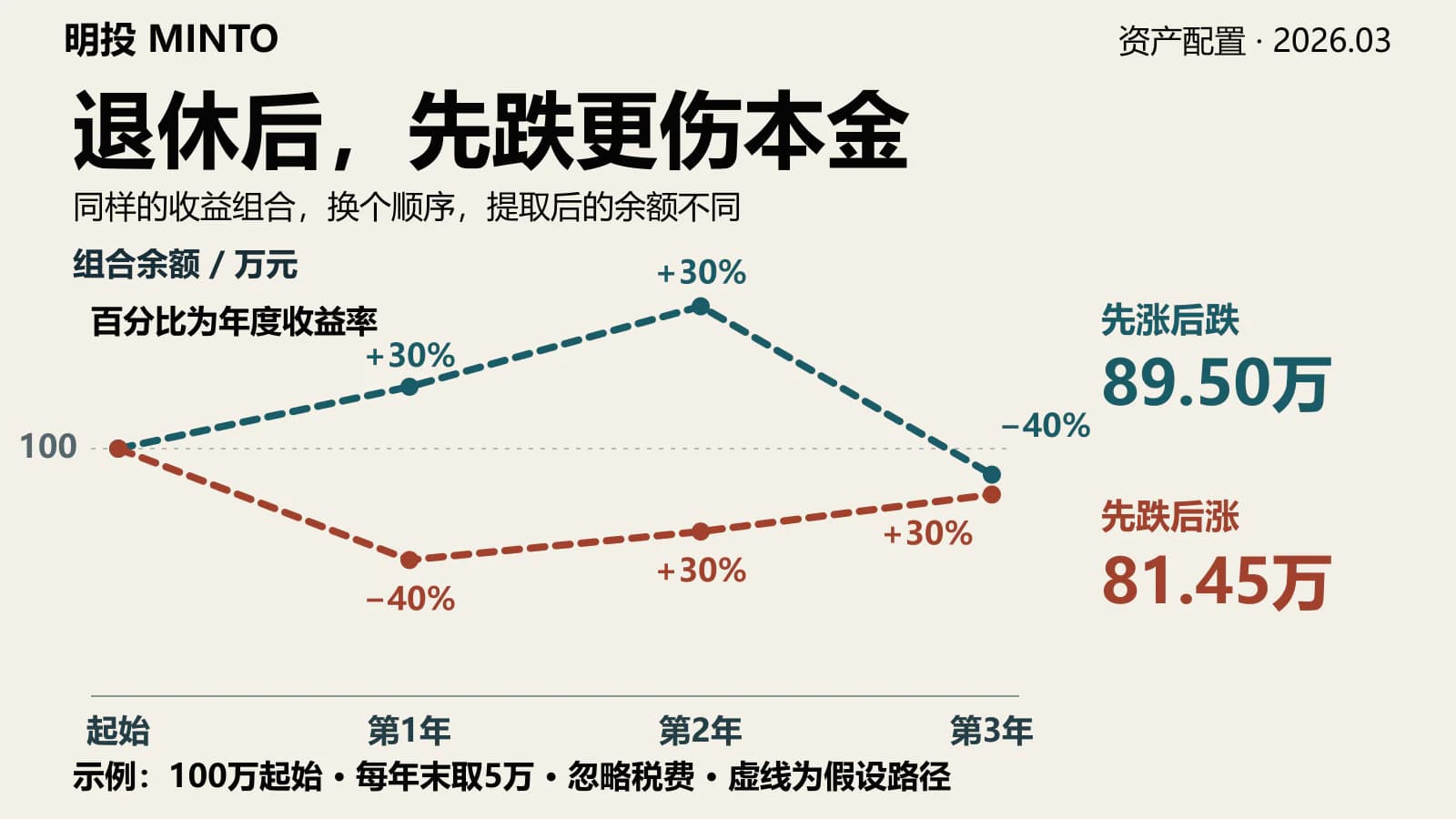
Imagine two people. Both retire at 65 with a $1 million nest egg. Both plan to withdraw $50,000 a year to live on. They invest in the same assets, with the same 30-year average annual return and the same volatility — the only difference is the sequence in which those returns occur.

Person A (lucky): The first few years of retirement see big market gains. The crash hits later. Person B (unlucky): A crash hits right in the first few years, then a slow recovery.

Intuitively, you'd think: same average return, same volatility — the final outcome should be about the same, right?

Wrong. The difference can be night and day — A enjoys a comfortable retirement with growing wealth, while B may run out of money by age 80, facing financial hardship.

Same average return, same volatility, just because a crash came early or late — one ends up wealthy, the other bankrupt.

That's sequence of returns risk — when you start withdrawing from your portfolio continuously, the order in which returns occur determines your fate. And you have no control over that order.

Why the Sequence Is So Deadly: Withdrawals Amplify Everything

Why does "sequence" become so lethal after retirement? One key action: you are continuously taking money out.

During your accumulation phase (only depositing, never withdrawing), sequence doesn't matter much. Whether a crash comes early or late, as long as you don't sell, your final compounded result is largely determined by the average return. Early crash or late crash, it evens out over the long term.

But in the withdrawal phase (retirement, pulling money out every year), everything changes —

Consider Person B: In the first year of retirement, the market crashes 40%. His $1 million becomes $600k. But he still needs $50k to live. So he is forced to sell assets at the bottom to raise that $50k (remember the cash piece — "forced selling" is the biggest killer). After the withdrawal, he has only $550k left.

The next year, the market might rebound, but his principal has been permanently dented by "selling low" — the shares he sold at the bottom are gone forever, and they miss the entire recovery.

This cycle repeats year after year — each time he is forced to withdraw at a market low, he permanently and irreversibly erodes his principal. By the time the market fully recovers, his capital has been hollowed out by those low-point withdrawals.

Person A? In the early years of retirement, the market surges. His $50k withdrawals come from a growing pool, with no damage. When the crash finally arrives a few years later, his capital has already thickened from the early gains, allowing him to weather the storm comfortably.

Same average return. But because the crash came early for B, forcing him to sell low, his principal was permanently gutted. Because the crash came late for A, his capital had already grown thick. Sequence determined their fates.

This Isn't Just a Retiree Problem

You might think: "I'm young, retirement is far away. Sequence risk doesn't affect me."

Wrong. Sequence risk affects anyone who withdraws from their portfolio, not just retirees —

Any phase with "withdrawal needs" faces sequence risk: saving for a child's education, needing a lump sum for a house, freelancers using investments to supplement income, people pursuing FIRE (Financial Independence, Retire Early) ... Whenever you continuously or in large sums take money out of your portfolio, the sequence of returns during that period significantly impacts your outcome.

More broadly — sequence risk reveals a profound truth that goes beyond retirement: in investing, sometimes "when" something happens is more important than "what" happens.

A crash of the same magnitude is an opportunity if it occurs during your accumulation phase (you're not withdrawing and can even buy the dip), but a disaster if it occurs during your withdrawal phase (forced selling). The same lump sum invested early vs. late (remember the dollar-cost averaging piece) yields different results. The same returns, in different sequences, produce different fates.

Time and sequence are severely underestimated dimensions of investing. Most people only care about "how much" (magnitude) but ignore "when" (sequence and timing) — and the latter, in certain phases, truly determines outcomes.

How to Defend: Three Lines of Defense

The horror of sequence risk is that you cannot control the order (you can't choose to delay a crash). But through asset allocation, you can reduce its damage. Three lines of defense —

First: A cash/short-term bond buffer (most important). This is the most effective weapon against sequence risk, directly echoing the cash piece. Prepare 2-3 years of living expenses in cash or short-term bonds for your withdrawal phase. That way, when the market crashes, you withdraw from the cash pool for living expenses, instead of touching your crashed stocks — you avoid the most lethal action: being forced to sell stocks at the bottom. Once the market recovers, you replenish the cash pool. This buffer blocks the core damage of sequence risk — forced low-point selling — at the door.

Second: Reduce equity allocation during the withdrawal phase (glide path). As you approach or enter the withdrawal phase, gradually lower your stock allocation and increase defensive assets (remember the drawdown piece — allocation is determined by your risk tolerance, and that tolerance is lower during the withdrawal phase). Because the cost of encountering a crash during withdrawal is far higher than during accumulation. Someone nearing retirement shouldn't be 90% stocks — that's exposing yourself to massive sequence risk. But don't go to the extreme of conservatism either (inflation will eat your retirement over 30 years — remember Siegel), so balance is key.

Third: A flexible withdrawal strategy. Don't mechanically withdraw a fixed $50,000 every year. In years when the market crashes, actively reduce withdrawals (tighten your belt, use the cash buffer, postpone large expenses); in years when the market booms, withdraw normally. This flexibility — "withdraw less when the market is bad, withdraw normally when it's good" — significantly reduces the damage from forced low-point selling. This echoes Laozi's "know when to stop" — in bad markets, contract.

Combine these three lines of defense — cash buffer (don't sell stocks low) + lower equity in withdrawal phase (reduce exposure) + flexible withdrawals (take less when bad) — and you can minimize the damage from the order you cannot control. You still can't choose when a crash hits, but you can ensure that when it does, you won't be forced to make the most lethal move: selling your future at the bottom.

My Difference from Mainstream: Retirement Planning Must Not Rely on Average Returns

Mainstream retirement planning (and countless financial calculators) is built on a dangerous assumption — using average annualized return to project whether your retirement money is enough.

For example: "Assuming your portfolio earns 7% annually, with $1 million and $50k annual withdrawals, it will last X years."

This calculation entirely ignores sequence risk, and therefore can give you fatally misleading guidance.

Because it uses an "average 7%," but in reality, returns are not a smooth 7% every year; they are violently volatile (up 25% one year, down 20% the next). And if those down years happen to be concentrated in the early years of your retirement, your actual outcome will be far worse than the "average 7%" calculation suggests — you might go broke in 20 years when the calculator said 30.

Average returns assume a world that is "smooth and order-agnostic." But the real world has order, and order is lethal during the withdrawal phase.

My stance — retirement/withdrawal planning must never rely solely on average returns. Sequence risk must be factored in. Concrete approach: use Monte Carlo simulation (model thousands of different sequences of returns to see in how many scenarios your money runs out early) instead of a single average return calculation; or more simply — plan assuming the worst case: a crash in your first year of retirement, and see if your portfolio can survive. If you can endure the worst sequence, you're safe.

Plan for the worst sequence, not the average return — that's the most important correction sequence risk brings to retirement planning.

In Closing

Sequence risk is the most hidden and counterintuitive risk in asset allocation.

It's counterintuitive because it tells you something that goes against common sense — two people with exactly the same average returns and exactly the same volatility can end up worlds apart. The difference isn't in "what they experienced" (same average), but in "the order they experienced it" (crash early or late).

It's hidden because it only shows up during the withdrawal phase. For decades while you accumulate wealth, it lies dormant, invisible (sequence doesn't matter in accumulation). Then, at your most vulnerable moment — after retirement, when you start relying on that money to live — it can strike: a crash that comes just a little too early, combined with your forced low-point withdrawals, can hollow out decades of accumulated retirement savings in just a few years.

And the cruelest part — you can't control the order. You can't choose to have the crash delayed by five years. If you're lucky (crash late), you retire comfortably; if you're unlucky (crash early), with the same effort and same average returns, you might face hardship.

But that doesn't mean you're helpless. The entire point of asset allocation is here — you can't control the order, but you can build a structure that won't be fatally hit regardless of the order: a cash buffer to ensure you never have to "sell low;" a conservative allocation in the withdrawal phase to reduce exposure; flexible withdrawals to tighten in bad markets.

This brings us back to the core principle from the overview, and it's its most profound application yet — don't predict the future (you can't predict when a crash comes), but prepare for all futures (whether the crash comes early or late, you have a structure ready that won't be broken by it).

Sequence risk teaches us: In investing, you need to prepare not only for "what will happen," but also for "when it will happen." Because sometimes, the latter is what truly decides your fate.

Next, the final piece of the risk layer, and the last in the whole asset allocation series: leverage — the fuse that can turn a great portfolio into dynamite.

Minto
明投 Minto
投资分析 · 长期主义者

专注投资分析、市场洞察与资产配置。不追短期波动,只理解真正驱动长期回报的东西。

你读完了 · Colophon

Sequence Risk: Why When You Lose Matters More Than How Much

8
分钟
2026/03
期号
2026
年份
真正稀缺的,是一个不慌不忙的人。
明投 · MintoInvest Wisely
— From This Series
喜欢这篇?这类 资产配置 的深度拆解会持续发到你邮箱。
无广告 · 随时退订
— Enjoyed the read?
如果这篇文章对你有用,把它分享给一个朋友,就是对我最好的支持。

口碑是独立创作者最稀缺的燃料。

— Discussion

说说你的想法

评论基于 GitHub Discussions(Giscus)。登录后即可留言、点赞、互相讨论。

评论还在准备中。

想说什么可以直接发我邮件,比在评论区更容易认真回复。

mingtaohuang617@gmail.com →
支持沉浸式阅读