跳到正文 · Skip to content
内容
关于与合作
订阅与会员
★ 查看会员权益
外观与设置
外观
主题色
版本 · 深色 / 减动搜索⌘K
草稿预览·这篇还没发布,不会出现在列表和 RSS 里。review 完后把 frontmatter 的 draft: true 改为 false 即可。

Rebalancing: The Boring Habit That Quietly Boosts Your Returns Every Year

Rebalancing doesn't require you to predict anything or be smarter than anyone else. It simply asks you to do one thing that goes against human nature: sell what's flying high and buy what's beaten down.

2026.02.257 min原创
Rebalancing: The Boring Habit That Quietly Boosts Your Returns Every Year
资产配置MINTOVIEW2026.02.25

「Asset Allocation」Series · Execution Layer. Framework in the overview. We've covered "what to allocate" (strategic layer + asset layer). Starting from this piece, we look at "how to maintain." The first, and most underrated — rebalancing.

配置定好之后,会发生什么

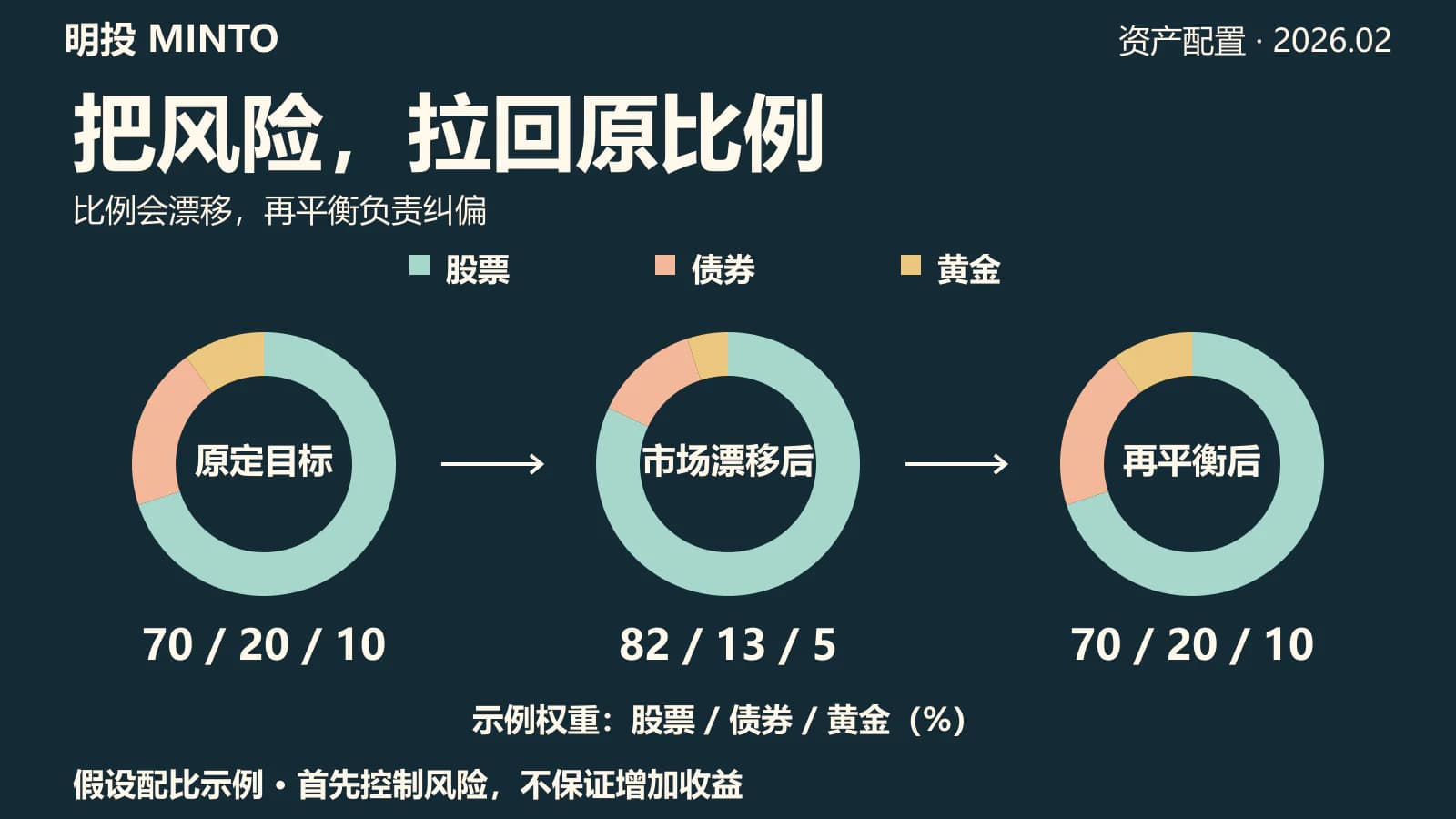
Suppose you've set a strategic allocation following our earlier logic — say 70% stocks, 20% bonds, 10% gold.

Many people think once the allocation is set, the job is done. Wrong — the job has only begun, because this mix doesn't stay put on its own.

Markets move, and your allocation drifts. Suppose stocks surge over the next year, bonds are flat, gold falls. At year-end, your portfolio might have become 82% stocks, 13% bonds, 5% gold.

Your "70/20/10" mix, without you lifting a finger, has drifted into "82/13/5."

This is a big problem — because the risk structure you carefully designed has been quietly rewritten by the market. You originally wanted the risk exposure of 70% stocks; now it's 82% — your portfolio, without you realizing it, has become more aggressive and fragile than you intended. And this happens precisely after stocks have rallied, valuations are richer, and risks are higher.

Rebalancing means pulling that drifted allocation back to your original target — selling some of the stocks that have run up too much, buying back the bonds and gold that have fallen, restoring the mix to 70/20/10.

再平衡为什么有效:它逼你高抛低吸

Rebalancing sounds like mere maintenance, but it contains a deep, almost free source of returns — it mechanically and forcibly forces you to "buy low, sell high."

Look at the example above — what does rebalancing ask you to do? Sell the stocks that have risen the most (sell high), and buy the gold and bonds that have fallen the most (buy low).

This is exactly what everyone knows they should do, yet almost nobody achieves — be fearful when others are greedy (sell the runaway winners), be greedy when others are fearful (buy the bloodbath) (remember Laozi's "reversal is the movement of Dao", Buffett, Marks' pendulum).

The brilliance of rebalancing is that it turns this deeply counter-human behavior into a mechanical discipline that requires no judgment from you.

You don't need to predict "have stocks peaked?" (no one can), you don't need to judge "has gold bottomed?" (no one can judge). You just need to follow one rule — when an asset deviates too far from its target, pull it back. This rule, automatically, at every market extreme, makes you do the correct contrarian move.

It takes "contrarian investing" — something that demands extraordinary psychological strength — and demotes it to a mechanical, rule-based action. That's its greatest genius.

This also explains a counterintuitive statistical observation — a "mediocre portfolio that rebalances regularly" often outperforms a "great portfolio that never rebalances" over the long run. Because rebalancing persistently and automatically does "buy low, sell high," while a non-rebalanced portfolio lets winners grow ever larger (concentration and risk rising), eventually giving back all outperformance in a single drawdown.

怎么做:两种触发方式

How exactly do you rebalance? Two mainstream approaches —

First: time-triggered (periodic rebalancing). For example, once a year or every six months, check on a fixed schedule and bring the allocation back to target. Pros: simple, mechanical, no need to watch markets. Cons: it might not be time when it's needed, or the market may move sharply right after you rebalance.

Second: deviation-triggered (threshold rebalancing). Set a deviation threshold (e.g., any asset deviates more than 5 percentage points from target). Rebalance only when triggered. Pros: responds more precisely to market moves (only acts when truly off). Cons: requires more frequent monitoring.

I use a combinationa fixed annual check (time-based), plus a deviation threshold (e.g., >5% deviation). I don't look regularly; if any asset goes too far off, it triggers. This way I don't miss a big drift just because "it's not yet a year," and I don't overtrade by "watching every day."

A few execution points —

First, don't be too frequent. Too-frequent rebalancing generates transaction costs and taxes (remember Bogle — costs are the surefire killer), and it reduces the benefit of letting trends run. Once or twice a year, or on big deviation triggers, is enough. Rebalancing is a blend of "doing nothing" and "discipline" — mostly stay put, only act when significantly off.

Second, prefer using "new money" to rebalance. If you are still adding cash to your portfolio (systematic investment), the simplest and most tax-efficient way is — direct the new money into the asset that is "down and underweight," rather than selling the winners. This brings allocation back without triggering a sale for tax purposes.

Third, do it in tax-advantaged accounts. If you have retirement accounts (tax-deferred), try to do the "sell" leg of rebalancing inside those accounts to avoid taxable events (capital gains tax in US stocks).

我跟主流的不同:再平衡的价值不是收益,是风控

Mainstream discussions on rebalancing almost always emphasize its "return enhancement" — "rebalancing gives you an extra X% return" (the so-called rebalancing premium). I think this framing is misleading.

Because the "return enhancement" from rebalancing is actually not stable. In some market environments (a straight bull market), not rebalancing yields higher returns — you let the winners (stocks) keep running, while rebalancing would "prematurely" sell them. If you focus on "returns," you'll find that sometimes rebalancing helps, sometimes it hurts.

So if you justify rebalancing on the grounds that "it increases returns," you will eventually doubt and abandon it in a bull market (precisely when it needs to be adhered to most).

I believe rebalancing's true, stable value is not in returns, but in risk control

Its core function is to prevent your portfolio from losing risk control. Remember the example — without rebalancing, your 70% stocks drift to 82%, then 85%, your portfolio becomes more aggressive, more concentrated, more fragile each bull year, until the next drawdown wipes it out (and your loss is far worse than if you had stayed at 70%).

Rebalancing's essence is to lock your risk exposure at a level you can tolerate, preventing the market from quietly pushing it beyond what you can handle. It ensures that no matter how high the market goes, your portfolio won't become dangerously overconcentrated because "winners ran too much."

So my positioning of rebalancing is — it is first and foremost a risk control tool that incidentally (in some environments) enhances returns. Treat it as risk control, and you can stick with it in any market (because risk control is always valuable); treat it as a return enhancer, and you'll abandon it in a bull market when "returns aren't boosted temporarily" — exactly when it matters most.

再平衡 vs 趋势跟随:两种对立的哲学

Interestingly, rebalancing and another popular strategy — trend following (the "advanced" version of chasing winners and cutting losers — add to winners, cut losers) — are philosophically opposed.

Rebalancing says: sell what's up too much, buy what's down too much (contrarian, mean-reversion — remember Laozi, Marks). Trend following says: buy more when it's rising, sell when it's falling (momentum, trend).

They seem contradictory, but really — they reflect different beliefs about markets on different time horizons.

Trend following believes in short-to-medium-term momentum (what's going up will keep going for a while); it works in markets with sustained trends. Rebalancing believes in long-term mean reversion (what's gone too far will eventually revert); it works in oscillating and long-term environments.

My judgment — for a long-term individual allocator, rebalancing is far more suitable than trend following. Trend following demands extreme discipline, frequent trading, precise timing, and once the trend reverses (from up to down), it "buys high, sells low" (chasing at the top, cutting at the bottom), easy to get whipsawed repeatedly. Rebalancing is mechanical, low-frequency, counter-human but simple; it needs no prediction of trends — perfect for someone with a day job who doesn't want to stare at screens and seeks steady long-term results.

Trend following bets "the direction will continue"; rebalancing bets "extremes will revert." For long-term allocation, the latter is more stable, more executable, and less dependent on luck.

写在最后

Rebalancing is the least sexy move in all of asset allocation.

It has no thrill of "I caught a ten-bagger," no high of "I timed the bottom perfectly," no bragging story. It's just a boring, mechanical, once-or-twice-a-year maintenance act — sell a bit of what's up too much, buy a bit of what's down too much, bring the mix back.

But this most boring move contains the two most precious things in allocation —

It turns "contrarian investing" — the most counter-human, hardest thing to do — into a mechanical discipline without judgment (remember — markets love to punish those who can't resist, and rebalancing gives your "can't resist" the right direction).

It locks your risk at a level you can tolerate, preventing the market from quietly pushing your portfolio toward danger in a bull market.

It doesn't require you to be smart, to predict, to be better than others. It only asks you to do one thing — when everyone is celebrating the runaway asset, you quietly sell a bit; when everyone is despairing over the beaten-down asset, you quietly buy a bit. Then do nothing and wait for the next time.

This sounds so simple it's almost trivial. But it achieves everything great investors constantly emphasize yet few actually execute — discipline, contrarianism, risk control, not being ruled by emotions.

And it achieves all that not through your willpower, but through a mechanical rule.

That is rebalancing — the most boring, yet possibly most valuable habit in allocation.

Next, the second habit in the Execution Layer: Dollar-Cost Averaging — what it fights is not the market, but yourself.

Minto
明投 Minto
投资分析 · 长期主义者

专注投资分析、市场洞察与资产配置。不追短期波动,只理解真正驱动长期回报的东西。

你读完了 · Colophon

Rebalancing: The Boring Habit That Quietly Boosts Your Returns Every Year

7
分钟
2026/02
期号
2026
年份
真正稀缺的,是一个不慌不忙的人。
明投 · MintoInvest Wisely
— From This Series
喜欢这篇?这类 资产配置 的深度拆解会持续发到你邮箱。
无广告 · 随时退订
— Enjoyed the read?
如果这篇文章对你有用,把它分享给一个朋友,就是对我最好的支持。

口碑是独立创作者最稀缺的燃料。

— Discussion

说说你的想法

评论基于 GitHub Discussions(Giscus)。登录后即可留言、点赞、互相讨论。

评论还在准备中。

想说什么可以直接发我邮件,比在评论区更容易认真回复。

mingtaohuang617@gmail.com →
支持沉浸式阅读