"Asset Allocation" series · Asset layer. Framework in the intro. I previously wrote a piece on gold prices, U.S. fiscal policy, and government debt — that one explained "why prices move"; this one covers "how much to allocate in a portfolio." Two different things.
I. Buffett Hates Gold, and He Might Be Only Half Right
The most famous critique of gold comes from Warren Buffett. He calls it an asset that "doesn't breed and doesn't produce anything." Pile up all the world's gold, you get a big metal block — same block decades later. No interest, no dividends, no value creation. By contrast, the same money buying all U.S. farmland and companies would generate endless crops and profits over time.
Logically, that critique is bulletproof. If you measure assets by cash flow generation, gold is the worst — its cash flow is zero.
But Buffett might be only half right, because the ruler he uses (cash flow) is precisely the wrong ruler for gold.
Gold's value has never been about output. It's about being the opposite of every other asset at certain moments.
Buffett's framework assumes a premise — that the monetary system is stable and trustworthy. Under that premise, "buy assets that produce cash" is obviously optimal. But gold's entire reason for existence is preparation for the moment when that premise breaks down.
II. Gold Doesn't Hedge "Downside" — It Hedges Collapse of Trust
To understand gold, you first need to get clear — what risk does it actually hedge?
Many think gold hedges "stock market declines." Wrong. The correlation between gold and equities is notoriously unstable — sometimes stocks fall and gold rises, sometimes they fall together (gold dropped during the March 2020 liquidity crisis). If you expect gold to save you in every crash, you'll be disappointed.
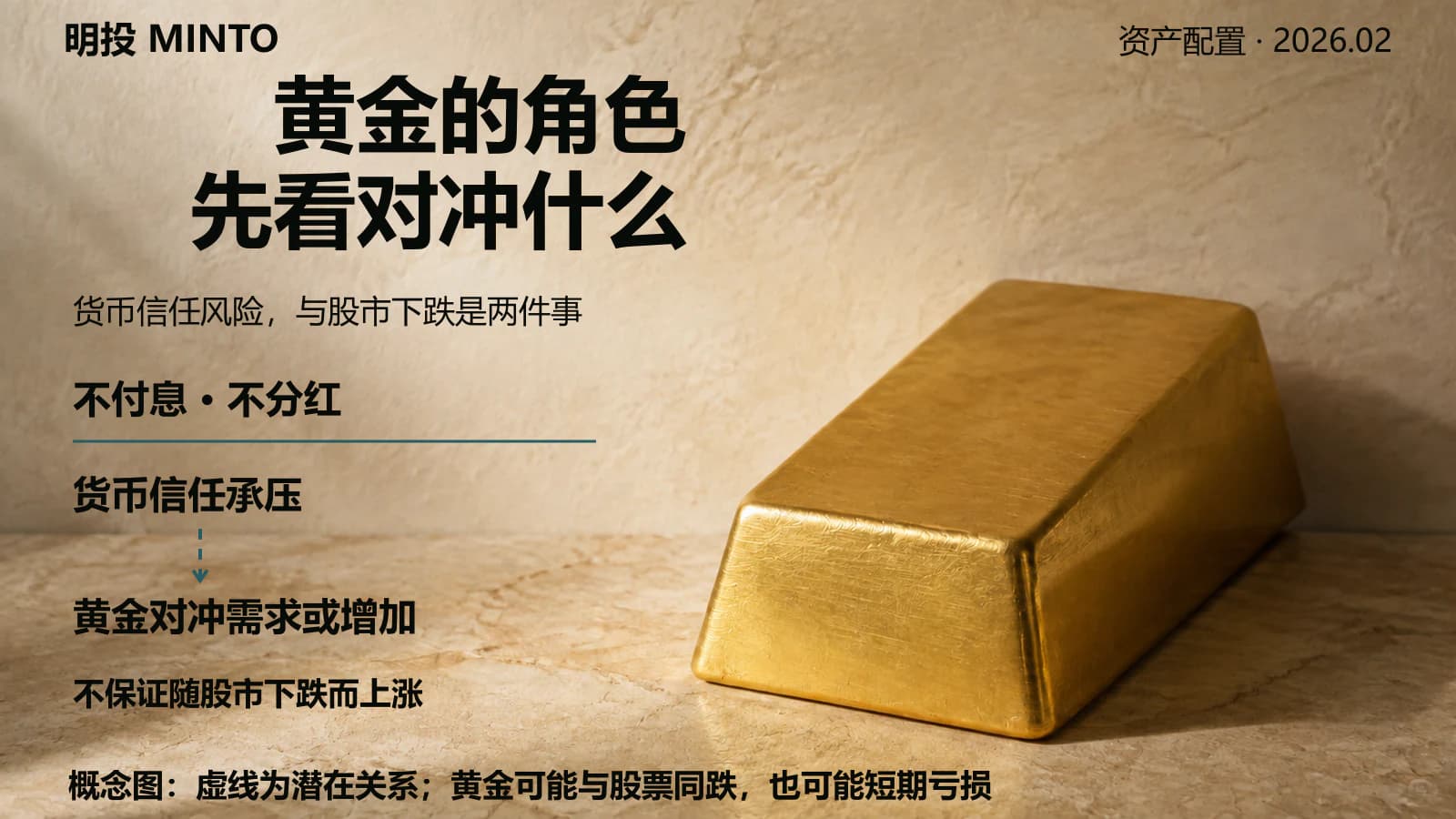
Gold truly hedges "collapse of trust in money and the system."
Think about when gold surges — 1970s high inflation (purchasing power collapse), 2008–2011 (financial system trust collapse + central bank money printing), post-2020 (fear of unlimited money printing), and any war, crisis, or currency devaluation.
The common thread isn't "stocks down" — it's "cracks appearing in trust toward fiat currency, governments, and the system." In those moments, stocks (dependent on economic activity), bonds (dependent on government credit), and cash (the very currency being doubted) — all "system-dependent" assets can fail together. Gold, because its value depends on no government, no promise, no system, becomes the last refuge.
That's gold's role — the only asset in your portfolio that depends on nobody's promise. It hedges that extreme moment when "assets that produce things can't save you": currency devaluation, system wobble, trust collapse.
This is why I've upgraded its role from "safe haven" to "currency hedge" — it protects not against ordinary market volatility, but against the devaluation of money itself and the trust behind it. In an era of high government debt everywhere (U.S. debt-to-GDP over 120%) and repeated central bank money printing, the value of this hedge is higher than ever.
III. So, How Many Percentage Points?
Once you understand the role, the allocation question answers itself.
Gold's role is a "low-probability, high-impact tail hedge" — in normal times (system stable) it contributes almost nothing or even drags (it produces zero), but during systemic crises it explodes, offering massive protection.
For a tail hedge, the correct logic is — allocate enough so that when crisis hits, it provides real protection; but little enough so that its zero output doesn't seriously hurt your long-term compounding during normal times.
History and experience suggest a range — 5% to 10%.
Below 5%, the protection during crisis is trivial (even if gold soars, it can't move the portfolio needle). Above 15–20%, the zero output over time becomes a meaningful drag on long-term compounding (you're parking too much capital in a zero-cash-flow asset, and you'll underperform equities significantly).
My own approach is to float within this range based on "systemic risk" —
When systemic risk is high (debt problems worsening, geopolitical tensions rising, central banks printing aggressively, declining trust in fiat), I push gold allocation higher (toward 10%). When the system is relatively stable and risk appetite high, I dial it down (toward 5%). It's my portfolio's "insurance specifically for system collapse," with the premium (allocation) moving with risk levels.
Key: gold is always a supporting actor, never the star. It's insurance, not a primary investment. The person hoping to get rich from gold misunderstands it. The person allocating zero to gold, with no hedge against systemic risk, underestimates it.
IV. Where I Differ from the Mainstream: Gold Is Not an "Inflation Hedge," At Least Not Always
The mainstream labels gold with its biggest tag — "inflation hedge." This label is half right, half wrong, and the wrong half often costs people money.
Gold hedges inflation over the long run — but often fails short-term.
Over decades, gold roughly keeps up with inflation, preserving purchasing power (recall Siegel's data: gold's 200-year real return is about 0.5%, basically matching inflation — no gain, no loss). So "long-term store of value" is correct.
But in the short to medium term, the relationship between gold and inflation is extremely unstable — the most telling counterexample is 2022: inflation hit 40-year highs. By the "inflation hedge" logic, gold should have soared. Instead, gold performed poorly, even declining at times. Why? Because the Fed was hiking rates aggressively, real rates skyrocketed, and gold's worst enemy is "rising real interest rates" (when real rates are high, the opportunity cost of holding a zero-yield asset like gold becomes prohibitive).
This reveals a truth hidden by the "inflation hedge" label — what really drives gold is not inflation itself, but real interest rates (nominal rates minus inflation). Real rates fall (inflation high but rates haven't caught up, or rates are being cut) → gold rises. Real rates rise (rates climbing faster than inflation) → gold falls.
So — if you blindly buy gold every time you see inflation coming, you could miss the move or lose money, as 2022 showed. The correct judgment requires looking at where real rates are heading, not just inflation numbers.
My view — gold is a "monetary system hedge" and a "long-term purchasing power store," but it's not a reliable short-term inflation hedging tool. Treating it as a simple "inflation comes → buy gold → profit" tool is one of the most common misuses.
V. Gold vs. Bitcoin: Two "System-Independent" Assets Face Off
Talking about gold in 2026 can't avoid its younger challenger — Bitcoin. The two are often lumped together as "digital gold vs. physical gold."
They share a core trait — both are assets that depend on no government or system, both hedge against distrust in fiat. That's where the similarity ends.
Their personalities are worlds apart:
Gold: thousands of years of consensus, relatively low volatility (by comparison), no cash flow but an ancient trust as "hard currency." It's the old, stable, proven-over-countless-cycles system-independent asset.
Bitcoin: a decade-plus history, extreme volatility (easily halving or doubling), no cash flow, and consensus still forming. It's the young, volatile, not-yet-fully-tested system-independent asset.
My judgment — they are not substitutes, but two different intensities of the same hedge. Gold is the low-risk, low-beta system hedge; Bitcoin is the high-risk, high-beta one. One suited as ballast; the other closer to a high-payoff satellite bet.
Their allocation logic is completely different — gold can be 5–10% (it's stable, you can hold more); Bitcoin can only be 1–5% and with an allowance for potential full loss (it's volatile, you can only hold a little). This "Bitcoin as a position-sizing question" topic deserves its own piece. For now, just this — don't lump them together. Their risk levels differ by an order of magnitude.
VI. Closing Thoughts
Gold is a strange thing. It produces no value, and Buffett's criticism is logically flawless. If the world were always stable and money were always trustworthy, holding gold would indeed be foolish — why hold a zero-output metal block when you can hold companies that generate cash flow?
But the world is not always stable, and money is not always trustworthy.
Across thousands of years of human history, currency devaluation, system collapse, and trust erosion happen repeatedly and inevitably (recall Durant, recall "This Time Is Different"). Rome debased its currency. Weimar Germany's Mark became worthless. Countless fiat currencies have turned to ashes. And through it all, gold remains the one thing that "people still accept at the end."
So gold's value is not what it does in normal times (it does nothing) — it's the protection it offers for "that worst moment" — when all system-dependent assets fail, it is the last store of value that depends on nobody.
It's the "doomsday insurance" in your portfolio. You hope you never use it (that means the system remains stable), but you can't be without it (because the system always wobbles eventually).
Allocate 5–10%, float with systemic risk, always a supporting actor. Don't expect it to make you rich, and don't abandon it just because it "produces nothing" in normal times.
That is gold's place in a mature portfolio — not to make money, but to ensure that in the worst moment, you still have something.
Next up: its younger challenger — Bitcoin. 0%, 1%, or 5%? A pure position-sizing question.

On investment analysis, market insight, and asset allocation — not chasing short-term noise, but understanding what truly drives long-term returns.