Series: Asset Allocation · Asset Layer. Framework in the overview. This piece may be the most uncomfortable one for my readers (most of whom are all-in on US stocks). But the more uncomfortable, the more it needs to be written.
1. Let’s be honest: over the past decade+, going all-in on US stocks was right
Before I write this, I want to honestly admit one thing — over the past decade+, “going all-in on US stocks and ignoring overseas” was an extraordinarily correct decision.
The data is cold and clear: from the 2010s to the 2020s, US stocks (especially the Nasdaq) massively outperformed almost every other market — Europe, Japan, emerging markets — all left in the dust. An investor who “globally diversified” in 2013 would have significantly underperformed someone who blindly went all-in on the S&P 500.
So if you were all-in on US stocks over the past decade+, you won, and you won handsomely. My own core position is also in US stocks. I don’t deny that, nor am I preaching the opposite.
But — it is precisely at this moment, when “going all-in on US stocks looks so right,” that I want to sound an alarm. Because investment history repeatedly shows that the most dangerous moments are exactly when a decision looks so correct that almost no one questions it (remember “This Time Is Different”? Remember the “tranquility” of the 15th year of the Wanli emperor?).
2. The logic is identical to what the Japanese used in 1989
The core logic supporting “go all-in on US stocks” usually runs like this — “US stocks have been the strongest over the past decade; the US has the best companies, the strongest innovation, the deepest capital markets; therefore they will continue to be the strongest in the future, so go all-in.”
This statement sounds unassailable. But it has an eerie historical echo that sends a chill down my spine — Japan in 1989.
That year, Japan was the world’s strongest economy. The Nikkei Index was at its peak. The land value of Tokyo could buy the entire United States. Japanese companies were sweeping the globe. Everyone believed “Japan is number one; Japan will win forever.” A Japanese investor in 1989 used exactly the same logic as today’s “all-in US stocks” — “the past was strongest, so the future will be strongest too” — and went all-in on the Nikkei.
Then what? The Nikkei crashed from nearly 39,000 points in 1989 and took a full 35 years, until 2024, to return to that level. An investor who went all-in on the Nikkei in 1989 waited 35 years just to break even — essentially burning their entire golden investment period waiting to get out of the hole.
I am not saying the US will become Japan (America’s institutions, innovation, and demographics are far healthier than Japan’s were — remember Acemoglu, remember Manchester). I am saying that the logic of “it was strongest in the past, so go all-in” was used by Japanese investors in 1989, and it ruined them. “Betting the farm on the current strongest market” is a logic that has repeatedly created disasters in history (remember “the successful underestimate the tailwinds of their era”).
3. The invisible concentration risk: you think you’re diversified
Many all-in US stock investors will push back: “I’m not concentrated — I buy the S&P 500 or a total market ETF. I’m diversified across 500 companies.”
This is the biggest allocation illusion of 2026. I pointed it out in the framework and in the Munger piece — when you buy the S&P 500, you think you’re diversified across 500 companies, but 1/3 of your money is actually on the Mag 7. The top 7 tech giants account for a third of the index’s market cap.
But deeper than “sector concentration” is “country concentration” — US stocks account for over 60% of global stock market capitalization. When you “go all-in on US stocks,” you are effectively making a huge, single bet: betting that “the country of the US” will continue to dominate globally.
This is an invisible concentration, because it’s disguised as “diversification” — you’re diversified across 500 companies, but those 500 companies are all in the same country, under the same institutions, same currency, same political system. Once a crack appears in “American exceptionalism” (the dollar’s status wavers, political polarization deepens, the innovation edge fades, a geopolitical shock), your “diversification across 500 companies” will all come under strain together.
True diversification is not just “spread across many companies” — it’s “spread across uncorrelated sources of risk.” And 500 US companies share the same biggest source of risk: the US itself. This risk has been completely masked during the decade-plus of US stocks winning, but it has always been there.
4. So, should you allocate overseas, and how much?
After all these alarm bells, let’s get to action — what do I do myself?
My core position is still in US stocks. I haven’t fled US stocks because of these concerns — because US institutions, innovation, and capital market depth are indeed the strongest globally (I argued this in the pieces on Manchester and Acemoglu). Uncomfortable is not bearish; caution is not exit.
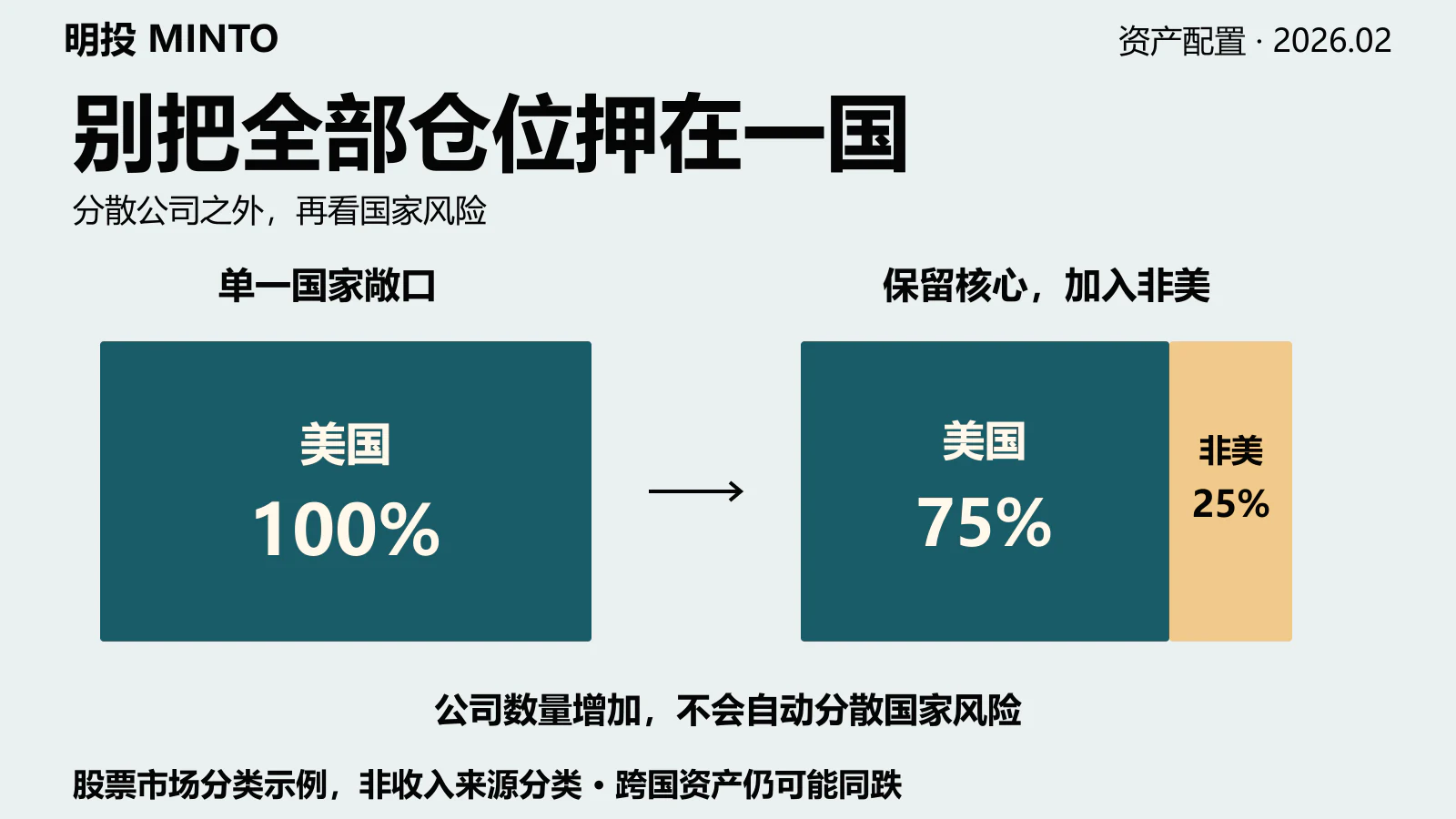
But I did one thing that most all-in US stock investors haven’t done — I carved out a slice of “non-US allocation” as a hedge against the tail risk of “American exceptionalism failing.”
Specifically —
First, a slice of developed markets (Europe, Japan). Their valuations are far below the US (European CAPE around 18, Japan also well below the US’s 35), and while their correlation with the US is high, it’s not perfectly synchronous. They aren’t there to “beat US stocks” (they probably won’t). They are there to provide a buffer that isn’t perfectly synchronized when US stocks go wrong.
Second, a slice of emerging markets. More volatile, higher risk, but with the lowest valuations (some CAPEs at 10-15), and growth drivers that are different from the US logic. A small allocation for an asymmetric opportunity of “valuation re-rating + growth.”
Third, the total proportion of this “non-US allocation” I keep at 20-30%. Not dominant (core remains US stocks), but enough to provide a meaningful hedge in a scenario where American exceptionalism fails.
The logic of this structure is entirely the core of the framework — I do not predict “will the US keep winning” (I lean toward yes, but I’m not sure). I set myself up to survive in both futures — “the US continues to win” and “American exceptionalism fades.” If the US keeps winning, my core US stocks capture the bulk of the gains. If the US has problems, my non-US allocation provides a buffer. Don’t bet on one future; prepare for both.
5. Where I differ from the mainstream: the valuation gap is my allocation signal
The mainstream has two attitudes toward “overseas allocation,” and I disagree with both.
One is the “global diversification dogma” — allocate mechanically by global market cap (US 60%, rest 40%) regardless of time. I disagree because it ignores “quality” and “valuation” — it forces you to mechanically allocate by market cap between “the US has obviously superior institutions but is also obviously more expensive” and “elsewhere has worse institutions but is cheaper.” Allocation should not be mechanical; it should be judgmental.
The other is “US always best” — the US is just better, so go all-in; overseas is garbage. I disagree even more, for all the reasons in this piece — it repeats the 1989 Japanese logic, it equates “past strength” with “future certainty,” and it ignores the hidden risk of concentrating in a single country.
My stance — use the “valuation gap” as an allocation signal.
This is the tool I brought from the Shiller CAPE piece. When the US CAPE is 35 (90th percentile historically), while Europe is 18 and emerging markets are 12, this huge valuation gap is itself a signal — it doesn’t mean “immediately sell US stocks and buy elsewhere” (expensive can stay expensive for a long time). But it does mean “the expected forward 10-year return for US stocks is likely suppressed, while the expected return elsewhere is relatively higher.” At extremes of this valuation gap, shifting modestly toward “cheaper elsewhere” is data-rational, not diversification for its own sake.
So my non-US allocation is also floating — the more extreme the valuation gap (US more expensive, elsewhere cheaper), the more I tilt toward non-US. When the gap narrows, I adjust back. Valuation is the thread connecting the “US vs. overseas” allocation decision.
6. In closing
I know this piece makes many readers uncomfortable. Because over the past decade+, “going all-in on US stocks” has made everyone a ton of money, and here I am saying “be careful of concentration risk, allocate some overseas” — which sounds like questioning a method that has worked beautifully and repeatedly.
But that’s exactly my point — the time to sound the alarm is never when a method fails; it’s when it is “too successful, too correct, and almost no one questions it” (remember Grove’s strategic inflection point — most dangerous at the peak of success; remember the 15th year of Wanli — collapse hidden in tranquility).
“All-in US stocks” is in exactly that state right now — it has been so successful that almost no one is willing to question it, so successful that “allocating overseas” sounds like something only fools do.
And Japanese investors in 1989, at the moment they went all-in on the Nikkei, felt the same “unequivocally correct, no one questions it” sensation.
I don’t know if the US will have problems, or when. I lean toward believing its institutions are resilient enough to lead for a long time. But “I lean toward believing” is different from “I stake my entire net worth on that belief.”
The entire wisdom of allocation lies in this distinction — you can lean toward a judgment, but you cannot stake everything on any single judgment, because you may be wrong, and the cost of being wrong (like the Japanese of 1989) is 35 years.
Keep a slice overseas. Not because I’m bearish on the US. Because I admit — I could be wrong about the US, and I need an escape route if I am.
That escape route usually looks like a drag (it underperforms your all-in US stocks). But if “American exceptionalism” ever really cracks, it will be the only thing you’re grateful you kept.
Not predicting whether the US will keep winning. Instead, prepare for both futures — it wins, and it doesn’t.
That is the only thing this uncomfortable piece wants to say.
Next: the final piece of the asset layer, and the real core of most portfolios: why my core is broad-based ETFs, not individual stocks.

On investment analysis, market insight, and asset allocation — not chasing short-term noise, but understanding what truly drives long-term returns.