跳到正文 · Skip to content
内容
关于与合作
订阅与会员
★ 查看会员权益
外观与设置
外观
主题色
版本 · 深色 / 减动搜索⌘K
草稿预览·这篇还没发布,不会出现在列表和 RSS 里。review 完后把 frontmatter 的 draft: true 改为 false 即可。

Your Drawdown Tolerance Dictates Your Stock Allocation

What determines your stock allocation is never how much you want to earn, but how much of a drawdown you can endure without panic-selling. The former is desire; the latter is the truth.

2026.03.068 min原创
Your Drawdown Tolerance Dictates Your Stock Allocation
资产配置MINTOVIEW2026.03.06

The "Asset Allocation" series: Risk Layer. Framework can be found in the overview. The previous parts covered "what to allocate" and "how to maintain it"; this final layer confronts the core of allocation—risk. First article, and the most fundamental: what should really determine your allocation?

1. Most people start at the wrong end

The vast majority of people begin asset allocation from the "return" end—"I want to earn 15% a year, so I should go heavy on stocks, be aggressive."

This is starting at the wrong end.

Because "how much I want to earn" is desire, and desire has no ceiling—everyone wants more and more. If you start from desire, everyone would conclude "go all-in on stocks, be aggressive, use leverage."

But allocation should truly start from the other end—not "how much I want to earn," but "how much of a drawdown can I endure without breaking down and selling at the bottom."

This end is called drawdown tolerance. It is not desire; it is a constraint. And it is this constraint, not your desire, that should determine your allocation.

Why? Because—an allocation, no matter how high its theoretical return, if its volatility exceeds the limit you can bear, causing you to panic-sell in some crash, then its real return is negative. No matter how good the allocation, if you can't hold it, it doesn't exist (remember the framework piece—"a second-best that you can stick with beats the optimal that you can't hold").

Therefore, the starting point of allocation is not your return target, but your drawdown tolerance. This is the single most commonly reversed thing in this entire layer and even the whole allocation framework.

2. The "truth" about stocks: high returns come with deep drawdowns

To understand why drawdown determines allocation, you must first honestly see the "truth" about stocks.

Stocks are the highest long-term returning asset class (remember Siegel—200 years real annualized 6.6%). This is the shiny side, the reason everyone wants to overweight them.

But the other side of that shine is bottomless drawdowns

Historically, the S&P 500 has suffered several brutal drawdowns: 1929–1932, down about 86%; 2000–2002 (dot-com), down about 49%; 2007–2009 (financial crisis), down about 57%; 2020 (pandemic), down about 34% in one month; 2022, down about 25%.

That is the truth about stocks—long-term they deliver the highest returns, but along the way, they repeatedly and without warning cut your money in half. And "long-term highest" and "midway halving" are two inseparable sides of the same asset. If you want the former, you must endure the latter.

The critical question is—when your stock holdings drop 50% one day, what will you do?

Answering that honestly is more important than any return target. Because it determines—whether you can truly hold stocks and thus truly enjoy their long-term returns.

3. A brutal algorithm: reverse-engineering your stock allocation from drawdown

Once you understand that "high stock returns = deep drawdowns," you can use a brutal but honest algorithm to reverse-engineer how much stock you should own:

Step 1: Honestly ask yourself—what is the maximum drawdown I can tolerate without panic-selling?

Note: be honest. Not "how much I hope I can take," but "when my real money suddenly shrinks by a chunk and the news is full of apocalyptic talk, can I truly refrain from selling?" Most people severely overestimate themselves—in a bull market, everyone thinks they can handle a 50% drawdown; but in a real crash, many people break at 20% (remember Wang Yangming—"cultivation that hasn't passed through real events is fake").

Step 2: Use that drawdown tolerance to reverse-engineer your stock allocation.

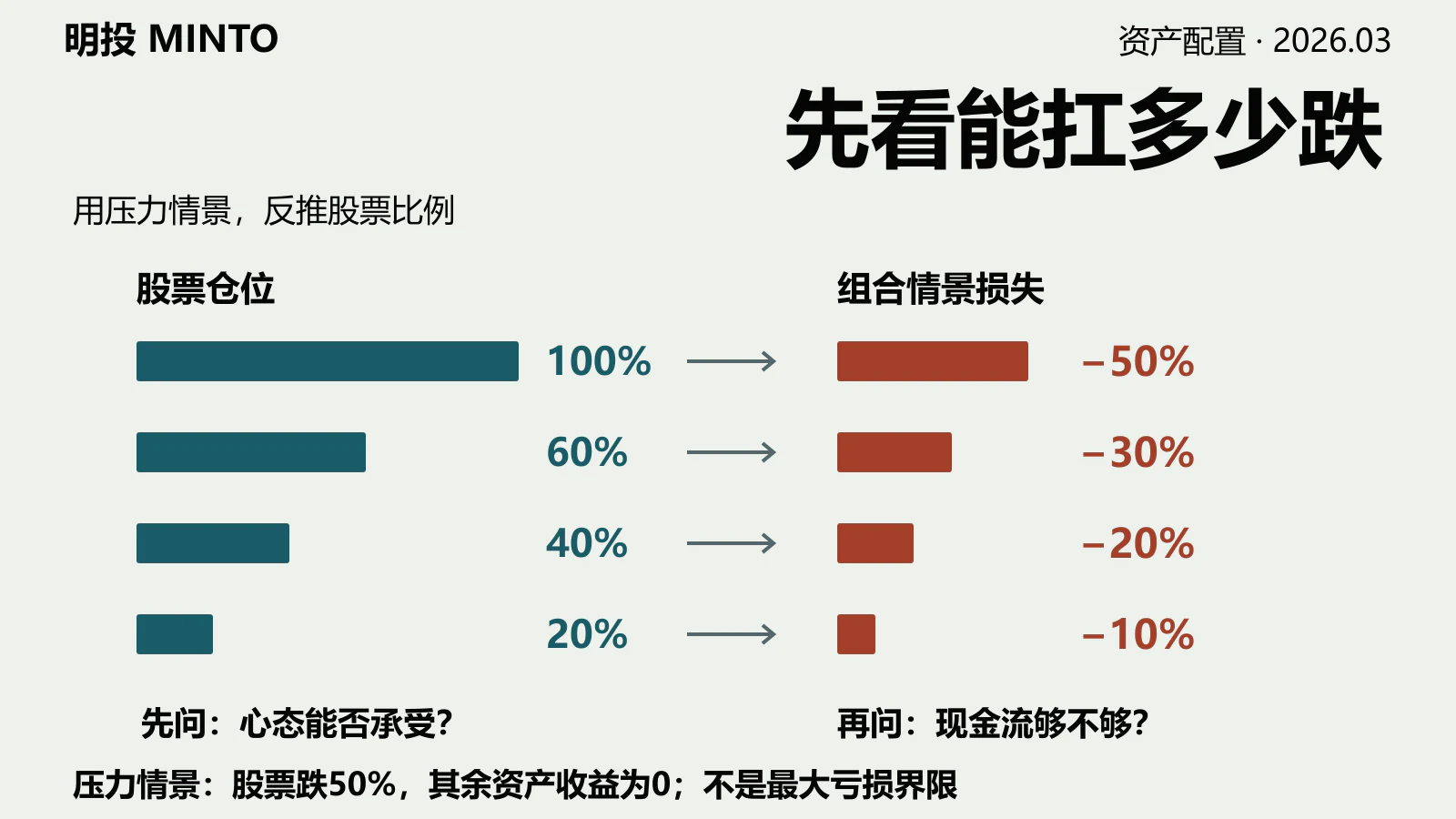
A rough but practical estimate—in a severe bear market, stocks typically fall about 50%. So:

If your portfolio is 100% stocks, in a severe bear market you'd draw down roughly 50%. If it's 60% stocks + 40% defense (cash/bonds), drawdown roughly 30% (stocks fall 50%, defense mostly holds). If it's 40% stocks, drawdown roughly 20%. If it's 20% stocks, drawdown roughly 10%.

Thus: how much drawdown you can tolerate in turn dictates how much stock you should own.

Can handle 50% → you can be nearly full stocks. Can only handle 30% → stocks no more than 60%. Can only handle 20% → stocks no more than 40%. Can only handle 10% → stocks no more than 20%.

The brutality of this algorithm is that it turns "allocation" from a desire-based question of "how much I want to earn" into a constraint-based question of "how much I can endure." And the latter is the truth. Your stock allocation should not be determined by your greed, but by the limit at which you will not break in the worst of times.

4. Where I differ from the mainstream: ditch the risk questionnaire, use "imagine the crash"

The mainstream way to assess risk tolerance is to make you fill out a "risk assessment questionnaire"—checking your age, income, investment experience, risk preference (conservative/moderate/aggressive).

I think such questionnaires are almost useless, even harmful.

Because the questionnaire is filled out in "calm times," while risk tolerance only reveals itself in "crash times" (remember Wang Yangming's "testing in the midst of affairs"—cultivation that hasn't passed through real events is fake). A person filling out the questionnaire in a bull market, feeling happy, will check "I am aggressive, can handle high risk"—because at that moment there is no real pain. But when the real crash comes and his money is actually halved, that "aggressive" person may be the first to panic-sell.

The questionnaire measures the "you that you think you are," while the market tests the "real you." These two are often vastly different.

My alternative—don't do a questionnaire; "imagine the crash."

Specifically, painfully, vividly imagine this scenario—your portfolio drops 40% tomorrow. The number in your account is almost half. You open any financial media—all doom, "crisis," "collapse," "this time is different," "might fall another half." People around you are panicking, selling. You can't sleep, staring at that shrunken number.

In this imagination, honestly ask yourself—Can I hold? Can I not sell? Can I even have the courage to rebalance (buy)?

If imagining this scenario already makes you think "I definitely can't hold, I would sell"—then your current stock allocation is too high for you; you should lower it.

Using "imagine the worst pain" to test risk tolerance is more accurate than any questionnaire. Because it forces you to face your real self, not the false, overestimating self of calm times.

5. Risk tolerance is not just psychological, but also financial

One last important dimension—drawdown tolerance is not just about whether your "psychology" can hold, but also whether your "finances" can hold. They are different, but both determine your allocation.

Psychological tolerance: Can your emotions hold during a crash without panic-selling (as discussed above).

Financial tolerance: Will you be "forced" to touch this money during the crash, thus forced to sell at the lowest point (remember the cash piece—"the right to not be forced to sell").

Both must be satisfied for you to truly "hold" stocks—

A person with strong psychology but weak finances (e.g., might lose his job and need to draw on this investment) might not want to sell emotionally but could be "forced" by reality to sell at the bottom. For such a person, stock allocation should be lowered because his "financial tolerance" is insufficient.

A person with stable finances (this money is not needed for a long time) but weak psychology might not be "forced" to sell, but could "actively" sell due to emotional breakdown. For such a person, stock allocation should also be lowered.

What truly supports a high stock allocation is a person who is robust in both psychology AND finances—someone who will neither panic-sell from emotional collapse nor be forced to sell due to real needs. Only such a person can truly hold stocks through crashes and thus truly enjoy stocks' long-term high returns.

So to assess how much stock you should own, ask both questions—when a crash comes, can my "heart" hold? Can my "money (cash flow)" hold? If either fails, your stock allocation should be dialed down.

6. Final words

This article may be the most "deflating" one in the entire allocation series. Because it takes everyone's excitement of "I want to make a lot" and drags it back to the reality of "how much can I endure."

But this is precisely the most fundamental and most overlooked wisdom of allocation—your allocation should not be determined by your desire, but by your capacity to endure.

The tragedy of most investors is not that they chose the wrong assets, but that they allocated risk beyond their true capacity to endure—driven by greed in a bull market, they built a portfolio with a "theoretically high return but volatility far beyond what they could handle"; then when the crash came, their psychology (or finances) broke, they sold at the bottom, turning paper losses into permanent realized losses.

They didn't lose to the market; they lost to "the risk they allocated exceeding their own capacity to endure."

And the way to avoid this tragedy is as simple as it is deflating—first, honestly and painfully imagine the worst drawdown, figure out how much you can truly withstand; then use that "how much you can withstand" to reverse-engineer how much stock you should own. Better to be conservative and earn a little less than to allocate beyond your endurance and break in some crash.

Because—a "conservative" portfolio you can hold through every crash will, over the long run, outperform an "aggressive" portfolio you can't hold and end up selling at the bottom.

That is the wisdom of drawdown. It's not sexy; it's deflating. But it is the starting point of all defense in allocation—before pursuing returns, first ensure you can survive the inevitable, bottomless crashes on the road to those returns.

Next, the second pitfall of the Risk Layer: what you think is diversification may be fake.

Minto
明投 Minto
投资分析 · 长期主义者

专注投资分析、市场洞察与资产配置。不追短期波动,只理解真正驱动长期回报的东西。

你读完了 · Colophon

Your Drawdown Tolerance Dictates Your Stock Allocation

8
分钟
2026/03
期号
2026
年份
真正稀缺的,是一个不慌不忙的人。
明投 · MintoInvest Wisely
— From This Series
喜欢这篇?这类 资产配置 的深度拆解会持续发到你邮箱。
无广告 · 随时退订
— Enjoyed the read?
如果这篇文章对你有用,把它分享给一个朋友,就是对我最好的支持。

口碑是独立创作者最稀缺的燃料。

— Discussion

说说你的想法

评论基于 GitHub Discussions(Giscus)。登录后即可留言、点赞、互相讨论。

评论还在准备中。

想说什么可以直接发我邮件,比在评论区更容易认真回复。

mingtaohuang617@gmail.com →
支持沉浸式阅读