"Asset Allocation" series · Execution layer. Framework in the overview. Last post covered rebalancing; this one covers another execution habit — DCA. It's often mythologized, and often misunderstood.
First, a bucket of cold water: DCA is mathematically often not optimal
Dollar-cost averaging (DCA, regularly investing a fixed amount) is treated by many as the "holy grail of guaranteed gains" — "set it and forget it, ride out bull and bear, guaranteed profit."
Let me pour that cold water first — from a purely mathematical standpoint, DCA is often not the optimal strategy.
There's a counterintuitive but repeatedly validated conclusion: If you have a lump sum of money, investing it all at once (lump sum) has a higher expected return, on average, than DCA.
Why? Because markets trend upward over time (remember Siegel). If that's the case, the sooner your money is in the market, the sooner it starts compounding. DCA delays a portion of your capital (later installments wait), causing you to miss some of the upside. Statistically, about two-thirds of the time, lump sum beats DCA.
So if you suddenly come into a lump sum (inheritance, selling a house, bonus), purely from a "maximize expected returns" perspective — lump sum is better.
At this point you might wonder — why does everyone recommend DCA? What's its real value?
The answer is — DCA's value has never been about "mathematical optimality"; it's about "human optimality."
What DCA really fights is yourself
To understand DCA's real value, first ask: If "lump sum all at once" is mathematically superior, why can't — and shouldn't — most people do it?
Because humans are not rational machines (remember Kahneman, Thaler). Imagine you dump your entire lump sum in one go, and then — the market drops 20% the next week.
What happens? You panic, regret, lose sleep, and then capitulate at the worst possible moment. That mathematically superior lump sum becomes a disaster because of your own nature.
That is precisely the problem DCA solves — it's not fighting the market; it's fighting the version of you who makes the worst decisions at the worst times.
DCA cages that enemy — the "you" — through several mechanisms:
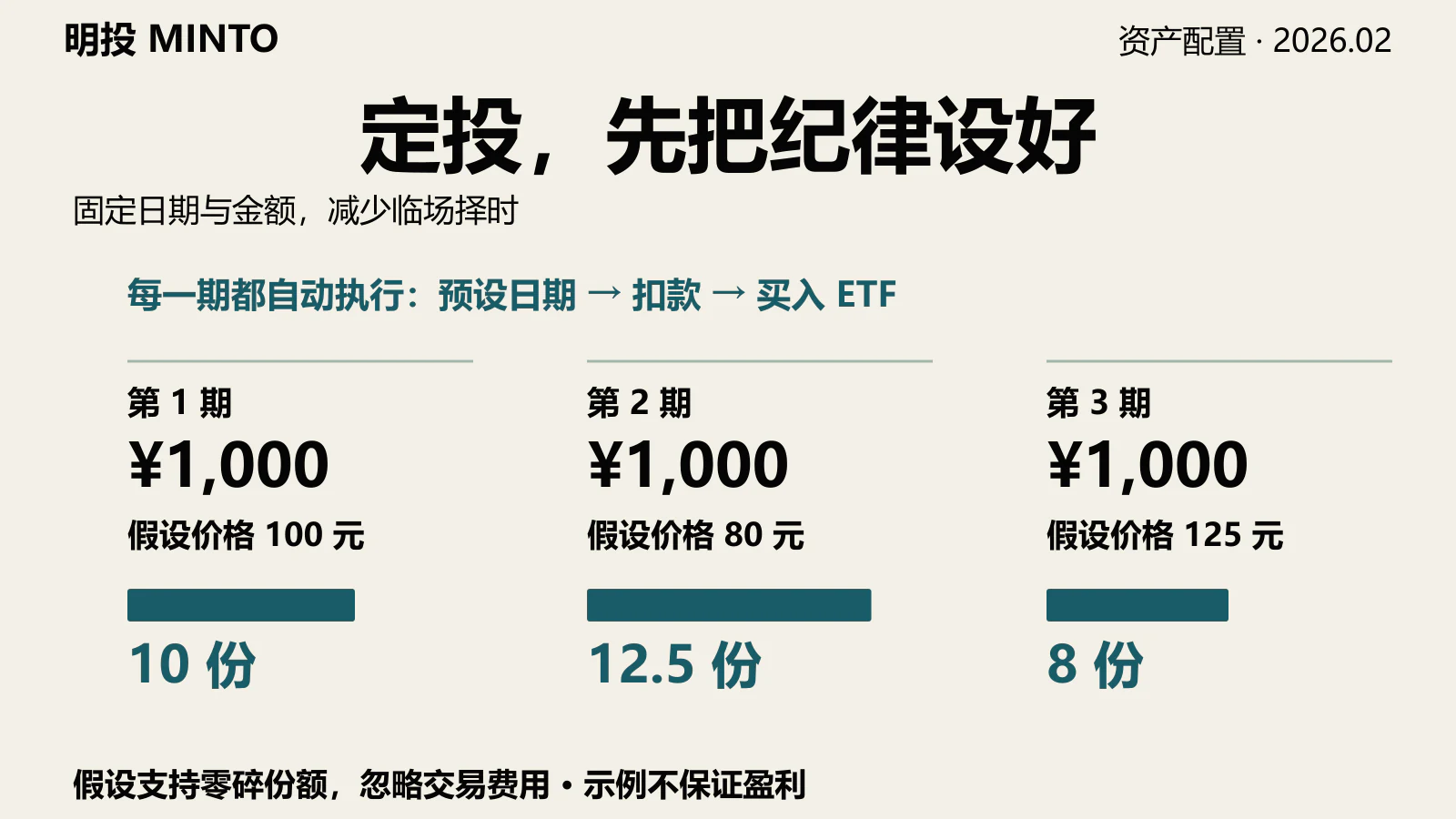
First, it eliminates timing anxiety. DCA means you don't need to decide "is now a good time to buy?" (a judgment nobody gets right). You mechanically and regularly buy, regardless of market moves. It removes the paralyzing question "should I buy now?" entirely.
Second, it turns fear into opportunity. For lump-sum investors, a drop is a disaster (unrealized losses widen). For DCA investors, a drop is actually good — the same amount of money buys more shares at lower prices. DCA makes you think, during a crash, not "I'm panicking" but "this month my money went further." It psychologically flips the market's enemy into a friend.
Third, it bypasses your emotions via automation. This is key (remember Thaler's "nudge") — the best DCA is set up as an automatic deduction and automatic purchase. Once configured, your money flows in without you feeling, hesitating, or emoting. It bypasses the part of your brain that gets greedy, fearful, and procrastinates.
So — DCA is not a return-optimization tool; it's a behavior-correction tool. It doesn't make you the most money; it ensures you don't lose the returns you would have earned, thanks to your own nature.
The core of DCA: automation + discipline
If there's one "right way" to do DCA, it comes down to two words: automate it.
Thaler's "nudge" in Misbehaving — the essence is: don't rely on willpower; rely on mechanisms. Willpower is finite, gets tired, and crumbles at critical moments; mechanisms don't.
Applied to DCA —
Worst DCA: Every month, you "decide" whether to invest and how much. This leads you to greedily invest more when markets are surging (chasing highs) and fearfully hold back when markets crash (missing the bottom). Your "active decisions" directly contradict the spirit of DCA.
Best DCA: Set it to fully automatic — fixed day each month, fixed amount, automatic deduction, automatic purchase of a designated ETF. Once set, you make no more decisions. Whether the market hits new highs or new lows, that money goes in mechanically, relentlessly.
The entire point of automation is to remove "you" from the process. Because "you" — the greedy, fearful, hesitant, clever version of yourself — is the biggest risk in this process. Handing the decision to a mechanical, automatic routine actually improves your long-term returns.
This echoes what I've repeatedly emphasized: your biggest enemy in investing is yourself, and the most effective way to fight yourself is not "more discipline" (willpower breaks) but "build a mechanism that locks you in" (mechanisms don't tire). Automated DCA is exactly that mechanism.
Where I diverge from the mainstream: don't treat DCA as a guaranteed-profit myth
Two common misconceptions about DCA that I want to correct.
Misconception 1: "DCA is guaranteed to make money; it's a holy grail." This is wrong and dangerous. DCA does not guarantee profits — it only guarantees that you won't lose your potential returns due to timing and emotions. If the asset you're DCA-ing into is in long-term decline (e.g., a fading market or a single stock heading to zero), DCA just ensures you "automatically, mechanically, and repeatedly lose more money" — because you keep buying something sinking. The prerequisite for DCA is that the asset has a long-term upward trend (hence, broad index funds are suitable, not individual stocks — remember indices have self-renewal mechanisms). Treating DCA as "mindless guaranteed gains" makes you lose more on the wrong asset.
Misconception 2: "Once you set up DCA, you don't need to do anything else." Also wrong. DCA is just the execution mechanism for "continuous capital deployment"; it doesn't replace asset allocation (what are you DCA-ing into? Are the proportions right?) or rebalancing (DCA can drift your portfolio weights). DCA is an execution habit within an allocation system, not the system itself. A complete framework is: first set strategic allocation (overview) → use DCA for continuous investing (this post) → maintain proportions with rebalancing (last post). All three are necessary.
My precise positioning for DCA: it's an excellent "behavior-correction + continuous investing" tool, provided the underlying asset is trending upward and it's used alongside proper allocation and rebalancing. It's not a guaranteed-profit myth; it's a mechanism to help you overcome yourself and stay the course.
A special case: what to do when you suddenly have a lump sum
Back to the opening question — what if you suddenly come into a lump sum (inheritance, house sale, bonus)? Mathematically, lump sum is superior, but emotionally you're afraid of an immediate drop. What to do?
My practical advice: Compromise: split it into a few tranches and deploy over a short period.
For example, divide the lump sum into 6-12 portions and invest them over 6-12 months. This isn't textbook "long-term DCA"; it's a psychological buffer —
It sacrifices some of the mathematical edge of lump sum (some capital is delayed), but gains enormous "psychological sustainability" — if the market drops right after you start, you still have dry powder to buy at the bottom, rather than the despair of being immediately fully invested and underwater.
This compromise returns to the core principle of the overview — it doesn't pursue "mathematical optimality"; it pursues a plan you can execute, stick with, and not collapse under. A "mathematically suboptimal but sustainable" plan far outperforms a "mathematically optimal but you'll capitulate at the first crash" plan.
In investing, "a suboptimal strategy you can stick with" always beats "an optimal strategy you can't sustain." That's the single most important sentence for DCA, and indeed for the entire execution layer.
In closing
DCA, like rebalancing, is one of those unsexy execution details in allocation. No get-rich-quick stories, no brilliant insights. It's just "every month, mechanically and automatically, invest a sum."
But it addresses the most fundamental — and least admitted — problem in investing: yourself is your own biggest enemy.
It's not the market that beats most investors. It's that most investors, when the market crashes, panic-sell; when the market rallies, greedily buy; when they should hold, they quit; when they should wait, they act impulsively — they defeat themselves with their own nature.
And DCA, with an exceptionally simple mechanism, cages that enemy — it removes the need for timing (eliminates anxiety), turns drops into opportunities (corrects fear), and bypasses emotions with automation (overcomes human nature).
It doesn't let you make the most. It ensures you — don't lose the returns that were rightfully yours because of your own actions.
That may sound like a humble goal — "don't lose what you should have had" rather than "max out everything." But for the vast majority of investors, "not defeating yourself" is a more realistic and more valuable goal than "beating the market."
Because statistics repeatedly show that the average individual investor's actual return is far lower than the return of the funds they hold. The gap is entirely due to behavior — chasing highs, panic selling, timing mistakes, emotional entry and exit. DCA is precisely the most effective tool to bridge that "behavior gap."
DCA is not voodoo, nor a guaranteed-profit myth. It's the simplest and most reliable weapon for someone who honestly admits, "I can be defeated by myself," and then builds a mechanism to protect themselves.
Next up, the third and most underestimated hidden killer in the execution layer: costs.
专注投资分析、市场洞察与资产配置。不追短期波动,只理解真正驱动长期回报的东西。