"Asset Allocation" series · Execution Layer. See the framework in the overview. The first two posts covered rebalancing and dollar-cost averaging. This one is about a killer everyone knows exists but no one truly takes seriously: cost.
I. The One Certain Thing
In investing, almost nothing is certain —
Will stocks go up or down next year? Uncertain. Will this company succeed? Uncertain. Is this thesis right? Uncertain.
But there is one thing that is 100% certain — cost.
If you buy a fund that charges 1.5% annually, you are 100% certain that every year it will take 1.5% of your money, whether it goes up or down, whether the market is good or bad. Each time you trade, you are 100% certain to incur commissions and taxes.
Bogle (in Common Sense on Mutual Funds) drove this home — in a world full of uncertainty, cost is the one thing you can be 100% certain of, and 100% control.
And that "one certain thing" is the most underrated killer in asset allocation — because it is certain, it persists; because it persists, under compounding it eats a staggering share of your wealth.
II. The Tyranny of Costs: How Compounding Magnifies It
Cost is terrifying not because "that 1% or 2% a year" looks large, but because compounding magnifies it infinitely.
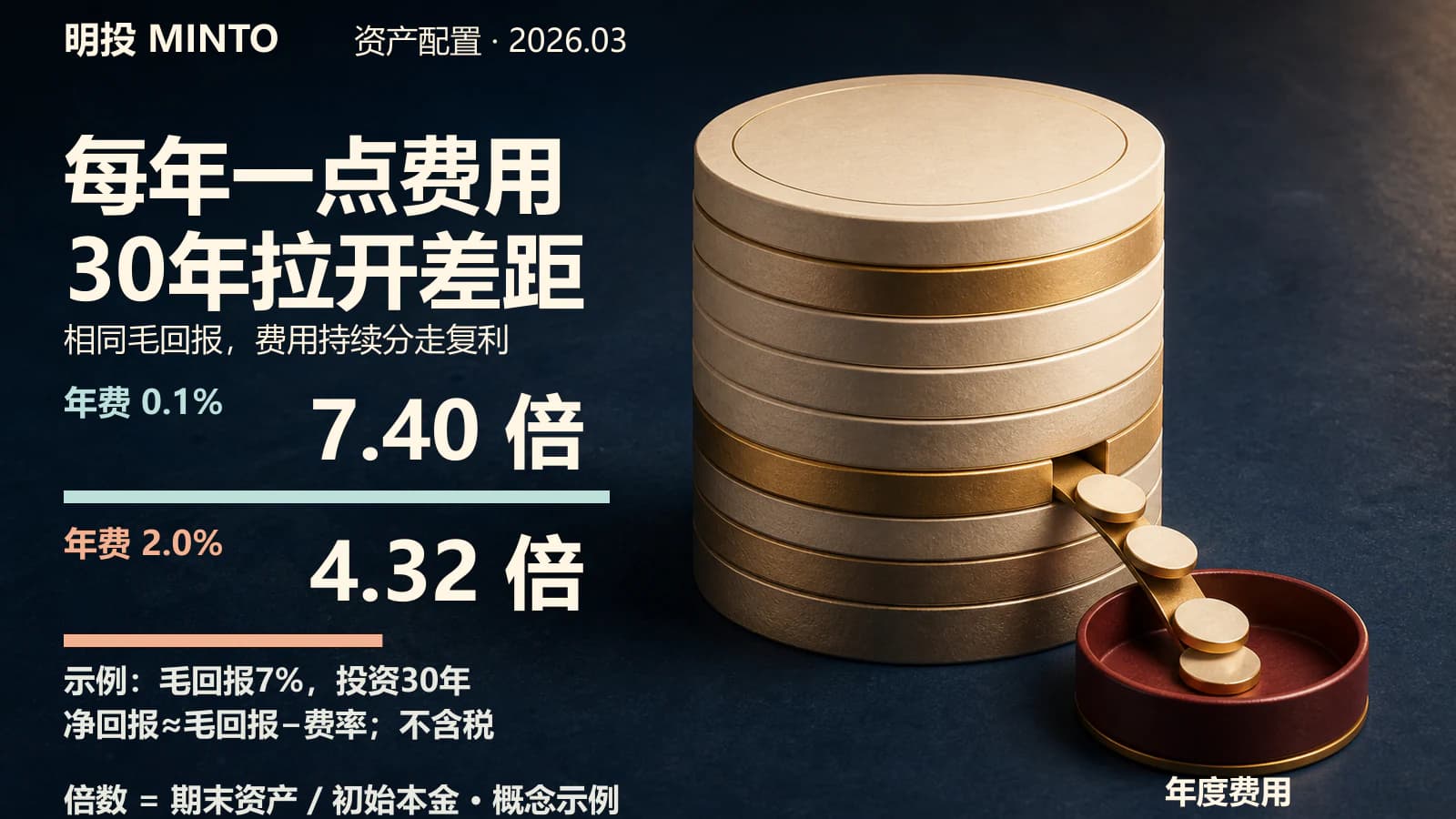
Bogle ran a classic calculation — let me reproduce it with specific numbers:
Assume market annual return of 7%, and you invest for 30 years.
An index fund charging 0.1% (actual net return ~6.9%): 30 years later, $1 becomes about $7.3.
An active fund charging 2% (actual net return ~5%): 30 years later, $1 becomes about $4.3.
The gap — the latter ends up with nearly 40% less wealth than the former.
Read that number again — a mere 1.9% annual fee difference, compounded over 30 years, eats almost half your final wealth.
This is what Bogle called "the tyranny of compounding costs." Its horror lies in its invisibility — that 2% every year, you barely feel it (it's silently deducted from NAV, you don't see it). But day after day, year after year, it erodes via compounding, and over decades it carves out a number that shocks you.
And the irony — you pay that 2% and often get zero extra return in return (remember: 80% of active funds underperform the index). You pay high fees for the privilege of "likely underperformance + high-cost erosion" — a double loss.
III. Cost Is More Than Fees: Three Hidden Costs
Most people, when talking about cost, only think of "management fees." But cost in asset allocation runs much deeper. At least three layers exist, and the last two are far more hidden:
Layer 1: Explicit fees (management fees, loads). These are the easiest to see — management fees, subscription/redemption fees, platform fees. The solution is simple: choose low-cost instruments. An S&P 500 ETF charging 0.03% versus an active fund charging 1.5% — the long-term gap is night and day. This layer is the easiest to save on, yet most ignore it.
Layer 2: Transaction costs (commissions + bid-ask spread + market impact). Every trade has a cost — commissions (though many brokers are now zero-commission), the bid-ask spread, and the price impact of large orders. The key here is not "per-trade cost" but "trading frequency." The more you trade, the more these costs accumulate. This is one reason why overtrading is a return killer (remember: Laozi's "wu wei" and low-frequency rebalancing). Trade less — that itself is a cost-saving strategy.
Layer 3: Taxes (the most underrated and potentially the largest). The vast majority completely ignore this — every profitable sale can trigger capital gains tax. In US equities, short-term holdings (under one year) are taxed at much higher rates than long-term holdings. This means — frequent trading not only incurs commissions but also converts "long-term low tax" into "short-term high tax" — a double whammy. A frequent profit-taker may capture price gains, only to give a big chunk back in taxes. Holding for the long term and not selling lightly is itself the best tax optimization.
Add these three layers together, and you find — the "frequent trader, hot-chaser, high-fee product buyer" is bleeding from all three layers: explicit fees, transaction costs, and taxes. Meanwhile, the "low-cost index + long-term hold + minimal trading" person is saving on all three simultaneously. Over decades of compounding, this gap is decisive.
IV. Where I Differ from the Mainstream: Cost Is an "Asset Allocation Strategy," Not Just a "Savings Tip"
The mainstream treats "controlling costs" as a "money-saving tip" — pick cheap funds, trade less. That's not wrong, but it undervalues the role of cost.
I argue: cost control is, in essence, a core part of asset allocation strategy, not a peripheral trick.
Why? Because cost directly determines your active vs. passive trade-off.
Think about it — why do you engage in active investing (stock-picking, market-timing, buying active funds)? Because you want "excess returns." But active investing inevitably comes with higher costs (higher fees, more trading, higher taxes). So — your active investing must first clear the "cost hurdle" before you can even talk about "excess."
Specifically: if active investing costs 2%/year more than passive, then your active picks must outperform the index by at least 2% annually just to break even; to create real value, they need to beat it by more. And the data says 80% of active investing can't even beat the index, let alone beat it by 2%+.
So this seemingly technical thing called "cost" is actually helping you answer a fundamental allocation question: "Should I go active at all?" The answer: go active only in the very few areas where you have a strong conviction you can beat "the index + the cost gap" (the satellite); everything else, use low-cost passive (the core). This is exactly the logic behind my earlier post "Why Core Should Be Broad-Based ETFs" — and cost is the decisive, overlooked variable behind that logic.
In other words — once you understand costs, you understand why most of your money should be passive. Not because passive is smarter, but because active first requires you to pay a certain high cost for the chance at uncertain excess, and that math rarely works out.
V. Minimizing Costs to the Bone: Four Concrete Rules
Here are four rules I use to control costs:
First, use only ultra-low-cost broad-based ETFs for the core position. An S&P 500 or total market ETF at 0.03%-0.1% is the default choice for the core. Every basis point (0.01%) saved is a certain, compounding gain.
Second, be extremely disciplined about trading frequency. Every "can't-resist trade" bleeds money in three layers (commissions + spread + tax). Treat "trading less" as a rule (remember: Laozi's "wu wei," low-frequency rebalancing, automated DCA). Doing nothing is itself a way to save.
Third, exploit tax-advantaged accounts and long holding periods. Put operations that generate taxable events (e.g., rebalancing sells, tactical swings) into tax-deferred accounts whenever possible. In taxable accounts, hold for the long term to enjoy lower long-term capital gains rates; avoid short-term profit-taking. "Long-term holding" isn't just an investment philosophy — it's the biggest tax optimization.
Fourth, watch out for all "invisible costs." Before buying any product, calculate the total cost — not just the explicit fee but also hidden loads, spreads, taxes, and the implicit turnover costs of active management. Many products that seem to have good returns, after deducting all costs, underperform a 0.03% ETF.
VI. In Closing
Cost is the most mundane and most easily overlooked element in asset allocation. It doesn't have the narrative appeal of stock-picking, doesn't have the thrill of market-timing. It's just a quiet, persistent, certain number — taking a little bit from your money each year.
But it is precisely this "quiet, persistent, certain" nature that makes it the most insidious killer in the age of compounding. Because it is certain, you cannot escape it; because it persists, it comes back every year; because of compounding, over decades it carves out nearly half your wealth.
And its cruelest part: it's the one thing you can 100% control, yet most people let it run wild. You can't control market ups and downs, you can't control whether the companies you pick succeed, you can't control luck. But you can 100% control — how much you pay in fees, how often you trade, how long you hold, how much tax you trigger.
Bogle spent a lifetime proving the weight of this. The index fund he created is, at its core, a tool that "pushes cost to the extreme." And his most counterintuitive line, which I take as the motto for the execution layer:
"In investing, you get what you don't pay for."
Every dollar of cost you save directly becomes your return.
In a market where you can control almost nothing, cost is the lever you can hold entirely in your hands.
Hold it tight. Because it is certain — and in investing, certainty is precious.
Next post, the final one of the Execution Layer, and the one that pulls the entire allocation framework to the longest time horizon: a portfolio you can pass down to the next generation.
专注投资分析、市场洞察与资产配置。不追短期波动,只理解真正驱动长期回报的东西。