"Asset Allocation" series. See the framework in the opening piece, Don't Predict the Future — Prepare for All Futures. The first two posts covered 60/40 and All Weather. This one puts the three most important strategic frameworks side by side — to help you choose.
I. It's Not 'Which Is Best,' It's 'Which Fits You'
The last two posts dissected two classics (60/40 and All Weather). But the real decision isn't picking between them — it's one level up: choosing among fundamentally different allocation philosophies that suit who you are.
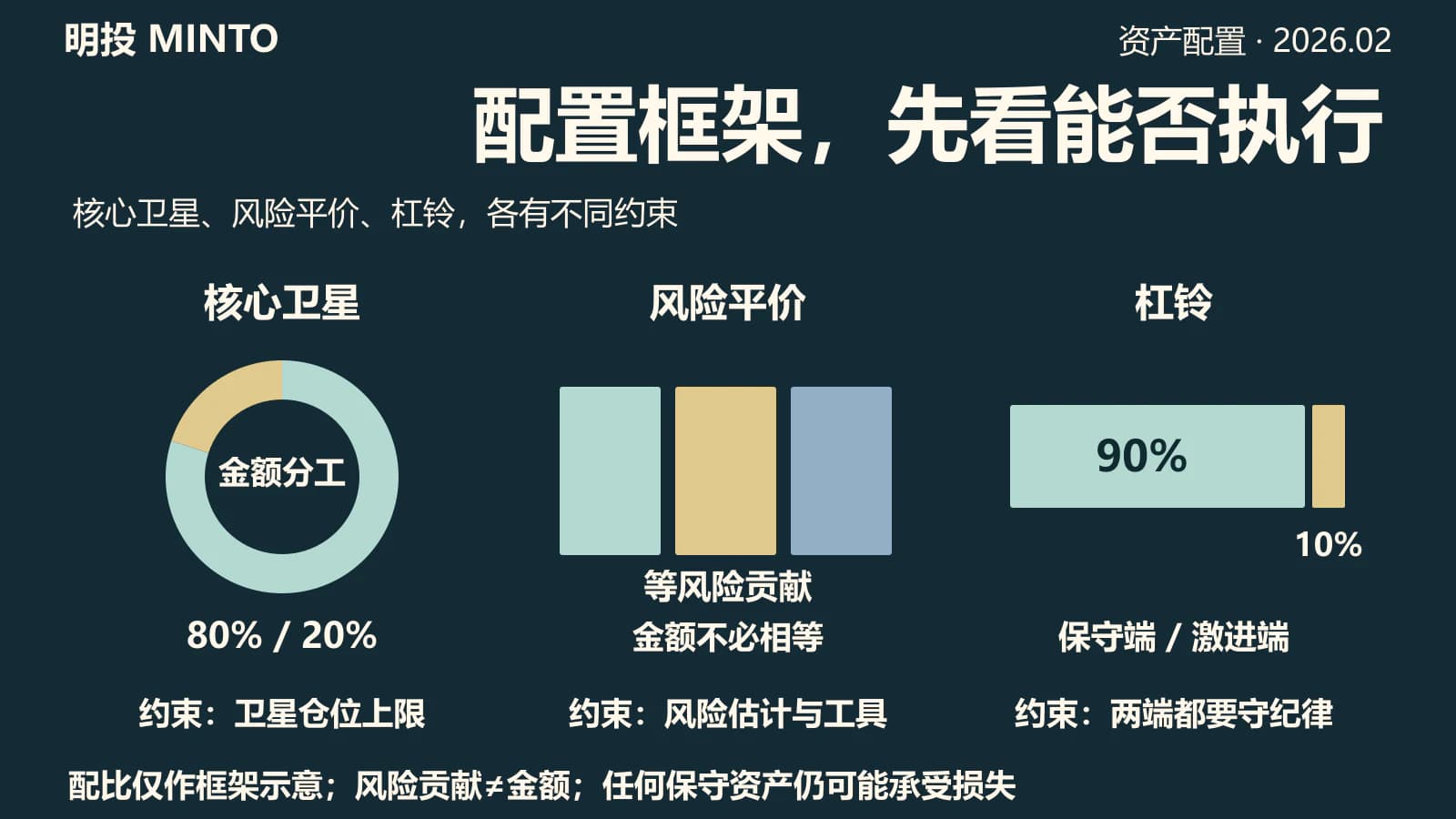
The three dominant frameworks at the strategic layer are Core-Satellite, Risk Parity, and Barbell. Behind each is a completely different worldview.
But let me pour cold water first: There's no objectively "best" framework.
This is the mistake most people make when picking a framework — they ask "which has the highest return and lowest drawdown," as if there's a single right answer. The truth is: Choosing a framework isn't a technical question — it's a question of who you are. Your cognitive depth, your discipline, the volatility you can sleep through — these determine which framework fits. A framework that works for Warren Buffett can destroy an ordinary person; one that works for an ordinary person might feel like a waste to Ed Thorp.
So below, I won't rank "which is best." I'll explain what each framework is, its implicit assumptions, and who it's for. Then you check which box you fall into.
II. Core-Satellite: For Most People
Core-Satellite is the most pragmatic framework and the best fit for the majority.
Its structure is simple —
Core (70-90%): The most stable, lowest-maintenance stuff — broad-market index ETFs, long-term holdings of quality companies. This part aims to "track the market, compound long-term," and is almost hands-off.
Satellite (10-30%): Where you have a unique insight and are willing to actively manage — thematic bets, individual stocks, cyclical opportunities. This is your "learning + flexibility sleeve" — more active, but with strict size limits.
The "three-layer asset structure" (Cash + Core + Satellite) I wrote earlier is essentially a personal version of core-satellite.
Its implicit assumption is: "You admit you don't have an edge most of the time, but you do in a few areas." So you entrust most money to the market (passive core) and only get active where you truly have conviction (satellite).
Who it's for? — The vast majority, especially people with day jobs, limited time and energy, but who don't want to be purely passive. Its biggest strength is "psychological sustainability": core keeps you connected to the market, satellite keeps you engaged and curious, and strict size limits prevent your "active mistakes" from being fatal.
This is my default recommendation for 90% of people. It's not sexy, but it's stable, executable, and you can hold it for life.
III. Risk Parity: For Those Who Believe in Diversification and Have the Tools
Risk Parity is the idea behind the All Weather portfolio from the previous post — allocating by "risk" rather than "dollars," so each asset class contributes equal risk.
Its implicit assumption is: "You believe no one can predict which asset class will win, so the fairest approach is to make each asset class bear equal risk." It's an extreme "don't predict, just diversify" philosophy.
Who it's for? — Those who believe in "complete diversification" and have the ability to execute (including using leverage, rebalancing, and calculating risk through the portfolio), and institutions.
But I have two reservations about risk parity for ordinary people (as I said in the previous post):
First, it depends on leverage. To make low-volatility bonds contribute the same risk as stocks, you need to lever the bonds. And leverage is dangerous for ordinary people — it amplifies returns in good times but destruction in bad times (2022 is an example).
Second, its assumption about correlations is fragile. The diversification benefit of risk parity relies on assets being "low or negatively correlated." But 2022 showed that correlations suddenly converge in crises (everything falls together), when diversification fails and the damage from leverage multiplies.
So my take: The "idea" of risk parity (seeing through to real risk) is worth learning for everyone, but its "full execution" (levered multi-asset portfolio) is better for institutions than most individuals. Individuals can borrow its insights without copying its leverage.
IV. Barbell: For Those Who See the World as Unknowable
Barbell is Taleb's signature (I covered it in detail in the Antifragile piece) — 90% ultra-safe + 10% ultra-aggressive, nothing in between.
Its structure is counterintuitive — heavy on both ends, empty in the middle. One end is ultra-safe assets (short-term Treasuries, cash), ensuring you never go bust. The other end is ultra-aggressive, high-odds bets (allowing most to go to zero), giving you exposure to positive black swans. The "middle-of-the-road" moderate-risk assets are cut out.
Its implicit assumption is: "The world is fundamentally unknowable, and extreme events (good and bad) determine everything." So it abandons "moderate balance" and uses "extreme ends" to deal with an extreme world: the safe end keeps you alive, the aggressive end gives you a shot at life-changing opportunities.
Who it's for? — People who deeply believe "the world is unpredictable," can tolerate the aggressive sleeve going to zero repeatedly, and have the discipline to stick with the safe sleeve.
The appeal of the barbell is its "convexity" — downside is capped (you lose at most 10%), upside is open (the aggressive end can 10x, 100x). It sacrifices "moderate comfort" for "extreme protection + extreme opportunity."
But its cost is that it's psychologically brutal. Putting 90% in nearly stagnant safe assets means in a bull market you watch others make money while you "miss out" on 90% of it; the 10% aggressive sleeve frequently goes to zero, forcing you to "admit defeat" repeatedly. It's beautiful mathematically, but tormenting emotionally. That's why most people can't stick with a pure barbell.
V. Side-by-Side Comparison: A Table at a Glance
Put the three frameworks together —
| Core-Satellite | Risk Parity | Barbell | |
|---|---|---|---|
| Core Philosophy | Mostly passive + a little active | Equal risk allocation, pure diversification | Both ends extreme, middle cleared |
| Implicit Assumption | I'm only advantaged in a few areas | No one can predict; spread risk evenly | World unknowable; extremes determine everything |
| Key Risks | Satellite spills over; core not stable enough | Leverage; correlations converge | Psychologically unsustainable; aggressive sleeve goes to zero |
| Who It's For | Most people | Institutions / those with tools | People who embrace unknowability and have strong mental fortitude |
| Representative Figure | Most financial advisors | Dalio | Taleb |
Looking at this table, you'll notice something interesting — the three frameworks correspond to three different beliefs about the "knowability of the world."
Core-satellite says: The world is partially knowable (I have advantages in a few areas). Barbell says: The world is largely unknowable (extreme events dominate; I can only prepare on both ends). Risk parity says: The unknowability of the world is uniform (so spread risk evenly).
Choosing a framework is essentially choosing "how knowable you believe the world is." That's the real question it asks you.
VI. How I Use It: None Pure, But a Blend
Having laid out all three, here's my own approach — I don't use any single one purely; I mix them.
My actual structure looks roughly like this —
Bottom layer: core-satellite skeleton. About 80% core (mostly US broad-market ETFs + a bit of international diversification) + about 20% satellite. This is my main framework because it's the most sustainable and best fits my situation: "day job, limited time, genuine insights in only a few areas."
Inside the satellite: barbell thinking. That 20% satellite isn't spread evenly across a bunch of "medium-risk" positions. Instead, it leans barbell — most satellite weight goes to relatively confident bets, a small part goes to high-odds, zero-allowed bets (e.g., early AI applications, certain themes).
Global view: risk parity's eyes. I don't copy risk parity's leverage recipe, but I use its insight — periodically see through the entire portfolio and ask "where is my real risk coming from?" Often I find: even though nominally I have stocks, bonds, and international, my real risk is still 70% from a single direction (US stocks). This "see-through check" is the most practical gift risk parity gave me.
So my answer is — use core-satellite as the skeleton, barbell as the spirit inside the satellite, and risk parity as the inspection tool. Three frameworks, not a zero-one choice, but each contributing its strength.
Behind this is an attitude I keep emphasizing — don't become a disciple of any method (remember the stance I take when reading those books). Each framework has its insight and its boundary. Treat them as different tools in the toolbox, not competing religions.
VII. Final Word
These three pieces (60/40, All Weather, and this one) together form the full picture of the "strategic framework layer."
If I condensed the common conclusion of these three into one sentence, it would be: There is no "objectively optimal" allocation framework — only one that "fits you"; and whether it fits depends on who you are, how knowable you believe the world is, and what volatility you can sleep through.
Most people choose a portfolio framework like picking the "best product" — find the one with the highest return and lowest drawdown. But that's wrong. A portfolio framework isn't a product; it's an extension of your worldview. Someone who doesn't believe they can predict will suffer if forced into a framework that requires prediction. Someone psychologically fragile will break down under the barbell's missed opportunities.
So before choosing a framework, ask yourself three questions —
How knowable do I believe the world is? (Determines the macro direction: core-satellite vs. barbell vs. risk parity) How much time, energy, and professional capability do I have? (Determines the active share) How much volatility and missed opportunity can I sleep through? (Determines the mix of aggressiveness and conservatism)
Think through these three, and the framework choice will emerge naturally. It won't be the "optimum" answer from a textbook — it will be the one you can hold, stick with, and execute for a lifetime.
And "being able to execute for a lifetime" is a hundred times more important than "theoretically optimal."
Because no matter how good a framework is, if you can't hold it, it counts for nothing.
This is the last lesson of the strategic framework layer. Next layer: from "framework" to "assets" — first up, the asset everyone underestimates: cash.
专注投资分析、市场洞察与资产配置。不追短期波动,只理解真正驱动长期回报的东西。