跳到正文 · Skip to content
内容
关于与合作
订阅与会员
★ 查看会员权益
外观与设置
外观
主题色
版本 · 深色 / 减动搜索⌘K
草稿预览·这篇还没发布,不会出现在列表和 RSS 里。review 完后把 frontmatter 的 draft: true 改为 false 即可。

Bonds: The Shattered Illusion of 'Risk-Free'

Bonds were never 'risk-free' — they just swapped one risk for another: from 'company bankruptcy' to 'rising interest rates.' In 2022, a 30% drawdown reminded everyone.

2026.02.158 min原创
Bonds: The Shattered Illusion of 'Risk-Free'
资产配置MINTOVIEW2026.02.15

"Asset Allocation" series · Asset layer. Framework in the overview. Last post unpacked cash; this one unpacks the asset that got slapped in 2022 — bonds.

1. Bonds' 'Safe' Persona, Shattered

Before 2022, bonds had a rock-solid persona in most people's minds — safe.

"Stocks are risky, bonds are boring"; "If you don't want risk, buy bonds." U.S. Treasuries were even crowned the "risk-free asset" — the anchor pricing the entire global financial system. Retirees were told to increase their bond allocation for "stability."

Then came 2022. U.S. 20+ year Treasury bonds posted a drawdown of more than 30% that year. The asset considered "risk-free" fell harder than many stocks.

Investors who treated bonds as a "safety net" were left stunned — I bought bonds for stability — how did they fall even more than stocks?

That slap shattered an illusion decades in the making. To understand whether bonds still have a place, you first need to understand — the 'safety' of bonds was always conditional, always misunderstood.

2. Bond Risk, Just Under a Different Name

The illusion of bond safety stems from one truth: if you hold a bond to maturity and the issuer doesn't default, your principal and interest are locked in. That part is indeed "risk-free" (credit-risk-wise).

But that "certainty" hides a massive trap — it only holds if you 'hold to maturity' and 'ignore the interim price.' In reality, bonds trade on a market with daily price fluctuations. And those prices face a killer risk — interest rate risk.

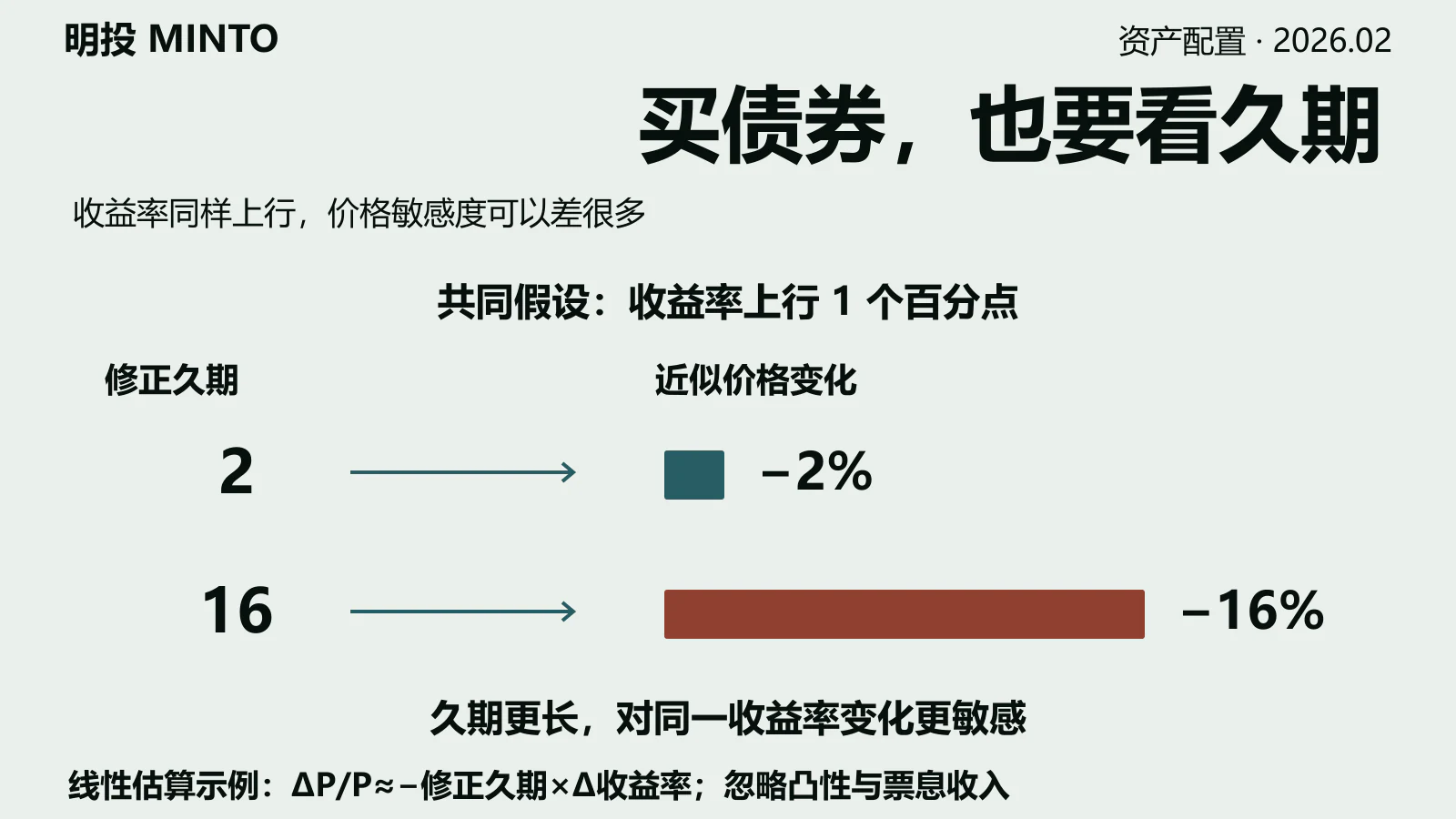
Bond prices and interest rates are inverse: rates go up, existing bond prices fall (because new bonds pay higher coupons, making the old ones less valuable). And — the longer the bond's maturity (the larger its duration), the more sensitive to rates, the harder it falls when rates rise.

That's the truth of 2022 — the Fed, fighting inflation, hiked rates violently from near-zero to above 5%. Rates surged, long-term bond prices collapsed. Those holding long-term Treasuries, while "credit risk-free" (the U.S. won't default), were slaughtered on the "interest rate" front.

So — bonds were never 'risk-free,' they just swapped one risk for another: from a stock's "company bankruptcy risk" to "interest rate rise risk." What's safe is not bonds, but 'bonds misunderstood as safe.' A person who truly understands bonds never calls them "risk-free" — they ask: "What risk is this bond exposed to, and how big is that risk right now?"

3. Different Bonds Are Different Assets

Treating "bonds" as a single category is another fundamental mistake. Different maturities and credit qualities are entirely different assets —

  • Short-term Treasuries / Money Market Funds: Very short duration, barely sensitive to rates. They sat rock-solid through the 2022 hikes. Their role is closest to "cash" — a bit of yield plus extreme stability. This is truly reliable "defense."
  • Long-term Treasuries: Long duration, extremely rate-sensitive. They are a great hedge in "growth panic, rates falling" scenarios (stocks down, bonds up), but a disaster in "inflation panic, rates rising" (2022). They are a double-edged sword — in the right environment a hedge, in the wrong environment dynamite.
  • Corporate Bonds / High-Yield Bonds ("junk bonds"): Besides rate risk, they add credit risk (company may default). They offer higher yields, but in a recession they fall alongside stocks (because everyone fears defaults). Their 'defense' attribute is weakest — when the economy sours, they don't hedge stocks; they fall with them.
  • TIPS (Treasury Inflation-Protected Securities): Principal adjusts with inflation, so they hedge "inflation risk." In a 2022-like inflation environment, they held up better than regular Treasuries.

Understanding this, you realize — "Should I allocate to bonds?" is a pseudo-question. The real question: which bonds, hedging which risk, under what environment. Treating "bonds" as a monolith is unprofessional.

4. So, in the New Rate Normal, How I Use Fixed Income

Having laid out the nature of bonds, here's my own approach.

My core judgment on bonds (fixed income) — they still have a place, but their role shifts from 'primary defense' to 'specific tool,' and you must distinguish which kind.

Specifically, in the 2026 environment — rates no longer in one-way decline, inflation risk still present —

First, for 'primary defense' in fixed income, I use short-dated bonds + cash, not long bonds. Since long bonds only hedge effectively when rates fall, and the rate direction is uncertain now, I won't bet my defense on long bonds. I use short-term Treasuries and money market funds as a "stability pad" — they sacrifice a bit of yield but are immune to rate hikes, exactly the lesson of 2022 (recall the cash piece — unconditional defense).

Second, long bonds I only deploy tactically when I judge rates are about to fall. For example, if the economy heads into a clear recession and the Fed is set to cut aggressively, long bonds become a great offensive hedge (rates down → long bonds surge). But that's a tactical timing move, not a long-term core holding. I won't unconditionally hold a big pile of long bonds.

Third, I allocate a bit to TIPS as part of an 'inflation hedge.' In a world where inflation risk hasn't vanished, having one asset class that specifically hedges inflation makes sense (though gold and real assets play a similar role — I'll write about that later).

Fourth, corporate bonds / high-yield bonds I mostly avoid. Their 'defense' is the weakest (they fall with stocks in a recession), and the extra yield doesn't compensate for the added credit risk. For similar risk, I'd rather hold equities directly (more upside).

In a sentence — bonds are not out; they must be 'sorted by type, clear in role, placed in the right environment.' The era of treating bonds as a 'thoughtless safety blanket' ended in 2022.

5. Where I Differ from the Mainstream: Retire the 'Age = Bond Allocation' Formula

Mainstream bond advice has a widely spread yet deeply outdated formula — 'bond allocation = your age' (40 years old → 40% bonds, 60 years old → 60%).

I think this formula is harmful today.

First, it assumes bonds are always 'safe.' The whole logic: 'the older you get, the more stability you want, so allocate more to bonds.' But 2022 proved — long bonds are far from stable. A 60-year-old retiree following this formula with 60% long bonds got crushed in 2022. The formula pushes people into an allocation that can explode like 2022.

Second, it ignores the rate environment. Bond attractiveness depends heavily on current rate levels and direction. When rates are high and could fall, bonds are attractive (lock in high yield + future capital gains); when rates are low and could rise, bonds are a trap. A fixed 'age formula' completely ignores this most important variable.

Third, it ignores 'which bonds you allocate to.' As outlined, short-dated and long-dated bonds are entirely different assets. A vague 'allocate X% to bonds' formula never answers 'which ones?' — and that's exactly the key question.

My alternative — don't use age to set bond allocation. Instead, use 'your cash flow stability + current rate environment + what risk you need to hedge' to determine the type and proportion of fixed income. It's more complex, but it won't lead you into a 2022-style disaster. Investing has no 'one formula for life' shortcut (recall my caution about all 'success formulas').

6. Bonds vs Cash: Two Tools on the Defense Side

Connecting this piece to the previous one — cash and bonds are two tools on the portfolio's 'defense side,' but with different temperaments.

  • Cash: Unconditional defense + option value. It never betrays you in any crisis, but offers the lowest long-term return.
  • Bonds: Conditional defense + a bit of yield. Short-dated bonds are close to cash; long-dated bonds are a double-edged sword on rates. They all offer a bit more yield than cash (as compensation for taking rate risk).

A smart defense side is not 'all-in bonds' (the 2022 lesson) nor 'all-in cash' (too low yield), but dynamically mixing cash, short bonds, long bonds, and TIPS based on the environment

  • When rates are high and could fall, moderately increase long bonds (to capture gains from falling rates).
  • When rate direction is unclear and inflation risk remains (like 2026), lean toward cash + short bonds + a bit of TIPS.
  • When absolute stability is the goal, use cash and short bonds as the base.

The art of defense is not 'finding the always-safe asset' (it doesn't exist) — it's 'using several complementary defense tools to handle different crises.' That's the core of the framework — don't predict which crisis will come, but have a tool ready for each.

7. Closing Thoughts

The story of bonds, like 60/40 and All Weather, is a story of 'illusion shattered.'

An entire generation treated bonds as a 'risk-free haven.' That belief was built on the unique backdrop of 40 years of one-way declining rates — in that backdrop, bonds were indeed both stable and profitable (rates fell → bonds rose). So people gradually forgot that bonds carry real risk, just that risk (rate rises) hadn't materialized on a large scale in four decades.

2022 — that risk, dormant for 40 years, finally woke up, delivering a 30% drawdown to give everyone a lesson: There is no 'risk-free asset,' only 'an asset whose risk hasn't yet been triggered' (remember This Time Is Different — supposedly safe sovereign debts have defaulted repeatedly in history).

That's the deepest lesson bonds taught me, and it goes far beyond bonds — Beware of anything labeled 'safe,' 'risk-free,' or 'stable.' Those labels often exist not because the thing is truly risk-free, but because its risk last showed up so long ago that people forgot it existed.

True safety doesn't come from believing any asset is 'risk-free.' It comes from understanding 'what risk does this asset carry, when would that risk materialize, and what do I have for backup if it does?'

Bonds? Yes. But use them with this clarity — They are not a safe harbor. They are a tool with its own temper. A good helper when used right; when used wrong, they'll hit you hardest exactly when you most want stability.

Next, we talk about the eternal, most controversial asset: gold — how many percentage points should you allocate?

Minto
明投 Minto
投资分析 · 长期主义者

专注投资分析、市场洞察与资产配置。不追短期波动,只理解真正驱动长期回报的东西。

你读完了 · Colophon

Bonds: The Shattered Illusion of 'Risk-Free'

8
分钟
2026/02
期号
2026
年份
真正稀缺的,是一个不慌不忙的人。
明投 · MintoInvest Wisely
— From This Series
喜欢这篇?这类 资产配置 的深度拆解会持续发到你邮箱。
无广告 · 随时退订
— Enjoyed the read?
如果这篇文章对你有用,把它分享给一个朋友,就是对我最好的支持。

口碑是独立创作者最稀缺的燃料。

— Discussion

说说你的想法

评论基于 GitHub Discussions(Giscus)。登录后即可留言、点赞、互相讨论。

评论还在准备中。

想说什么可以直接发我邮件,比在评论区更容易认真回复。

mingtaohuang617@gmail.com →
支持沉浸式阅读