"Asset Allocation" series · Asset Layer. Framework in the master outline. Last piece on gold ended with a hook — this one, its young challenger: Bitcoin.
1. Most People Are Arguing the Wrong Question About Bitcoin
Open any discussion about Bitcoin, and you'll see two extremes screaming at each other —
On one side, the believers: "Digital gold" "Future of money" "You're just poor if you don't get it"; On the other, the critics: "Tulip bubble" "Ponzi scheme" "Worthless".
These two sides have been arguing for over a decade, and neither can convince the other. And my point is — for someone doing asset allocation, neither side is arguing about the most important question.
The believers and critics are arguing about "will Bitcoin succeed or not, does it have value?" — that's a binary, all-or-nothing question. But an allocator never thinks that way.
The allocator's question is never "should I or shouldn't I?" (all-in or zero) — it's — "How much should I allocate, so that if it goes up I benefit meaningfully, but if it goes to zero it doesn't kill me?"
This is a sizing problem, not a faith problem. Once you turn it into a sizing problem, that endless "faith vs. scam" shouting match becomes irrelevant to you.
2. Bitcoin Is a "Convex Bet"
To decide how much to allocate, you first need to understand its "personality." And Bitcoin's personality is best captured by one of Taleb's terms — convexity (remember Antifragile, remember the barbell from the framework piece).
What is a convex bet? Downside limited (at most you lose your invested principal), upside enormous (could be 10x, 100x).
Bitcoin is exactly that —
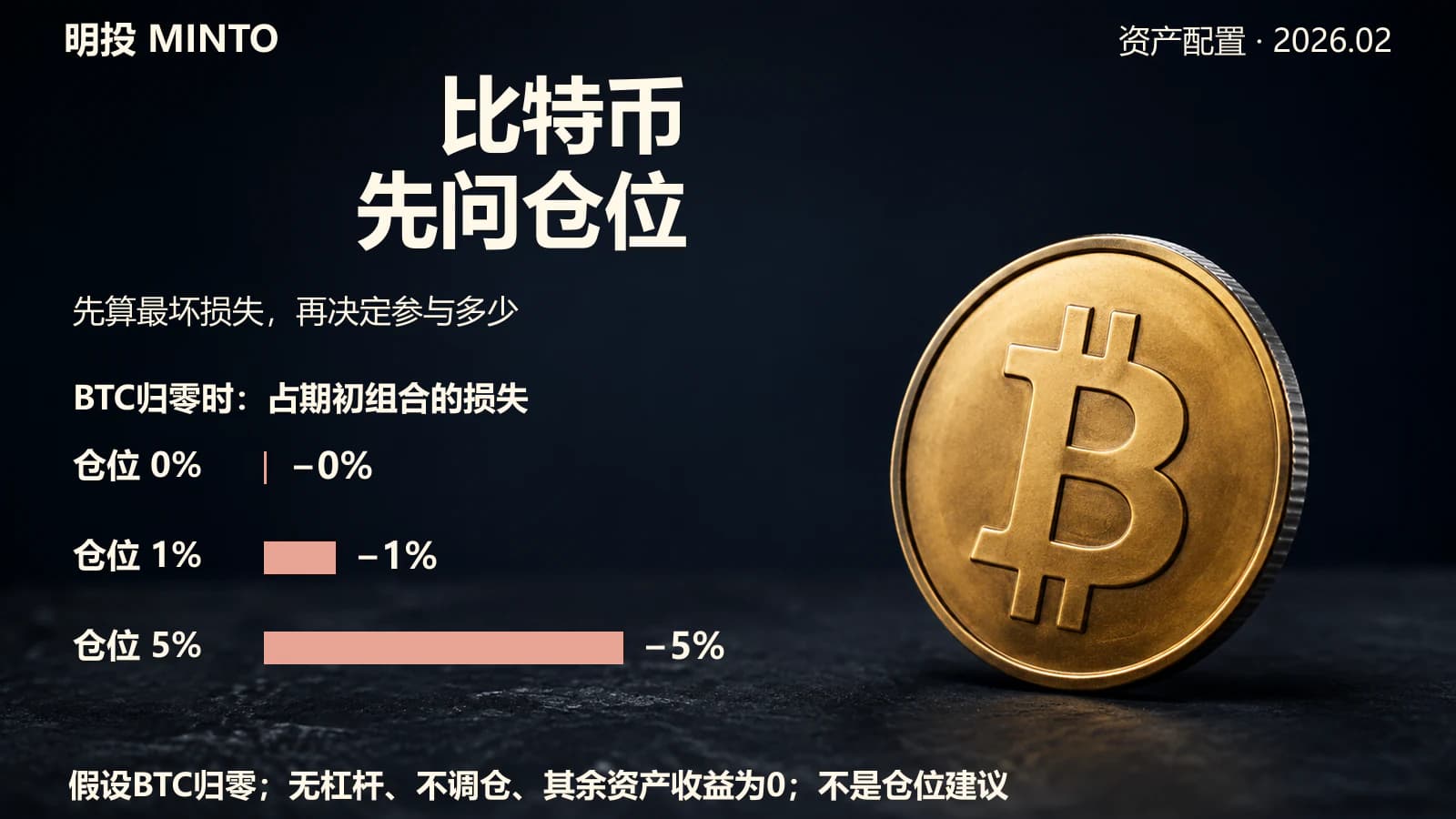
The downside is limited and clear: if you only invest 2% of your portfolio, even if Bitcoin goes completely to zero (entirely possible), your total portfolio loses only 2%. That's a loss you can fully absorb without shaking your foundation.
The upside is huge and asymmetric: if Bitcoin continues to gain broader acceptance (becoming a mainstream store of value, allocated by central banks/institutions, a hedge against fiat debasement), it could rise several times over. That 2% position could become 10%, 20%.
Downside capped at 2%, upside potentially unlimited — that's a perfect convex structure.
Once you understand this, the logic for allocating to Bitcoin becomes clear — you're not "betting it will definitely succeed" (faith), you're "using a small, losable sum to bet on an asymmetric big opportunity" (convexity).
This is the same idea as the barbell strategy I discussed in the framework piece — 90% conservative (keeps you alive), 10% bet on high-payout convex plays (most can go to zero, but if one works, returns cover all losses). Bitcoin is a classic convex candidate for that 10% aggressive end.
3. So, How Much? A Kelly Criterion Perspective
How much should you allocate to a convex bet? Here we can borrow from the Kelly Criterion (discussed in my piece on Ed Thorp's Beat the Dealer) — it's designed exactly to answer "how much to bet."
The core idea of the Kelly Criterion is — your bet size should be proportional to your "edge" and inversely proportional to "risk." The bigger and more certain your edge, the more you bet; the bigger the risk and uncertainty, the less you bet.
Plug in Bitcoin —
Its "edge" (probability of success × payoff if successful) is highly uncertain. You can't nail down its probability of success (maybe 30%, maybe 70%, no one really knows), but if it succeeds, the payoff is huge. Its "risk" is extreme. It's wildly volatile (routinely cuts in half), and it could go to zero entirely (technology superseded, regulatory crackdown, consensus collapse).
When "edge is highly uncertain" and "risk is extreme," the Kelly Criterion says — bet very small. Because your estimate of the edge itself could be seriously wrong (overconfidence in one's judgment is something Taleb warns about repeatedly), and the risk is devastating. In such a situation, any "heavy bet" is dangerous gambling.
So, combining the convex logic and Kelly logic, my answer is — allocate 1% to 5% to Bitcoin, and mentally prepare for it to go to zero entirely.
What does this 1%–5% range mean? — It means: if Bitcoin goes to zero, you lose 1–5% (fully bearable, doesn't affect your life or core portfolio); if Bitcoin goes up 10x, that 1–5% becomes 10–50%, materially boosting your overall returns. Downside not fatal, upside meaningful. That's the right allocation for a convex bet.
Below 1%, even if it goes up it won't move the needle on your portfolio (pointless); above 5%, if it goes to zero it actually hurts you (its probability of going to zero doesn't allow you to bet more).
4. Where I Differ from Both Sides: Neither Faith Nor Contempt
My stance on Bitcoin likely satisfies neither believers nor critics — because I don't take either side.
I disagree with the believers' "all-in faith." People who bet a large portion of their net worth on Bitcoin make a fatal mistake — they treat a "highly uncertain + possibly zero" convex bet as a "certain to succeed" faith. This violates the most basic principle of the Kelly Criterion: Never bet heavily on something uncertain and potentially ruinous. I've seen too many people who went all-in during bull markets, calling it "faith," only to get wiped out in bear market drawdowns — they didn't lose on Bitcoin, they lost on position sizing. Even the best convex bet, if you over-bet, will kill you.
I also disagree with the critics' "total rejection." People who dismiss Bitcoin as "scam, zero value, never touch it" make a different mistake — because they can't be sure it will succeed, they completely pass up this convex opportunity. But the whole point of a convex bet is precisely that you don't need to be sure it will succeed — you only need to "use a small, losable amount to bet on an asymmetric big opportunity." Not allocating at all means voluntarily giving up a "downside-controlled, upside-huge" asymmetric opportunity. In a world of persistent fiat debasement and rising sovereign debt (remember the gold piece), completely failing to hedge against "distrust in the fiat system" is also a form of bias.
My stance is in the middle — treat it as a convex bet, participate with a small 1–5% position, neither all-in faith nor total contempt. This stance isn't "passionate" enough (believers think you don't believe enough), nor "clear-headed" enough (critics think you're still touching this thing), but it's the stance an allocator should have — calm, based on position sizing.
Investing is not about taking sides; it's about sizing. This is the deepest reminder Bitcoin has given me.
5. Bitcoin vs. Gold: Two Intensities of the Same Hedge
Picking up from the end of the gold piece — Bitcoin and gold are two intensities of "off-system assets."
Their common core: neither depends on any government or system; both hedge against "distrust in fiat currency."
Their fundamental difference lies in "maturity and risk level" —
| Gold | Bitcoin | |
|---|---|---|
| History | Thousands of years of consensus | A decade or so, consensus forming |
| Volatility | Relatively low | Extreme (routinely cuts in half) |
| Probability of going to zero | Almost zero | Real |
| In a portfolio | Ballast (allocate 5–10%) | Convex satellite (allocate 1–5%) |
| Personality | Steady system hedge | Intense system hedge |
So my approach is — allocate to both, but with completely different roles and allocations. Gold is the "stable, bigger allocation" ballast (5–10%); Bitcoin is the "intense, smaller allocation" convex satellite (1–5%). They are not an either/or; they are two tools — one steady, one intense — for the same need: "system hedge."
Together, I use roughly 5–10% gold + 1–5% Bitcoin to form the block of my portfolio that hedges against "monetary system risk" — one backed by millennia of ancient consensus as the foundation, the other using a small position to bet on young technology's asymmetric upside.
6. In Closing
Bitcoin is the most controversial asset of our era. The shouting matches around it will likely continue for many more years.
But what I want to say is — for someone who truly does asset allocation, you don't need to win that shouting match, and you don't even need a definitive answer to "will it succeed or not?"
All you need is to put it into the right framework — it's a convex bet: downside controlled, upside huge, outcome highly uncertain. For something like this, the correct approach is not "faith all-in" (could destroy you), nor "contempt zero" (pass up the opportunity), but — use a small position you can fully afford to lose (1–5%), participate calmly, and accept whatever outcome.
If it goes up, that small position gives you a pleasant surprise; if it goes to zero, you're unscathed, turn around, and continue.
That's the wisdom of allocation — it takes something that makes everyone either fervently excited or gritting their teeth, and calmly reduces it to a sizing problem. Don't take sides, don't have faith, don't hold contempt — just ask: how much should I allocate so that I can benefit from its upside without being crushed by its downside?
The answer: a number small enough that "going to zero doesn't matter" and large enough that "a surge benefits me." 1% to 5%.
This isn't a judgment on Bitcoin. It's a judgment on how to treat any high-payoff, high-risk, high-uncertainty opportunity.
And this calm of "using sizing instead of faith" may be worth more than any judgment on Bitcoin itself.
Next piece, we'll talk about a topic that's most uncomfortable for those all-in on U.S. stocks, yet most important: international allocation.
专注投资分析、市场洞察与资产配置。不追短期波动,只理解真正驱动长期回报的东西。