I. Why Allocation Matters More Than Stock Picking — and Almost Everyone Gets It Backward
I’ve written plenty of company deep dives and market postmortems. But if I could tell a regular investor just one thing, I’d say: 80% of your lifetime returns come from how you allocate your assets, and less than 20% from which stocks you pick.
This isn’t my opinion; it’s a repeatedly validated conclusion. The classic Brinson study found that the vast majority of a portfolio’s return variability over time comes from the allocation across asset classes, not from specific securities or timing.
Yet most people spend 95% of their energy on that <20% — researching individual stocks, chasing hot themes, agonizing over entry and exit points — and almost no time on the 80% factor: How should my money be positioned overall? How much in stocks, bonds, cash, overseas?
This is the biggest effort misallocation in investing. People work hardest on the least important things and are casual about the most important.
Why? Because stock picking has narrative thrill — it’s a story, it’s exciting, it gives the illusion of “I’m smart.” Allocation is boring: no story, only percentages. It doesn’t make you look clever; it just keeps you alive.
This article is the master blueprint for all my asset allocation content. It answers that neglected but crucial question: How should your money be positioned overall?
II. The Essence of Allocation: Admitting You Don’t Know the Future
Before we talk about “how,” let’s talk about “why.” If you don’t understand the essence of allocation, any specific breakdown is built on sand.
Asset allocation is fundamentally an act of humility toward the unknowable.
The books I’ve read — Taleb’s The Black Swan, Mitchell’s Complexity, Camus’s The Myth of Sisyphus — all point to the same truth from different angles: the future is inherently unpredictable. Markets are complex systems whose direction emerges from millions of independent decisions. No one can consistently forecast them.
If you truly accept that, your approach to money changes fundamentally:
If the future is unknowable, then betting your entire net worth on a single scenario is insane. Going all-in on tech stocks is betting “tech keeps winning.” All-in on cash is betting “there will be a crash.” All-in on gold is betting “currencies will devalue.” Every all-in is an arrogant confidence in a specific future.
Allocation is a different stance: I don’t know which future will arrive, so I make sure I survive in every one.
If inflation hits, stocks and real assets carry me. If deflation hits, cash and bonds do. If one asset collapses, others hold me up. I don’t aim to win the most in any single future; I aim to survive in every possible future.
That’s the philosophical core: Don’t predict the future; prepare for every future. Taleb would call it antifragile, Dalio would call it All Weather, Laozi would call it “know when to stop.” Different words, same core: in a world you cannot control, true power isn’t prediction — it’s preparation.
III. Three Layers of Allocation: A Complete Map
Now that we understand the “why,” let’s draw the “how” map. I split asset allocation into three layers — like a pyramid, from strategy to tactics to execution, all indispensable.
Layer One: Strategic Framework (Overall Money Split)
This is the top-level, most important decision: How should your money be split among stocks, bonds, cash, and alternatives (gold, crypto, commodities, real estate)?
That split is determined by two things: your risk tolerance (the drawdown you can sleep through) and your time horizon (how long the money won’t be touched). A 30-year-old with a 20-year horizon should have a completely different framework from a 60-year-old who needs liquidity soon.
The strategic framework is your anchor — once set, it shouldn’t change with short-term market moves. It determines 80% of your long-term returns.
Layer Two: Tactical Asset Allocation (How Each Class Is Structured)
Under the strategic framework, you drill into each asset class:
- Stocks: How much US vs. international? Broad index vs. individual names? Growth vs. value?
- Bonds: Long vs. short duration? How to manage interest rate risk?
- Cash: How much to hold? It’s not a drag on returns — it’s an option to avoid forced selling (I’ll write a dedicated piece).
- Alternatives: How much gold? Bitcoin — yes or no, and how much?
This is the layer most finance content focuses on — chasing hot assets. But without the strategic framework, discussing whether a specific asset “will go up” is meaningless. Assets aren’t allocated in isolation; they play roles within an overall structure.
Layer Three: Execution Mechanisms (How to Implement and Maintain)
This is the most overlooked but most impactful layer:
- Rebalancing: Sell what has gone up too much, buy what has fallen, bringing proportions back to target. This boring act quietly adds returns every year (it forces you to buy low and sell high, fighting human nature).
- Dollar-cost averaging: Using discipline to beat your own emotions and timing impulses.
- Costs: Fees, taxes, friction — costs are the only certainty, and their compound effect destroys returns (remember Bogle).
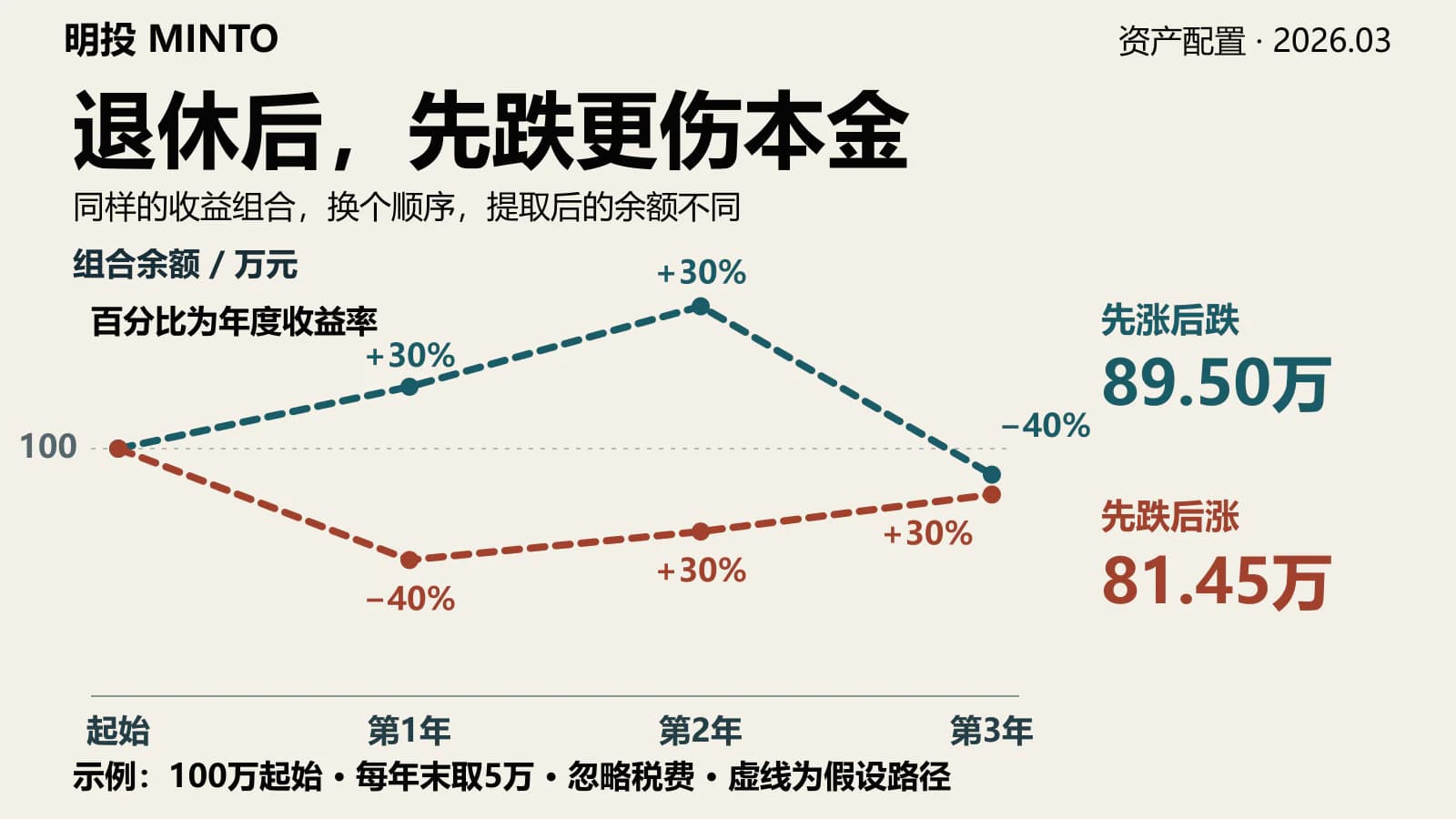
- Risk management: Drawdown control, leverage discipline, avoiding sequence-of-returns risk.
Anyone can draw a framework. Execution is the real skill. An average framework plus strict execution beats a perfect framework with chaotic execution.
IV. That “Three-Layer Asset Structure” Article Is the Strategic Implementation of This Map
I previously wrote “A Three-Layer Asset Structure for Individual Investors” — cash safety net / core position / satellite positions.
That article is a concrete implementation of Layer One (Strategic Framework) for individual investors:
- Cash safety net (6-12 months of expenses) — the right not to be forced to sell, the foundation of the whole structure.
- Core position (60-80%) — broad index funds + quality long-term holds, pursuing long-term compounding, never exiting due to volatility.
- Satellite positions (<20%) — learning positions + tactical bets, staying connected to the market, with strict boundaries.
If you read only one piece and remember only one structure, remember those three layers. It’s simple, robust, and fits most people.
This master blueprint fills in the “why” (allocation philosophy) and “how to maintain” (execution mechanisms) on top of that structure, placing it in a complete map. The three-layer structure is the skeleton; this blueprint is the worldview and flesh behind it.
V. Four Disagreements with Mainstream Allocation Views
After laying out the framework, here are four places where I diverge from conventional allocation wisdom. These are points where I think most allocation advice is outdated or incomplete.
First, the golden age of the 60/40 portfolio is over.
60% stocks + 40% bonds was the classic allocation for 40 years. It worked because it assumed stocks and bonds were negatively correlated — when stocks fell, bonds rose, hedging each other.
But 2022 slapped that assumption hard: stocks and bonds fell together, giving the 60/40 its worst performance in decades. Why? Stock-bond negative correlation only holds in low-inflation environments. Once inflation returns (as in 2022), both fall together.
My view: In a world where inflation and interest rates are no longer stable, the 60/40 needs an upgrade — add assets that hedge inflation (gold, TIPS, real assets, some commodities) instead of relying solely on bonds for defense. Bonds are no longer the universal hedge.
Second, All Weather really is only one weather.
Dalio’s All Weather portfolio (risk parity) is another classic. But as I said in my reading of The Debt Crisis — it’s called All Weather, but it truly excels in only one climate: low inflation + falling low interest rates. It looked gorgeous during the 1981-2020 bond bull, but in 2022 it suffered its worst drawdown on record.
Any portfolio that claims to handle every environment should be met with skepticism. An honest allocation will tell you clearly: “This is where it fails.” I’d rather have a portfolio that knows its weaknesses than one that peddles an all-weather illusion.
Third, rebalancing is severely underrated.
Most people obsess over “what to buy” and barely give rebalancing a thought. But rebalancing might be the highest-ROI action in allocation — it requires no forecasting ability, only discipline: periodically bringing the portfolio back to target.
Its magic: it forces you to do the counterintuitive thing — sell what has run up (take profits) and buy what has fallen (buy the dip). That’s a mechanized version of “be fearful when others are greedy” (remember Laozi: “reversal is the movement of the Way”). A mediocre portfolio that rebalances consistently often outperforms a “good” portfolio that doesn’t.
Fourth, passive investing is becoming a hidden concentrated bet.
“Buy the index, hold long term” is good advice (Bogle, Malkiel). But in 2026 there’s a new problem: when you buy the S&P 500, you’re effectively putting one-third of your money into the Mag 7. The top 7 stocks make up a third of the index. So-called diversification has morphed into a hidden concentration in a few tech giants.
So when I look at a portfolio, I drill through to the underlying real concentration — a portfolio that seems diversified might have its top 5 underlying companies accounting for over 40%. In 2026, “buying the index” does not equal “being diversified.” This is a new risk many overlook in allocation.
VI. How This Framework Applies in the 2026 US Stock Market Environment
Let’s drop the above framework into today’s specific context:
First, face the concentration risk in US stocks. I focus on US equities and my core is also US stocks. But 2026 US stocks have two structural dangers: extreme Mag 7 concentration, and the S&P 500’s CAPE near 35 (90th percentile historically). This means “mindlessly buying the US broad market” is taking on an invisible concentrated + high-valuation risk. My response: core remains US stocks, but within the strategic framework, allocate some space to non-US markets (Europe, Japan, emerging markets) — not because I’m bearish on the US, but as a tail hedge against “US exceptionalism fails” (remember Siegel’s piece on Japanese investors going all-in on their home market and taking 35 years to break even).
Second, at a high valuation starting point, lower expectations and keep dry powder. Shiller’s data is clear: starting at CAPE 35, the expected 10-year return is likely below the historical average. This doesn’t mean liquidating; it means don’t use leverage at these levels, don’t go all-in, and keep cash as an option — have bullets ready when valuations revert.
Third, re-examine every asset class through the AI lens. AI isn’t just about tech stocks. It will reshape the entire allocation: it could boost productivity (favoring stocks), increase energy demand (favoring real assets), or widen winner-take-all dynamics (accentuating concentration risk). I’ll write a dedicated piece on “new allocation questions in the AI era.” For now, just one line: any allocation framework set before 2020 that hasn’t factored in AI needs a full review.
VII. What I’ll Unfold After This Master Blueprint
This is the apex. Next, I’ll expand each layer and each asset class into a complete system:
- Strategic Layer: The rise and fall of 60/40, the truth about All Weather, Permanent Portfolio, Core-Satellite vs. Risk Parity.
- Asset Layer: Cash as an option, whether bonds still matter, how much gold, Bitcoin as a position size, international allocation, why the core should be broad-based ETFs.
- Execution Layer: The rebalancing bonus, behavioral finance of DCA, the tyranny of costs, a portfolio that can be handed down for 30 years.
- Risk Layer: The drawdown you can tolerate determines how much equity you hold, the trap of pseudo-diversification, sequence risk, leverage as a fuse.
Every article will unfold from this master blueprint and link back to it. They aren’t scattered pieces; they form a pyramid — this is the apex, the rest is the body supporting it.
VIII. In Closing
I’ve read a lot of books and written a lot about companies and markets. But the further I go, the more I believe this: for the vast majority, the basic question of “how to position your money overall” is 100 times more important than the sexy question of “which stock to buy.”
Allocation isn’t sexy. It has no get-rich story, no “I caught a 10-bagger” thrill. It has only one job: to keep you alive in a future you can’t see, allow you to sleep well, prevent you from being crushed by any single disaster, and then let time and compounding work for you, slowly.
It sounds boring. But Buffett, Bogle, Dalio, Malkiel — all the people who have truly lasted and won steadily — are essentially doing the same boring thing: not betting on a single future, but arranging their money into a structure that can withstand every future, then patiently waiting.
I call that boring but fundamental thing asset allocation.
Its highest state is not predicting anything correctly, but — no matter what happens, you are already prepared.
Don’t predict the future. Prepare for every future.
That is the entirety of this master blueprint, and the starting point of all my thinking on allocation.
Every subsequent article will unfold from this single sentence.