"Asset Allocation" series. Framework see the master post Don't Predict the Future, Prepare for All Futures. Last installment dissected the 60/40; this one takes on its "upgraded rival" — the All Weather.
1. A Portfolio That Wants to Adapt to All Weathers
If the 60/40 is the "classic model" of portfolio construction, then Ray Dalio's All Weather portfolio is the "engineering masterpiece."
Dalio's starting point is much deeper than the 60/40. He asked a fundamental question: The economic environment is determined by just two variables: growth (high/low) and inflation (high/low). Their combinations produce four "weather" conditions. So is there a portfolio that won't collapse in any of them?
That's the origin of the "All Weather" name — it doesn't predict which weather comes next; it designs itself to survive in any of them (a philosophy I championed in the master post).
His approach introduced a key concept: Risk Parity.
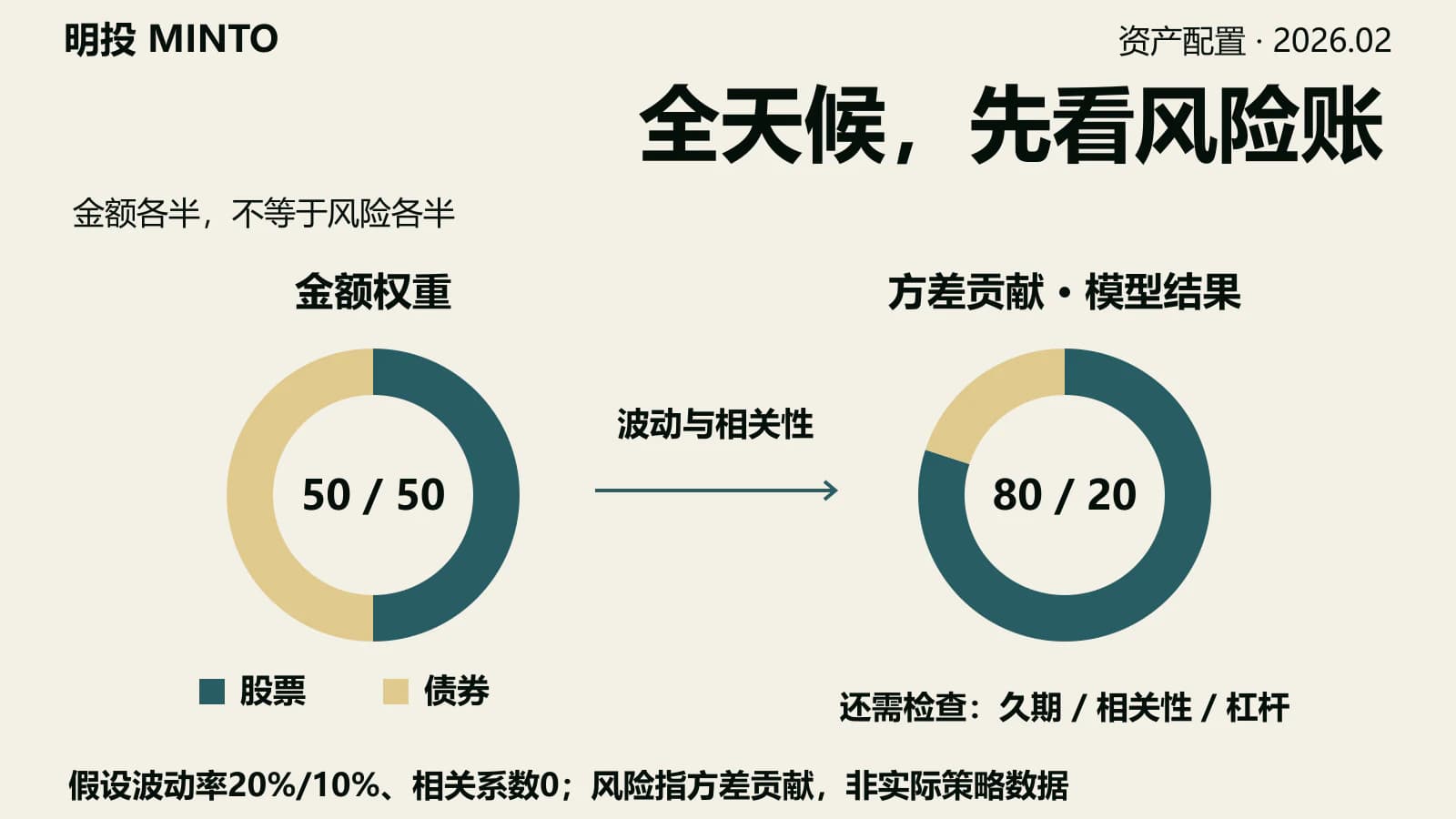
Traditional 60/40 allocates by "dollar amount" (60% in stocks, 40% in bonds). But Dalio says — that's wrong. Because stocks are far more volatile than bonds, in a 60/40, though the dollars are split 60/40, the risk is actually 90/10 — 90% of your portfolio's volatility comes from the 60% in stocks. You think you're diversified, but you've actually placed almost all your risk on stocks.
Risk Parity's solution: allocate by "risk" not "dollars," so each asset class contributes equal risk. Since bonds have low volatility, to make them contribute risk equal to stocks, you need to leverage bonds. The resulting All Weather portfolio is roughly: 30% stocks + 55% bonds (mostly long-duration) + 15% gold and commodities, with moderate leverage applied.
The design is extremely elegant. In backtests from 1981 to 2020, it looks beautiful — returns close to stocks, but volatility and drawdowns far smaller. It seemed to have truly achieved "all weather."
2. Then 2022 Arrived
Like the 60/40, the All Weather suffered its worst year in 2022 — a drawdown of over 20%, one of the worst performances since the strategy's inception.
Why did a portfolio designed for "all weather" fall so hard in 2022?
The answer lies in its structure — the All Weather is heavily overweight bonds, and to achieve risk parity, it even leverages those bonds.
2022 was a year of "inflation panic + aggressive rate hikes." In this weather, bonds are the most harmed asset (rates surge → bonds crash). And the All Weather not only held a huge bond position but leveraged it — betting the heaviest precisely in the worst weather.
Worse — 2022 was a "stocks and bonds both down" year. The All Weather's large bond position and second-largest equity position both fell; only the 15% in gold and commodities held up, a drop in the bucket.
So — the portfolio that claimed to be "all weather" was nearly wiped out exactly in the "high inflation + rate hikes" weather.
3. The Truth: It Only Excels in One Weather
This leads to my core criticism of the All Weather: It calls itself "All Weather," but it truly excels in only one climate: low inflation + falling interest rates.
Let's review why it looked so good from 1981-2020 — those 40 years happened to be a "bond super bull market" in the U.S., with inflation falling from double digits to near zero, and interest rates falling from 20% to near zero.
And the All Weather is heavily weighted in bonds. So — the All Weather's stellar 40-year performance was essentially "holding a leveraged bet on an asset in the biggest bull market in history." It didn't succeed because it "adapted to all weathers"; it succeeded because it "happened to overweight the era's winner (bonds)."
This is a crucial distinction. Dalio attributes success to "All Weather's design wisdom," but a large part was actually "the tailwind of the 40-year bond bull market" (yet again the recurring problem — winners underestimate the era and overestimate their methods).
When the 40-year bond bull market ended in 2020-2022, the All Weather immediately revealed its true nature — it was never all-weather; it was a portfolio deeply dependent on a "bond-friendly environment."
I'll be blunt: Rename it the "Low Inflation Portfolio" and I'm fine; but calling it "All Weather" is marketing. A truly honest name would tell you under what conditions it fails, rather than implying it "adapts to everything."
4. So, Is the Risk Parity Idea Wrong?
I've been harsh on the All Weather, but to be fair — the Risk Parity idea behind it holds an extremely valuable insight that shouldn't be thrown out with the bathwater.
That insight: "Diversification by dollar amount" is not the same as "diversification by risk."
This is more important than ever in 2026. As I said in the master post: When you buy the S&P 500, you think you're diversified, but actually 1/3 of your risk is concentrated in the Mag 7. This is exactly what Risk Parity aims to address: Your "true risk exposure" and your "nominal dollar allocation" are often two different things.
So even if you don't use All Weather, Risk Parity teaches you one essential thing: Look through your portfolio and calculate "where the real risk comes from."
Many people have a "seemingly diversified" portfolio (stocks, bonds, funds, real estate), but when they calculate it, they find — its risk might be 80% from a single direction: the stock market. Once the stock market has a systemic downturn, the so-called "diversification" is useless because everything falls with it.
The wisdom of Risk Parity is not in its specific recipe (which relied on the bond bull market), but in the question it forces you to ask: Is my risk truly diversified, or does it only look diversified in dollar terms?
This question deserves every investor's serious consideration. Even if you end up not using All Weather.
5. Where I Differ from the Mainstream: Beware of Perfection Optimized by Backtesting
There are two mainstream attitudes toward the All Weather, and I disagree with both.
One is "All Weather is the GOAT, just copy it." These are people seduced by beautiful backtests. They see a curve of "40-year returns close to stocks with half the volatility" and think they've found the Holy Grail. But they fail to realize — this perfect curve was generated in a specific era that was extremely friendly to it. Any strategy that has been "optimized" to perfection within a particular era should make you wary — it's likely overfitted to that era's characteristics (remember the Good to Great debacle — the trap of studying successful samples).
The other is "2022 proves All Weather is garbage." This is an overreaction. All Weather has real wisdom (the Risk Parity insight); its problem is not "wrong design" but "its optimal environment ended." Calling a strategy that depends on a specific environment "garbage" after the environment changes is failing to understand that it always had a boundary of applicability.
My stance: Take the Risk Parity insight (look through to real risk diversification) but don't copy its recipe (heavy leveraged bonds), especially today when interest rates are no longer in a one-way decline.
Behind this is a deeper allocation principle: Beware of all "perfect backtests." The most dangerous thing about a beautiful historical curve is precisely its beauty — it makes you forget to ask, "Under what environment was this curve generated? Will that environment continue?" The real future never follows the script of historical backtests.
6. All Weather vs. 60/40: Partners in Misery
Putting these two pieces together, you'll notice a profound commonality: The 60/40 and the All Weather are partners in misery.
They look different (one simple, one elaborate; one by dollars, one by risk), but they fell for exactly the same reason —
Both are heavily weighted in bonds; both were born and optimized in the 40-year "low inflation + falling rates" era; both fell together in the 2022 "inflation + rate hikes" weather.
The lesson here is deeper than any single portfolio: An entire generation's "allocation conventional wisdom" — whether the classic 60/40 or the sophisticated All Weather — was built on the same implicit assumption: moderate inflation + long-term falling rates + bonds as a reliable hedge. When that assumption was shaken in 2022, the entire generation's allocation wisdom collectively showed its fragility.
This echoes the line from the master post: Any allocation optimized to perfection by a specific era will expose its fragility when that era ends. The 60/40 and the All Weather are the two best footnotes to that statement.
7. In Closing
The All Weather is a great attempt. Dalio wanted to build a portfolio that "doesn't rely on predictions and can withstand all weathers" — a philosophy I wholeheartedly endorse (it's the core of the master post).
But where it failed gives us an even deeper lesson: Between the ambition to "adapt to all weathers" and the reality of truly adapting to all weathers lies a vast gap.
The All Weather's design assumed it could handle four weathers, but its specific recipe (heavy bonds) deeply depended on one of them (low inflation). The design's ambition was "all weather," but the realized reality was "single weather." It didn't even recognize this contradiction until 2022 exposed it.
This makes me maintain a healthy skepticism toward anything that claims to "handle everything" — whether a portfolio, a methodology, or a guru who claims to have seen through it all. Truly honest things will tell you where their boundaries are; only marketing implies it is "all weather, no weaknesses, always effective."
Dalio's ambition was right — preparing for all futures is correct.
But his execution reminds us: "Preparing for all futures" cannot rely on overweighting a single asset (even if it looked beautiful for 40 years); it requires genuinely complementary assets that each work in different weathers. When you find your "All Weather portfolio" is actually 70% concentrated in one asset, it's no longer all weather.
Don't predict which weather will come; instead, prepare a truly effective raincoat for each type of weather.
This is what the All Weather set out to do, but didn't fully achieve.
And this is what this allocation series will piece together next — the next article: Core Satellite vs. Risk Parity, how to choose.

On investment analysis, market insight, and asset allocation — not chasing short-term noise, but understanding what truly drives long-term returns.