跳到正文 · Skip to content
内容
关于与合作
订阅与会员
★ 查看会员权益
外观与设置
外观
主题色
版本 · 深色 / 减动搜索⌘K
草稿预览·这篇还没发布,不会出现在列表和 RSS 里。review 完后把 frontmatter 的 draft: true 改为 false 即可。

The 60/40 Portfolio Isn't Dead—Its Assumption Is

The 60/40 isn't dead. What died is the assumption that stocks and bonds are always negatively correlated—an assumption that only held in one kind of weather.

2026.02.078 min原创
The 60/40 Portfolio Isn't Dead—Its Assumption Is
资产配置MINTOVIEW2026.02.07

This is part of the "Asset Allocation" series. See the overall framework in the opening post, "Don't Predict the Future—Prepare for Every Future"—this article expands the first classic model in the strategic framework layer.

1. A Portfolio That Dominated for 40 Years

If you had to pick the single most iconic asset allocation, it would be the 60/40 — 60% stocks + 40% bonds.

Those four numbers were the default answer for virtually every financial advisor, pension fund, and target-date fund over the past 40 years. Simple enough to explain in one sentence, stable enough to let generations sleep well. And its logic was elegant:

Stocks are the offense (long-term growth, but volatile), bonds are the defense (steady income, and crucially: when stocks fall, bonds tend to rise). Offense and defense, teeter-tottering together, gave you a portfolio with "decent returns but far less volatility than stocks alone."

At the core of this logic was one assumption — stocks and bonds are negatively correlated. In a panic, money fled to bonds for safety, bonds rallied, offsetting the stock selloff. That seesaw was the entire magic of the 60/40.

For the 40 years from roughly 1982 to 2021, that seesaw almost never failed. The 60/40 became about as close to a free lunch as finance gets — you barely had to think, just split your money that way, and you captured most of stocks' upside with only half the volatility.

Then came 2022.

2. 2022: The Seesaw Collapsed on Both Ends

In 2022, something happened that 60/40 believers thought impossible — stocks and bonds both crashed at the same time.

The S&P 500 fell about 18% that year. Meanwhile US long-term Treasury bonds, which were supposed to be the safe haven, did even worse — 20+ year Treasuries lost more than 30%. A portfolio built for "offense + defense" became "offense + defense both crumbling." The 60/40 recorded one of its worst years since 1937.

The seesaw that had held for 40 years broke on both ends exactly when it was most needed.

Why?

Because 2022's selloff wasn't a "growth scare" — it was an "inflation scare."

These two kinds of scares affect stocks and bonds very differently:

Growth scare (e.g., 2008, 2020): People fear recession, stocks fall; but to stimulate the economy, interest rates drop, bonds rise. Negative stock-bond correlation — the 60/40 works.

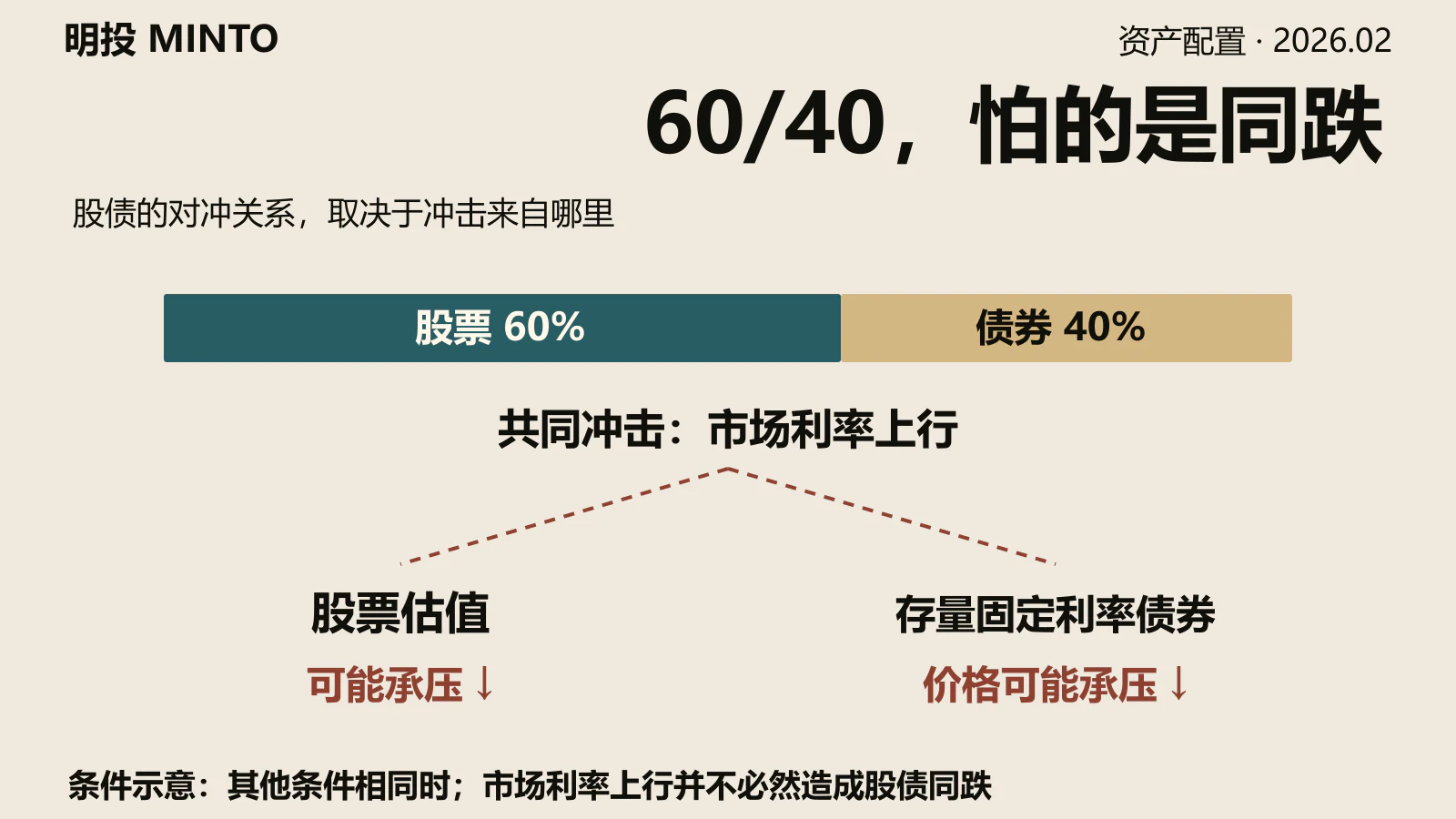
Inflation scare (e.g., 2022, the 1970s): People fear runaway inflation, central banks are forced to hike aggressively; interest rates surge, bonds get crushed (bond prices move opposite to rates). Higher rates also compress equity valuations, so stocks fall too. Stocks and bonds both go down — the 60/40 fails.

That's the truth of 2022 — The 60/40 portfolio isn't dead. What died is the assumption that stocks and bonds are always negatively correlated. And that assumption only held in one kind of weather: low inflation.

3. The Forgotten Truth: Negative Correlation Is a Recent Phenomenon

Here's a fact most people have forgotten: Stock-bond negative correlation, in the long history of finance, is actually a relatively rare, recent phenomenon.

If you stretch your horizon to 100 years, you'll find that for long stretches, stocks and bonds were positively correlated (moving up and down together). The stable "negative correlation" that most investors rely on mostly appeared in the 30 years from 1990 to 2020 — a special era of persistently falling inflation and declining interest rates.

In other words — The golden age of the 60/40 rode on a unique macro backdrop: 40 years of falling inflation + a bond bull market. In that environment, bonds provided both income AND a hedge. Perfect.

But our generation of investors made a classic mistake (remember "This Time Is Different," remember Durant's "history rhymes"): We mistook a 30-year special case for an eternal law. We assumed stock-bond negative correlation was an iron rule of finance, but it was actually just a product of a specific era.

When that era ended (inflation returning, interest rates no longer in a one-way decline), the magic of the 60/40 was diminished.

4. So, Should We Still Use the 60/40?

At this point, you might think I'm going to say "ditch the 60/40." No.

For the vast majority of ordinary investors, the 60/40 (or something like it) is still a reasonable starting point. Its core wisdom — "use a stable asset to buffer stock volatility" — is not wrong. What's wrong is thinking that bonds are the only, and eternally effective, buffer.

My view is — The 60/40 shouldn't be abandoned; it should be upgraded. How?

First, break up that 40% bonds and don't pile it all into long-duration Treasuries. A huge part of the 2022 disaster came from long-term bonds (the longer the duration, the more sensitive to rising rates, the worse they crash when the Fed hikes). Replace some of the fixed income portion with short-term bonds (immune to rate hikes) or cash / money market funds — they sacrifice a bit of yield, but in a rising-rate environment they're rock solid.

Second, add "inflation-hedging" assets. Since bonds fail in an inflation scare, you need other things to defend against inflation — gold, TIPS (Treasury Inflation-Protected Securities), some commodities, real assets. These are often the only things that hold up in an environment where stocks and bonds both fall. An upgraded version might be something like "60% stocks + 25% bonds + 15% inflation hedges."

Third, treat cash as a formal allocation, not just a residual. Cash isn't just "money that hasn't been invested yet." It's a strategic asset — its option value of "don't have to sell in a panic + ready dry powder for crises" is extremely valuable in turbulent times (I'll write a dedicated piece on "cash as an option").

The core idea of the upgrade: Don't put all your defense into bonds alone; use multiple complementary defensive assets to handle different kinds of crises.

5. Where I Differ From the Mainstream: Don't Deify Any Single Hedge

The mainstream reactions have split into two extremes — one camp says "the 60/40 is dead, abandon it," the other says "2022 was a fluke, stay the course."

I disagree with both.

Those who say "the 60/40 is dead" are overreacting. One bad year doesn't invalidate an internally logical framework. The core wisdom — "use a stable asset to buffer stocks" — is still sound. Calling it completely broken after a single failure is being hijacked by a recent event (remember Kahneman — recency bias).

Those who say "stay the course" are making a different mistake: clinging to a fixed formula when the world changes. They haven't understood that the 60/40's effectiveness depended on a specific macro backdrop (low inflation). When the backdrop changes, sticking to the original recipe is mistaking "a product of an era" for "eternal truth."

My position is in the middle — understand the wisdom of the 60/40 (using complementary assets as buffers), but shed its dogma (that bonds are the only, eternal buffer).

This is actually a broader allocation principle — Don't deify any single hedging tool. Bonds fail. Gold fails. Cash is eroded by inflation. No single asset can hedge every crisis. True defense comes from a portfolio of multiple complementary assets, each of which works in a different kind of crisis. This echoes what I said in the opening post: Don't predict which crisis will come; instead, have a defense ready for each.

6. 60/40 vs. All-Weather: Two Answers Beyond Stocks-and-Bonds

Interestingly, Ray Dalio's "All-Weather Portfolio" is essentially a response to the inadequacy of the 60/40.

The 60/40 says: stocks + bonds are enough. All-Weather says: not enough — you need gold, commodities, and risk-parity weighting instead of dollar-based allocation.

But ironically — All-Weather also suffered a big drawdown in 2022. It also had heavy bond exposure (just leveraged and with more asset classes) and likewise got hit by the combo of "stocks and bonds both falling + rate hikes."

This shows something deeper — 2022 didn't just slap the 60/40; it slapped every portfolio that had been optimized for the past 40 years of low inflation. The 60/40, All-Weather, risk parity — they were all children of the "low inflation + falling rates" era, so they all stumbled at that era's conclusion.

I'll dedicate the next piece to dissecting All-Weather specifically. For now, one key note — The shared lesson is: any allocation that is "optimized" to perfection for a particular era will reveal its fragility when that era ends.

7. In Closing

The story of the 60/40 is a story about assumptions.

It dominated for 40 years not because it was an eternal truth, but because it happened to ride a macro environment that was extremely friendly to it — falling inflation, a bond bull market, negative stock-bond correlation. In that era, it was nearly a free lunch.

Then the era shifted. Inflation returned, interest rates stopped their one-way decline, and the assumption that propped it up wobbled. In 2022, it made believers feel the pain for the first time.

But the 60/40 isn't dead. What died is the illusion that it would always work.

The lesson for all investors goes far beyond the 60/40 itself — Every portfolio you rely on to sleep well rests on an assumption you may not even be aware of. And that assumption may only hold in a specific environment.

Real wisdom isn't finding a "forever" formula (it doesn't exist) — it's knowing under what conditions your portfolio works, under what conditions it will fail, and having a plan for the day it fails.

What the 60/40 taught me isn't the specific ratio of 60/40. It's something deeper — No formula lasts forever. Only eternal vigilance lasts: What is my assumption? When will it be wrong? What will I rely on then?

If you can answer those three questions, you won't be caught off guard by the next "2022" — blindsided by the very portfolio you thought was safest.

That's the most valuable thing the 60/40's slap left us.

And it's the question this allocation series will ask again and again — next up: All-Weather.

Minto
明投 Minto
投资分析 · 长期主义者

专注投资分析、市场洞察与资产配置。不追短期波动,只理解真正驱动长期回报的东西。

你读完了 · Colophon

The 60/40 Portfolio Isn't Dead—Its Assumption Is

8
分钟
2026/02
期号
2026
年份
真正稀缺的,是一个不慌不忙的人。
明投 · MintoInvest Wisely
— From This Series
喜欢这篇?这类 资产配置 的深度拆解会持续发到你邮箱。
无广告 · 随时退订
— Enjoyed the read?
如果这篇文章对你有用,把它分享给一个朋友,就是对我最好的支持。

口碑是独立创作者最稀缺的燃料。

— Discussion

说说你的想法

评论基于 GitHub Discussions(Giscus)。登录后即可留言、点赞、互相讨论。

评论还在准备中。

想说什么可以直接发我邮件,比在评论区更容易认真回复。

mingtaohuang617@gmail.com →
支持沉浸式阅读