跳到正文 · Skip to content
内容
关于与合作
订阅与会员
★ 查看会员权益
外观与设置
外观
主题色
版本 · 深色 / 减动搜索⌘K
草稿预览·这篇还没发布,不会出现在列表和 RSS 里。review 完后把 frontmatter 的 draft: true 改为 false 即可。

The 30-Year Portfolio: Designed for a Generation

If your portfolio needs to last 30 years — or even be passed down to the next generation — then all the questions like 'what to allocate this year?' or 'who to favor next year?' become irrelevant. The only question is: can it survive on its own when you're no longer around?

2026.03.0310 min原创
The 30-Year Portfolio: Designed for a Generation
资产配置MINTOVIEW2026.03.03

The Asset Allocation series, final installment of the execution layer. For the overarching framework, see the master outline. All previous articles operated on time scales of "a few years to perhaps a decade." This one stretches it to the extreme — 30 years, a generation.

1. When the Time Scale Becomes 30 Years, Everything Changes

All the discussions earlier in this series — 60/40, rebalancing, cash allocation, gold weighting — implicitly assumed a time horizon of "a few years to a decade or so."

But in this piece, I want to run a thought experiment — what if your portfolio needs to span 30 years, or even be handed down to the next generation?

This isn't idle speculation. A lot of people's money is essentially on this scale — retirement savings that won't be touched for 30 years, money set aside for children (to be passed down), or family wealth meant to endure across generations. The time horizon here is far beyond the "few years" we normally talk about.

And once you stretch the time scale to 30 years, almost all the "short-term questions" become noise

"What should I allocate this year?" "Is now a good time to buy?" "Which sector will be strongest next year?" — on a 30-year scale, these are all noise. Over 30 years, there will be 7 or 8 bull-bear cycles, countless crises, several "game-changing" new technologies, and possibly wars and institutional shifts. Any clever call you make this year will barely leave a trace in the torrent of 30 years.

A 30-year time horizon forces you to ask a completely different question — not "what's the best allocation now," but "what kind of portfolio can survive on its own — even when I may not be around to manage it, or even when I'm no longer alive?"

This is a question about resilience and legacy, not about return maximization.

2. What Changes and What Doesn't Over 30 Years

To design a portfolio that can last 30 years, you first need to think clearly about — what will change over 30 years, and what won't? (This is a perspective I borrowed from Chi Pang-yuan's The River of Big Water and Will Durant's The Lessons of History — those long-cycle views.)

What will change (don't bet on these) —

  • Specific companies: Over 30 years, many of today's greatest companies will likely decline or even disappear (recall Schumpeter's creative destruction, West's "companies die," and Wu Jun's "no forever at the peak of the wave"). Of the top tech companies in 1995, very few remain leaders today. So never stake a portfolio meant to last 30 years on any single company — no matter how invincible it seems today.

  • Specific sectors: Over 30 years, hot sectors will rotate countless times. Today's AI is like the internet in 2000 or oil in 1980 — all were once "game-changing" futures, but the specific winners and narratives will be unrecognizable after 30 years.

  • Relative rankings of countries: 30 years is enough to shift the relative standing of nations (remember the overseas piece — Japan in 1989). Today's strongest market may not be in 30 years.

What won't change (build your portfolio on these) —

  • Human nature: Greed, fear, cycles — these remain constant over 30 years (recall Durant's "history rhymes" and Graham's "good books are about unchanging human nature"). So principles like "contrarian, rebalance, don't be ruled by emotion" will work for 30 years.

  • Equities as an asset class tend to rise over the long term: Even though specific companies die, the trend of "human productivity and innovation moving upward" is likely to hold over 30 years in the absence of civilization-level catastrophe (recall Siegel's 200-year data). So the broad direction of "holding a wide basket of equities" works for 30 years — but only if it's "broad" (an index), not "any specific company."

  • The value of diversification and resilience: Over 30 years, crises are inevitable, so a structure that "cannot be destroyed by any single disaster" will always be valuable (the core of the master outline).

Separate what changes from what doesn't, and the design principle for a 30-year portfolio becomes clear — don't bet on anything that changes (specific companies, sectors, countries); build the portfolio on everything that doesn't change (human nature principles, broad equities, diversification and resilience).

3. What a Portfolio That Can Live on Its Own Looks Like

Based on the above, a portfolio that can last 30 years and "live on its own" has several features —

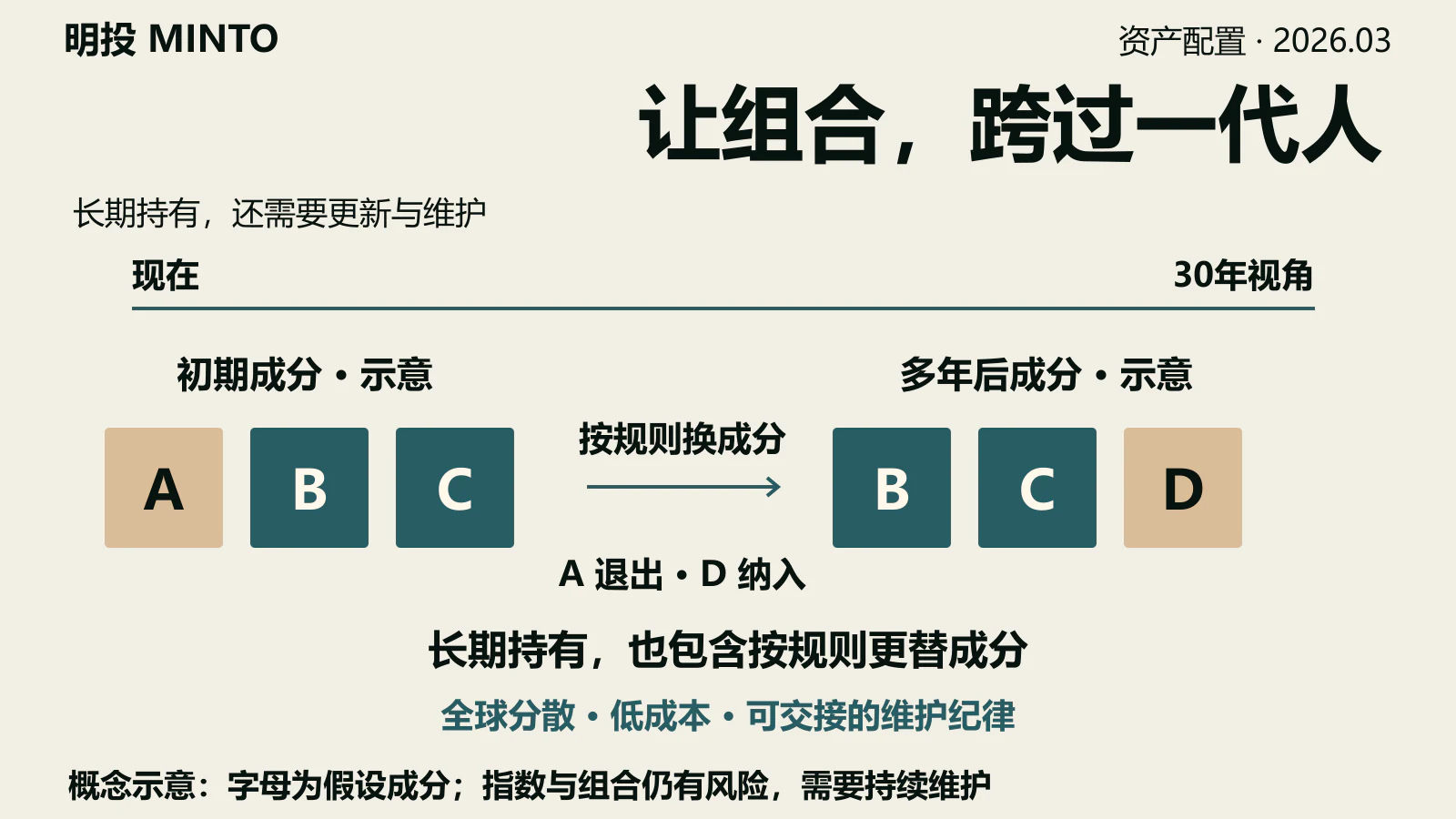
First, it must be built around broad-based indices, not individual stocks. The reason is as stated — stocks die, but indices have a self-renewal mechanism (recall "Why the Core Is a Broad-Based ETF"). A 30-year portfolio must be anchored in an index that automatically eliminates losers and includes new winners, not any specific company (even today's Mag 7). Because 30 years from now, today's giants may not be around, but the index will still be there — and it will hold the new giants you haven't even heard of yet.

Second, global diversification, not a single-country bet. 30 years is long enough to change the relative status of countries. A portfolio meant to last a generation should not be all-in on any single country (including the U.S.) — recall the overseas piece, Japan 1989. It needs a non-U.S. allocation as a hedge against the possibility that "American exceptionalism" may fade over 30 years.

Third, a small allocation to "non-system" assets as an end-of-the-world insurance. Over 30 years, currency debasement and systemic turmoil are likely (history proves it repeatedly). A long-term portfolio needs a small chunk of gold (and perhaps a bit of bitcoin) as a hedge against a collapse of trust in money and the system (recall the gold piece). It will drag on the portfolio in normal times, but in the "worst moment" over 30 years, it's what you have left.

Fourth, extreme simplicity with minimal required operations. A portfolio meant to last 30 years and be passed down to a generation that may not understand investing must be simple enough for a layperson to maintain. A complex portfolio requiring frequent judgment calls will collapse when you're not around. The best 30-year portfolio is one that "you set up, then only need to mechanically rebalance once a year, and do nothing else" — simple, mechanical, automatic, and resilient.

Fifth, ultra-low costs. Over 30 years, compounding is the most brutal force against fees (recall the cost piece — a 2% fee difference over 30 years eats nearly half your wealth). A 30-year portfolio must minimize costs: low-fee indexes, minimal trading, tax-efficient long-term holding. At a 30-year scale, every basis point saved is enormous compounded wealth.

Put these five points together, and a portfolio that can last 30 years looks roughly like this — a core of global broad-based indices (self-renewing + globally diversified) + a slice of non-system assets as end-of-the-world insurance (gold/bitcoin) + a stable cushion (cash/short-term bonds). The structure is extremely simple, costs are rock-bottom, and you only need to mechanically rebalance once a year.

It's not sexy. It won't make you rich overnight. It won't outperform any hot sector in the short run. But it can do one thing that is much harder — survive on its own through all the storms of 30 years.

4. Where I Differ from the Mainstream: The Goal of a Long-Term Portfolio Is Not "Maximization," but "Indestructibility"

The mainstream discussion of long-term investing is almost always about "how to maximize long-term returns." I believe that for a portfolio truly meant to last 30 years and be passed down, the goal should not be "maximization" at all — it should be "indestructibility."

Why? Because — on a 30-year scale, "avoiding catastrophic mistakes" is far more important than "earning an extra few percentage points" (recall Taleb, recall ergodicity — one blowout and it's over).

A portfolio pursuing "maximization" over 30 years often makes choices that boost expected returns but increase the risk of ruin — going overweight on the hottest sector, using leverage, concentrating bets. These will make it run faster most of the time, but they raise the probability of being completely wiped out in a crisis. And for a portfolio that must survive 30 years and 7-8 bull-bear cycles, if it gets destroyed just once (especially when you're not around, or when it's inherited by a panic-prone descendant), the entire 30 years of compounding goes to zero.

So what a 30-year portfolio should truly pursue is — "indestructibility": it doesn't have to be the fastest, but it must be "the one that cannot be destroyed no matter what happens over 30 years." It sacrifices some upside potential in exchange for the resilience to get through everything.

This is exactly the core of the master outline, but stretched to the extreme — don't predict what will happen over 30 years (it's impossible), instead construct a structure that "can survive no matter what happens." A 30-year allocation is the ultimate exercise in being anti-fragile.

5. The Dimension of Legacy: Beyond the Portfolio, What Else to Pass Down

Finally, one dimension that goes beyond the "portfolio" itself but is critical to "lasting 30 years" — if you want to pass wealth to the next generation, you shouldn't just hand over a portfolio. You should also hand over the wisdom to maintain it.

This is what Chi Pang-yuan's The River of Big Water taught me — what truly passes through turmoil and lasts across generations is often not tangible wealth (which can be lost in war, inflation, or squandering), but intangible capabilities and wisdom (in that story, her father didn't take gold or silver when fleeing — he took books, and those books became the spiritual seed for generations).

A portfolio passed to a descendant who knows nothing about investing and will panic-sell at the first crash will be destroyed no matter how perfect the portfolio is. So what "lasting 30 years" really requires passing down are two things —

First, the extremely simple, resilient portfolio (described above). It must be so simple that a layperson can maintain it without messing it up.

Second, and more importantly, the underlying "mindset" behind the allocation — why diversify, why not panic-sell during a crash, why hold for the long term, why rebalance, why not predict. This mindset is even more worth passing down than the portfolio itself. The portfolio may need to be adjusted over time (the specific tools and environment will change in 30 years), but the mindset (the wisdom from the master outline of "preparing for all futures") is timeless.

A fortune that truly lasts 30 years is "a resilient portfolio + an unchanging mindset." The former is the skeleton, the latter is the soul. Handing down only the skeleton without the soul will eventually destroy the portfolio in the hands of someone who doesn't understand it.

6. Final Thoughts

Stretching the time scale to 30 years is a humbling exercise.

In the face of that 30-year torrent, the things we fret about daily — this month's ups and downs, what to allocate this year, whether now is the right time — all look petty and ridiculous. Over 30 years, there will be so many crises, so many "game-changing" new things, so many moments of panic or euphoria. Any clever call you make today will barely leave a trace in that river.

But precisely this humility allows what truly matters to emerge — not "can I bet right on the future" (on a 30-year scale, you will be wrong many times), but "can I construct a structure that can survive on its own, no matter how many times I'm wrong and how the world changes?"

That is what asset allocation looks like at the longest time scale — not prediction, but resilience; not maximization, but indestructibility; not cleverness, but simplicity so pure that it can be passed down to the next generation.

Chi Pang-yuan's family spent a lifetime flowing from the Big River in Liaoning to Taiwan. That river flowed through war, exile, turmoil, poverty — and what truly traversed all of it and was passed down was not any specific wealth, but something "slow, resilient, and capable of living on its own."

A portfolio that can last 30 years pursues exactly the same — not to win in any given year, but to win by surviving all the years.

And its secret is not in any clever judgment, but in the simplest phrase from the master outline —

Do not predict the future, but prepare for every possible future.

Stretch that phrase to 30 years, to a generation, to the time when you are no longer present — and it becomes the entire design philosophy of a portfolio that can live on its own and be passed down.

This concludes the execution layer. The final layer — the risk layer — will confront the core of allocation's defensive side: drawdowns, false diversification, sequence risk, and leverage. First up: the drawdown you can tolerate determines how much equity you should own.

Minto
明投 Minto
投资分析 · 长期主义者

专注投资分析、市场洞察与资产配置。不追短期波动,只理解真正驱动长期回报的东西。

你读完了 · Colophon

The 30-Year Portfolio: Designed for a Generation

10
分钟
2026/03
期号
2026
年份
真正稀缺的,是一个不慌不忙的人。
明投 · MintoInvest Wisely
— From This Series
喜欢这篇?这类 资产配置 的深度拆解会持续发到你邮箱。
无广告 · 随时退订
— Enjoyed the read?
如果这篇文章对你有用,把它分享给一个朋友,就是对我最好的支持。

口碑是独立创作者最稀缺的燃料。

— Discussion

说说你的想法

评论基于 GitHub Discussions(Giscus)。登录后即可留言、点赞、互相讨论。

评论还在准备中。

想说什么可以直接发我邮件,比在评论区更容易认真回复。

mingtaohuang617@gmail.com →
支持沉浸式阅读