1. A Book That Tries to Answer an Ultimate Question
In 2012, Daron Acemoglu and James Robinson co-authored Why Nations Fail. The book is over 600 pages and tries to answer economics' biggest question — why some countries are rich and others poor, and why this gap has persisted for centuries.
In 2024, Acemoglu won the Nobel Prize in Economics, largely for this book and the research that followed.
The answer the book gives is one word — institutions.
Acemoglu proposes a dichotomy: inclusive institutions vs. extractive institutions.
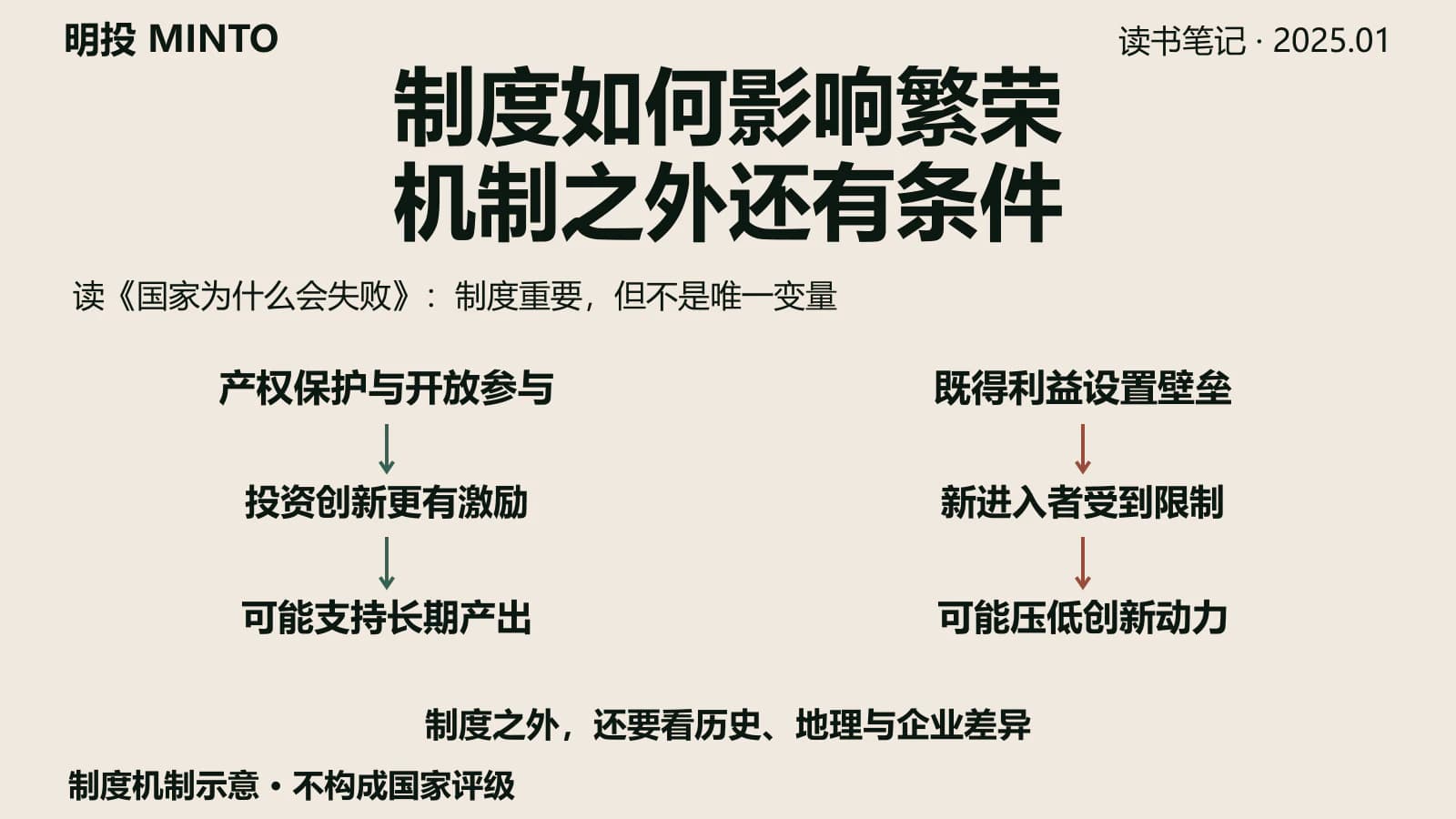
Inclusive institutions allow most people to participate in the economy and politics, property rights are protected, creative destruction can happen, and innovation is rewarded. Under such institutions, a country will flourish.
Extractive institutions benefit only a small elite, exploit everyone else, fail to protect property rights, and suppress innovation. Under such institutions, a country stagnates.
Acemoglu uses this single framework to explain everything from North Korea vs. South Korea, to Latin America vs. North America, to different Chinese dynasties — he claims it's all determined by the variable of 'institutions.'
This methodology of 'one variable explains everything' is worth deconstructing. Where it's right and where it's wrong is what I kept thinking through as I reread the book.
2. The Most Powerful Core: Creative Destruction Needs Institutional Protection
The part of this book I find most convincing is not the dichotomy itself, but its emphasis on 'creative destruction.'
Schumpeter introduced 'creative destruction' in 1942 — the essence of economic growth is the new constantly destroying the old. New firms replace old firms, new technologies replace old ones, new models replace old ones. The stronger the creative destruction, the faster the economic growth.
Acemoglu's core argument is — creative destruction needs institutional protection.
Why? Because creative destruction harms incumbents. The rise of new companies means the death of old ones, hurting the old companies' owners, employees, and suppliers. If old companies can use political power (bribery, lobbying, monopoly licenses, regulatory capture) to block new companies, creative destruction is suppressed.
So whether a country can long-term prosper is essentially about whether its institutions allow 'losers' to fail. This sounds counterintuitive — protecting losers sounds like a good thing, right? But Acemoglu says protecting losers means killing winners — and all economic growth comes from winners.
This is extremely important for investing. If a country protects losers (zombie firms, state-owned enterprises, politically connected firms), its stock market's long-term returns will be suppressed — because the most creative companies are blocked by the old guard.
Compare the U.S. and Europe over the past 30 years — the U.S. allowed Lehman to collapse, General Motors to go through bankruptcy restructuring, Sears to die, Blockbuster to disappear; Europe long protected its domestic giants from external disruption. The result is that the U.S. stock market outperformed Europe by about 5 percentage points per year for 30 years. This has nothing to do with GDP growth and everything to do with 'whether failure is permitted.'
3. The Two Best-Confirmed Cases: North Korea vs. South Korea, Nogales vs. Nogales
Acemoglu uses two paired comparisons that make his 'institutions thesis' stand firmest.
First, North Korea vs. South Korea. The two countries were nearly identical at the end of the Korean War in 1953 — same ethnicity, same language, same culture, same initial economic level. But 70 years later, South Korea's GDP per capita is over 30 times that of North Korea, and night satellite images show North Korea nearly dark.
The difference is just one variable — institutions. South Korea chose market economy + democratic transition, North Korea chose authoritarianism + planned economy. The same people, under different institutions, produced a 30x difference in outcomes.
This is the strongest evidence for Acemoglu's method. No cultural, geographical, genetic, or religious theory can explain this gap — because the relevant variables are all controlled. Only the institutions thesis can.
Second, the twin towns on the Mexico-U.S. border. Nogales, Arizona, and Nogales, Mexico, were originally one city split by the border. Both sides have the same race, language, culture, geography, and climate. But the U.S. side has three times the per capita income of the Mexican side, a life expectancy ten years longer, and half the crime rate.
The difference is again institutions — property rights, rule of law, education spending, political accountability.
Put these two cases together, and Acemoglu's argument is almost irrefutable. When all other variables are controlled and only institutions differ — the outcome gap is an order of magnitude.
4. The Most Controversial Argument: China Will Fail
When this book was published in 2012, one chapter caused huge controversy — Acemoglu directly predicted that China's high growth was unsustainable because it was built on extractive institutions.
His logic is that China's growth came from learning Western technology + cheap labor + government-led investment. These engines can fuel growth during the 'catching-up' phase, but once China needs to rely on innovation, extractive institutions become an obstacle — because innovation requires 'allowing failure,' 'protecting property rights,' and 'freedom of expression,' which are impossible under extractive institutions.
13 years later. Was this prediction correct?
Partly right, partly wrong.
Right part — China's high-speed catch-up indeed slowed significantly after 2015. GDP growth dropped from 10%+ to 5%, and in 2024 even approached 4%. Some industries (internet, gaming, education) were heavily regulated, directly confirming Acemoglu's argument that 'extractive institutions limit creative destruction.' The collapse of China's real estate market was essentially a failure of the 'no failure allowed' system — zombie developers were protected too long and eventually blew up together.
Wrong part — China still caught up with or even overtook the U.S. in some frontier areas. EVs, power batteries, solar energy, commercial space, open-source AI models (DeepSeek) — these are not simply 'learning from the West'; they are genuine original innovation. Acemoglu's method cannot explain why China still produced these innovations under 'extractive institutions.'
My own judgment is — Acemoglu's method works at the 'whole' level but fails at the 'sector' level. China's overall innovation efficiency is indeed lower than the U.S., but in certain sectors selected by national strategy (new energy, chips, AI), China can concentrate resources and become very strong. This pattern of 'breakthroughs in points + stagnation across the board' cannot be handled by Acemoglu's dichotomy.
5. Where I Differ from Acemoglu
By the third reading of this book, I began to have several real disagreements.
First, he underestimates the role of 'culture' and 'geography.'
Acemoglu uses the single variable of 'institutions' to explain almost everything. But some things 'institutions' cannot explain.
Singapore and Malaysia both became independent from British colonies with similar initial institutions, but outcomes are vastly different. Acemoglu says it's because Singapore later chose inclusive institutions — but he doesn't explain why Lee Kuan Yew could build such institutions in Singapore while Mahathir could not in Malaysia. 'Institutions being built' itself requires culture and leadership — Acemoglu skips this step.
Geography, too. The success of Nordic countries is related to their low population density, abundant natural resources, and relatively homogeneous population structure. Acemoglu attributes all of this to 'institutions,' but the causal direction may be reversed — geography and culture first gave Nordic people a 'cooperative tradition,' and only then did they build inclusive institutions.
Second, he has almost no theory of 'institutional change.'
Acemoglu describes 'inclusive institutions good, extractive institutions bad,' but he barely says 'how extractive institutions become inclusive.' This is the biggest blind spot in the book.
Very few countries in history have completed this transformation — mainly Britain (Glorious Revolution), the U.S. (War of Independence), Nordic countries, Japan (post-war reform), South Korea (1980s democratization). These transformations basically required some kind of 'external shock' — war, revolution, occupation. Without an external shock, extractive countries almost always remain extractive.
Acemoglu cannot answer — how does an ordinary extractive country peacefully become inclusive? Lacking this, his entire theory is 'telling you the conclusion but not the path.'
Third, he does not distinguish between 'corporate institutions' and 'national institutions.'
Acemoglu talks entirely about national-level institutions. But the real actors in economic activity are companies, and a company's internal institutions can differ sharply from national institutions.
An extractive country can have inclusive companies (Samsung in Korea, TSMC in Taiwan, Tata in India) — these companies internally allow innovation, protect talent, and reward output. They can still become world-class companies within extractive national soil.
Conversely, an inclusive country can have extractive companies (some oligopolistic U.S. firms, some European state-owned enterprises) — these companies are internally bureaucratic, protect incumbents, and suppress innovation.
So 'investing in a country' and 'investing in a company' can be two different things. Acemoglu doesn't distinguish this, but it is critical for investors.
Fourth, his framework partially fails in the 'platform economy' era.
Acemoglu's 'inclusiveness' mainly refers to political and economic participation rights. But after the 2010s, real economic power has increasingly concentrated in a few tech platforms — Google, Apple, Meta, Amazon, Microsoft, Nvidia.
In the 'platform era,' so-called 'inclusive institutions' increasingly look like an illusion — you seem to have entrepreneurial freedom and market participation rights, but in reality 80% of e-commerce must go through Amazon, 70% of advertising through Google, 90% of high-end phones through Apple's App Store. The actual concentration of economic power already exceeds that of any historical extractive state.
Acemoglu cannot handle this state of 'formally inclusive but substantively concentrated.' His dichotomy fails here.
6. Acemoglu vs. Ray Huang: Two Clashing Views of History
Reading Acemoglu inevitably invites comparison with Ray Huang's 1587, a Year of No Significance. Both try to answer 'why some societies fail,' but their methodologies are almost completely opposite.
Acemoglu is 'institutional determinism' — one variable explains everything. Ray Huang is 'management-by-numbers determinism' — he believes traditional Chinese society failed because it could not 'manage the country by numbers' and relied only on morality and personal connections.
Both essentially point to the same thing — a good society needs a 'quantifiable, accountable, correctable' system. Acemoglu calls this system 'inclusive institutions,' Ray Huang calls it 'management by numbers.' Two descriptions, different sides of the same mountain.
But Ray Huang's perspective is more nuanced than Acemoglu's — he describes how a society slowly builds this system through culture, technology, and organizational capacity, not just 'choosing which institution.'
My own posture when reading history is — use Ray Huang to see 'why,' use Acemoglu to see 'what.' Reading both books together, you can see both the conclusion and the path.
7. Implications for U.S. Equity Investing: How Much of the U.S. 'Inclusiveness Dividend' Remains?
If Acemoglu is right, then for long-term U.S. equity investors, the real core question is — are America's inclusive institutions still intact?
At the beginning of 2025, I made a 'U.S. Institutional Health Checklist' using Acemoglu's criteria:
Still inclusive — property rights (rule of law still strong), entrepreneurial freedom (VC ecosystem still #1 globally), immigration absorption (STEM talent still flows in), capital markets openness (IPO market still the deepest in the world).
Deteriorating — political polarization (declining policy continuity), regulatory uncertainty (tech antitrust / AI regulation swings), debt sustainability (federal debt/GDP already 120%), educational inequality (gap between elite universities and general education widening), trade openness (tariffs returning).
My judgment is — America's inclusive institutions still exist, but the dividend is thinning. This does not mean shorting U.S. stocks; it means the return on 'unquestioning long-term holding of U.S. ETFs' is likely to be a notch lower than the last 40 years.
Judged by Acemoglu's method, the U.S. remains one of the strongest institutional countries in the world — which is why my core position is still 70% in U.S. stocks. But 'the institutional dividend is gradually thinning' is also true — which is why I started to allocate about 20% of my periphery to some non-U.S. assets (Europe + Japan + EM ETFs) as a geographic hedge.
8. On the Over-Mythologizing of 'Institutionalism'
Last section — the thesis 'institutions determine everything' has been mythologized beyond its original meaning.
After reading Acemoglu, many people apply the 'institutions lens' to any national difference and 'corporate governance lens' to any firm difference. This usage is wrong — it turns a powerful but incomplete tool into a master key.
True use of institutional theory should be 'after controlling for other variables, how much does institutions explain? When other variables (culture, geography, historical path, leaders) differ significantly, 'institutionalism' cannot be directly applied.
Acemoglu himself actually knows this — but as the proposer of the methodology, he has an incentive to overemphasize institutions' explanatory power. The reader's job is to treat this method as one of many tools, not the only tool.
9. In Closing
Why Nations Fail is a great book. It gave the 21st century one of the most powerful frameworks for analyzing countries. Acemoglu's Nobel Prize is well deserved.
But 'great' does not equal 'complete.' This book provides a sharp knife, but that knife cannot cut every kind of meat.
My biggest takeaway from reading this book is not its explanation of nations, but the posture it teaches me to approach problems — find a core variable, see how much it can explain; then admit what it cannot explain, and look for other variables.
This 'main variable + residual' way of thinking is extremely useful in investing.
But use it too glibly, and you'll end up cramming everything into one variable — that is the temptation of any strong methodology.
Read Acemoglu to learn his tools, not to fall into his biases.
After all, he himself admits — the explanatory power of the word 'institution' may be smaller than he claims. He says this in academic papers, but not in popular books.
That is the most subtle thing about this book.
专注投资分析、市场洞察与资产配置。不追短期波动,只理解真正驱动长期回报的东西。