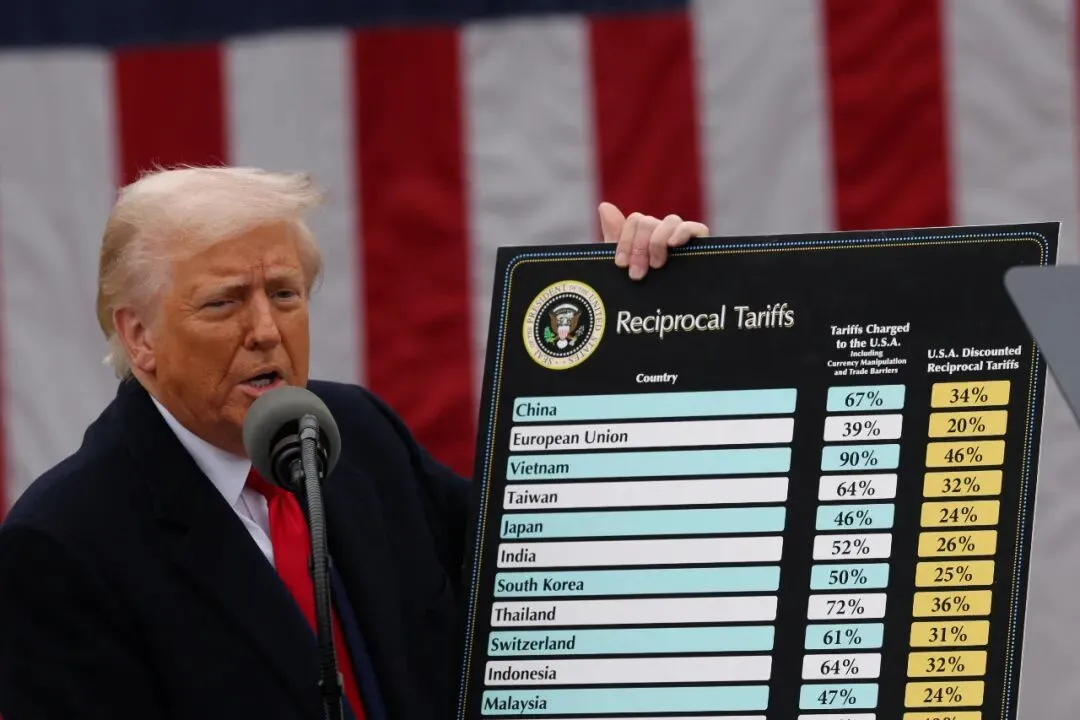
First, a summary of the tariff announcement. On Wednesday, April 2 at 3:00 PM ET (Thursday, April 3 at 3:00 AM Beijing time), Trump unveiled his "reciprocal tariff policy," including a 10% baseline tariff on goods from most countries and additional tariffs on specific nations. At a White House Rose Garden event, Trump displayed a poster listing country-specific tariffs: 34% on China, 20% on the EU, 46% on Vietnam, 32% on Taiwan, 24% on Japan, and more. The administration said these tariffs aim to boost U.S. manufacturing and encourage industrial reshoring to create jobs. Trump argued tariffs would "supercharge" the domestic industrial economy, "open foreign markets and break down foreign trade barriers," ultimately leading to "lower consumer prices." While alcoholic products were not explicitly targeted, the baseline and country-specific tariffs could affect foreign-made alcohol, potentially triggering retaliatory tariffs on U.S. products like Kentucky bourbon. Trump stated, "They do it to us, and we do it to them." The tariffs were enacted via executive order. Trump believes they will "supercharge" the domestic industrial economy, "open foreign markets and break down foreign trade barriers," all leading to "lower consumer prices."
Pre-announcement expectations
Before April 2, markets and analysts were on high alert. Reports suggested tariffs could include at least a 20% universal rate, with a particular focus on autos—possibly 25% on imported vehicles (The Guardian). CNBC reported that media and advertisers sought flexible terms due to uncertainty, reflecting economic concerns. Trump had repeatedly mentioned "Liberation Day," hinting at overturning the existing trade system, with markets expecting inflation and trade war risks (Reuters).
Tariff details are in the table below:
The tariffs are expected to have far-reaching impacts on the U.S. and global economy.
According to latest reports, the tariff policy will have the following effects:
- Inflation pressure: Higher import prices will raise living costs, with U.S. households expected to spend thousands more annually (Reuters).
- Market reaction: U.S. stocks have lost nearly $500 billion since mid-February; futures fell further after the April 2 announcement (Reuters).
- Economic growth: A CNBC survey shows Q1 GDP growth at just 0.3%; tariffs may exacerbate stagflation risks, with analysts warning of rising recession probability (CNBC).
- Global impact: Fitch Ratings' Olu Sonola said this could upend most economic forecasts and, if sustained, trigger a global recession (Reuters). Trading partners like the EU and China may retaliate; European leaders expressed disappointment, and Italian PM Giorgia Meloni sought to avoid a trade war (Reuters).
- Political reaction: The U.S. Senate voted 51-48 to try to end tariffs on Canada, but the measure may not pass the House (Reuters). Democratic Rep. Gregory Meeks called it "the largest regressive tax" that would hurt working families.
Summary analysis
From an economic perspective, Trump's tariff policy reflects protectionism, aiming to boost U.S. manufacturing by raising import costs, consistent with his "America First" philosophy. However, economic theory (e.g., David Ricardo's comparative advantage) suggests free trade maximizes global welfare. Tariffs may protect domestic industries in the short term, but long-term:
- Consumer costs: Higher import prices pass through to consumers, increasing inflation and potentially reducing demand.
- Supply chain disruption: Global supply chains may adjust; some firms may shift production to Canada or Mexico to avoid tariffs, but initial costs rise.
- Trade war risk: Retaliatory tariffs could escalate into a trade war, reducing U.S. exports and harming global trade efficiency. Historical data shows protectionism often correlates with slower growth (e.g., Peterson Institute studies).
- Long-term impact: If sustained, the policy could push the U.S. toward autarky, reducing international competitiveness and increasing stagflation risk.
The "reciprocal" tariffs are not truly reciprocal; they place heavier pressure on China's semiconductors, EVs, and solar sectors. Dubbed "fair trade," they are in fact a precise blockade on various countries' goods.
Key References
- Trump announces sweeping tariffs on largest trading partners, upending decades of US trade policy https://www.theguardian.com/us-news/2025/apr/02/trump-new-tariffs-liberation-day
- Trump's 'Liberation Day': Tariffs to take immediate effect after announcement https://www.nytimes.com/live/2025/04/02/business/trump-tariffs-liberation-day
- Trump announces 10% tariff on all imports, with higher rates for some countries https://www.reuters.com/world/us/trump-escalate-global-trade-tensions-with-new-reciprocal-tariffs-us-trading-2025-04-02/
- Trump's upcoming tariffs 'will be effective immediately,' White House says https://www.cnbc.com/2025/04/01/trump-tariff-timeline-effective-april-2.html
- Fact Sheet: President Donald J. Trump Declares National Emergency to Increase our Competitive Edge, Protect our Sovereignty, and Strengthen our National and Economic Security https://www.whitehouse.gov/fact-sheets/2025/04/fact-sheet-president-donald-j-trump-declares-national-emergency-to-increase-our-competitive-edge-protect-our-sovereignty-and-strengthen-our-national-and-economic-security/

On investment analysis, market insight, and asset allocation — not chasing short-term noise, but understanding what truly drives long-term returns.