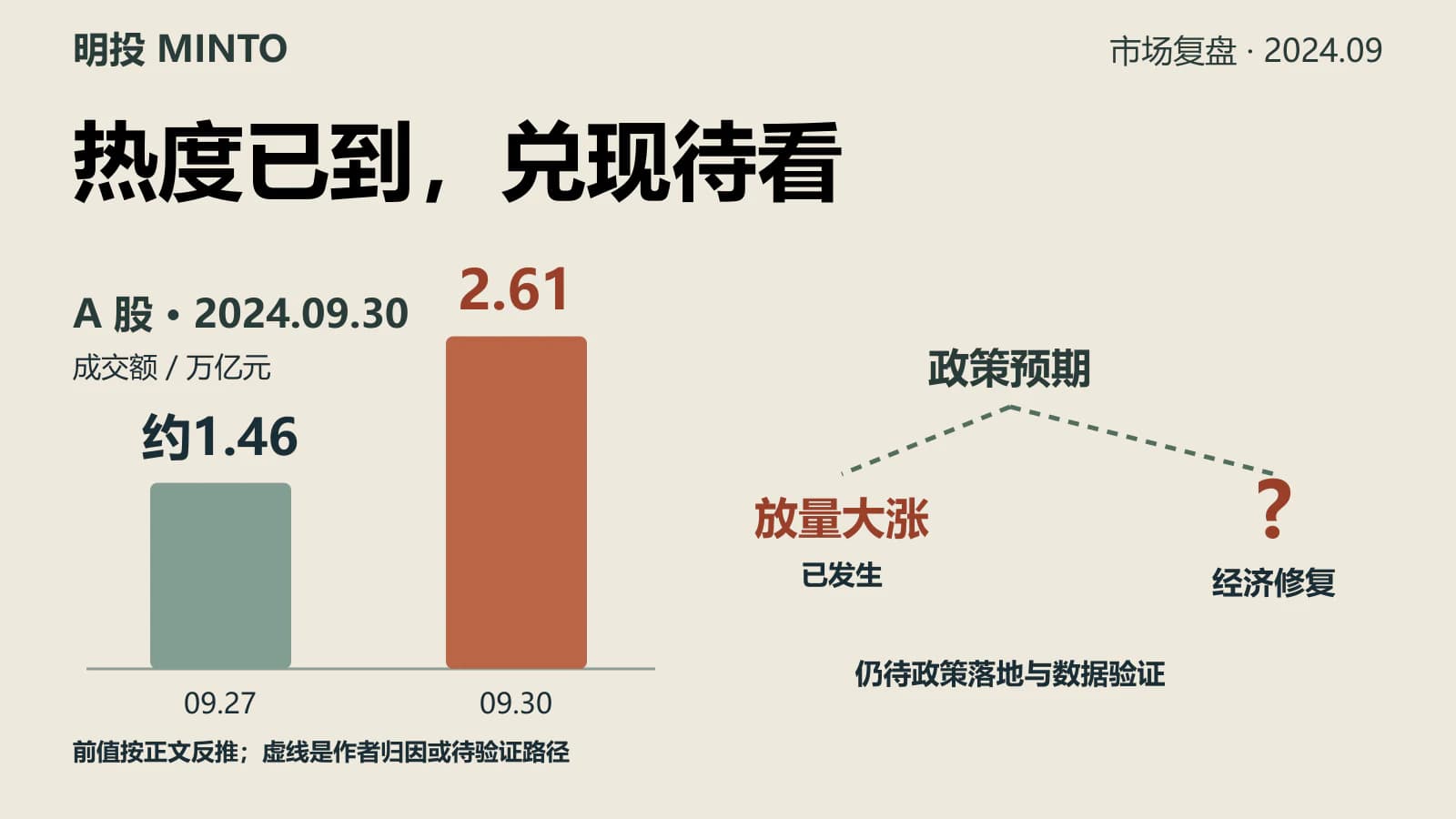
Last week, A-shares surged in their strongest weekly rally since 2008, driven by multiple policy stimuli. The ChiNext Index jumped 22.71% in a single week, a record, while the Shanghai Composite rose 12.81%, its biggest weekly gain since November 2008. On Friday, September 27, all three major indices rallied sharply: the Shanghai Composite approached 3,100 points, the ChiNext surged 10%, and total turnover exceeded 1.4 trillion yuan. In the previous article, PBOC新闻发布会和经济工作会议推出一系列刺激经济和资本市场强力措施, we summarized the key factors behind this rally.
This Monday, A-shares went even higher. Despite the upcoming National Day holiday and the fact that last trading day redemptions would not settle, market heat intensified: the Shanghai Composite rose over 8%, the Shenzhen Component over 10%, the ChiNext and STAR 50 over 15%, and the Beijing Stock Exchange 50 surged over 20%.
More than 30 sector ETFs, including securities, liquor, and semiconductor ETFs, hit the daily limit.
Volume and price rose together: A-share turnover expanded by 1.15 trillion yuan, reaching a total of 2.61 trillion yuan for the day, a record high and the first time since June 2015.
Other China-related assets:
Hang Seng Index turnover exceeded 450 billion Hong Kong dollars, a new all-time high, with total market turnover of 482.662 billion Hong Kong dollars.
The FTSE China 3x Leveraged ETF rose 53.2% over five trading days (not yet open today).
Ratings have also shifted from 'strong sell' to 'strong buy'.
The renminbi has appreciated over 4% in two months, and its rapid rise could attract foreign capital back into A-shares.
Is this FOMO or a reversal?
Many investors are rushing into the market out of FOMO (Fear Of Missing Out). When investors see others profiting or markets rising, they fear missing potential gains, creating anxiety or panic.
For the future trajectory of A-shares, we can look at two key factors: first, the heat and volume of incremental capital; second, the timeliness and intensity of subsequent policy measures.
Sources of incremental capital include:
- Number of new investor accounts
- Total market turnover and momentum
After conducting a full-market network test on September 29, the exchange scheduled another test for October 7. The September 29 test already simulated three times the volume of last Friday and twice the historical peak, yet another test is needed, indicating that the rally remains exceptionally hot and beyond expectations.
Reversal
Property Policy
Shanghai eased property policies: the VAT exemption period was reduced from 5 years to 2 years (no VAT for properties held over 2 years); for areas outside the Outer Ring Road, the social security contribution requirement for non-local families was reduced from 3 years to 1 year, treating them like local families; the down payment ratio for first homes was cut to 15%, and for second homes to 25%; the distinction between ordinary and non-ordinary housing standards was abolished.
Shenzhen also took significant steps.
Guangzhou announced the full removal of all purchase restrictions across the city.
Risk Warning:
In the short term, the market has risen sharply, accumulating massive profit-taking funds. As trading volume expands, market volatility increases, and the upward slope may flatten. However, as long as policy expectations remain, the market could still move higher. After the rapid rally in indices and heavyweight stocks, the market will likely enter a phase of divergence. We recommend focusing on policy-supported sectors and cyclical stocks with earnings visibility.
In the medium to long term, macro-wise, the Fed's rate-cutting cycle has begun, and global monetary easing is underway. Valuation repairs and risk appetite improvements could passively lift the overall level of Chinese equities. However, the impact of great-power competition and geopolitical conflicts must be monitored. From a policy perspective, the strength and effectiveness of policy implementation will determine market direction. After monetary policy easing and fiscal policy follow-through, whether they can positively repair economic growth and household balance sheets will be crucial.
Risk Warning: This content is for reference only and does not represent any investment advice. Markets are risky; invest with caution.
If interested, feel free to follow us!