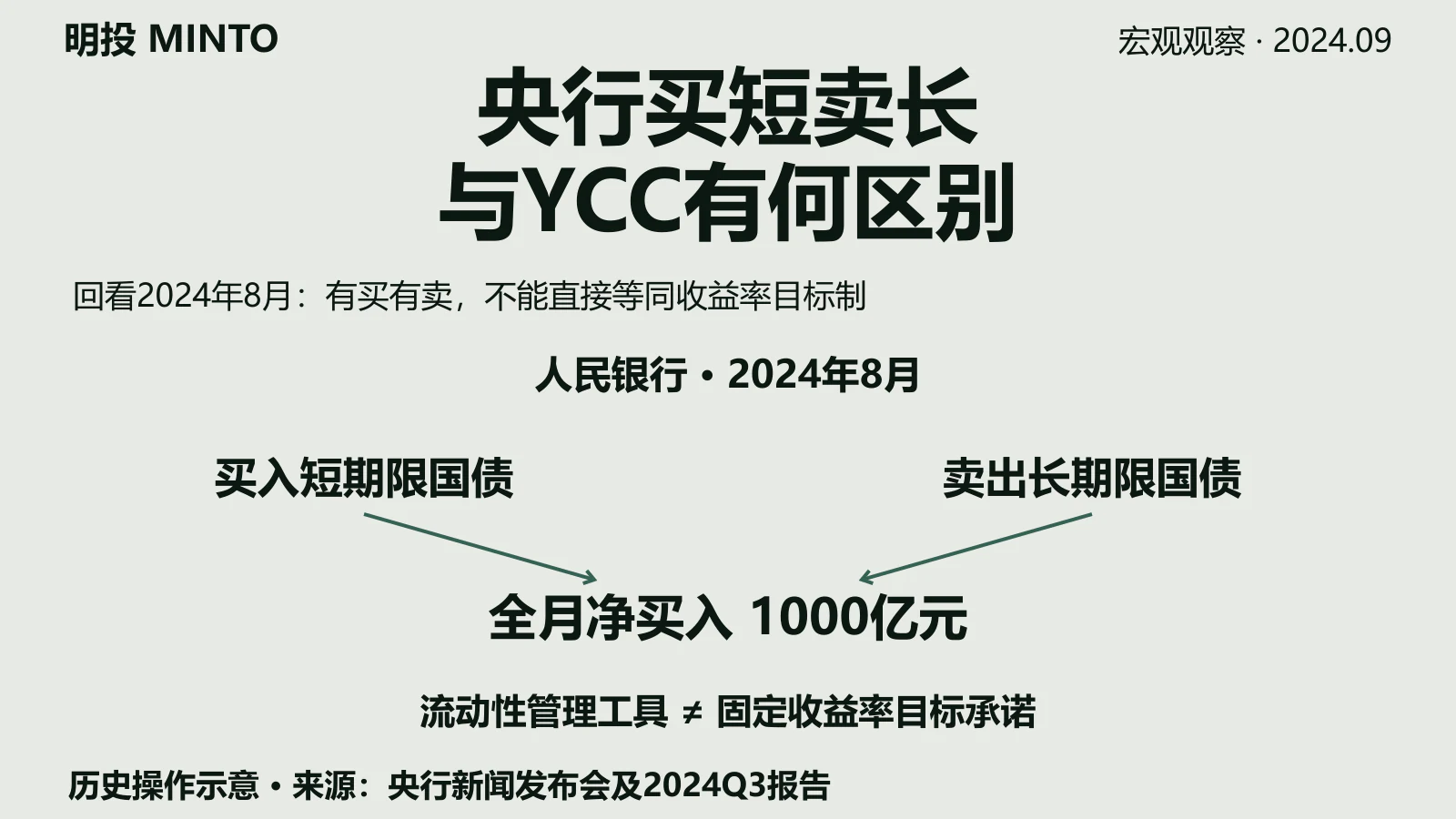
On August 28, the PBOC added a new column for 'Open Market Treasury Bond Trading Announcements' on its website. On August 30, it announced that in August, it bought short-term and sold long-term government bonds from primary dealers, with a net purchase of 100 billion yuan for the month. The market widely speculates that the net purchase of 100 billion yuan is to inject liquidity, while the 'buy short, sell long' operation inevitably reminds people of the YCC policy that just exited the stage. What is the connection?
(Source: Monetary Policy Department, People's Bank of China)
Understanding 'China's Version of YCC'
'YCC' refers to the yield curve control operation by the Bank of Japan in recent years, which keeps the yield curve of a specific maturity within a fixed range.
The BOJ sets a target for long-term government bond yields (e.g., 10-year) and, when necessary, buys or sells bonds to achieve these targets. For example, if market rates rise above the BOJ's target, the central bank may buy bonds to lower rates; conversely, if rates fall too much, it may sell bonds to raise rates. Additionally, the BOJ may purchase bonds through its Asset Purchase Program as part of its Quantitative Easing (QE) policy to increase money supply and stimulate economic growth.
However, due to fiscal discipline considerations, China prohibits the central bank from purchasing government bonds in the primary market. Article 29 of the 'Law of the People's Republic of China on the People's Bank of China' (hereinafter referred to as the 'PBOC Law') stipulates: 'The People's Bank of China shall not overdraw the government's fiscal account, nor directly subscribe, underwrite, or purchase government bonds and other government securities.' However, the central bank can trade government bonds in the secondary market through three methods: repurchase agreements, subscription of special government bonds, and outright transactions.
(Source: Ministry of Finance, PRC)
As shown in the chart above, generally, short-term yields are lower than long-term yields, and as maturity increases, yields increase in a roughly linear fashion. This curve is called a 'positive yield curve'. This is because short-term bonds have shorter maturities, are more actively traded, and ample liquidity pushes prices up and yields down. Also, long-term bonds carry higher risk due to uncertainty over a longer horizon; if investors expect future economic growth, bond yields compensate for the longer-term risk. By buying short-term bonds, the PBOC pushes up their prices and lowers yields; conversely, selling long-term bonds raises long-term yields. This 'buy short, sell long' combination helps maintain a normal upward-sloping yield curve, avoiding excessive flattening, which supports positive investment incentives, eases banks' net interest margins, and creates room for future autonomous rate cuts.
How to View Subsequent Bond Market Trends and Interest Rate Levels
The three charts below show that from short-term to long-term (1-year, 5-year, 10-year), Chinese government bond yields have been on a continuous downward trend.
(Source: Wall Street CN)
(Source: Wall Street CN)
(Source: Wall Street CN)
To understand the subsequent bond market trends, we need to know the most significant variable currently affecting bond trends.
Economic Trends Influence Monetary Policy Direction
Future economic trends play a decisive role in guiding the central bank's timely adjustment of monetary policy. A sluggish economy requires the central bank to lower the cost of borrowing, inject funds into the market, and reduce interest rates; a booming economy does the opposite.
Concentration of Funds
If the investment market remains overly depressed, some investors may shift to bonds due to their lower risk and stable returns compared to equities.
Inflation Expectations
If the market expects future inflation to rise, bond yields may increase to compensate investors for the loss of purchasing power.
In summary, based on the current situation, the bond trend may not be over yet.
From a medium- to long-term perspective, interest rates may continue to decline. This is mainly because the domestic economic growth foundation remains fragile, the real estate market is undergoing an adjustment period, leading to insufficient credit expansion momentum, and an asset allocation dilemma that is hard to change in the short term. Against this backdrop, monetary policy is expected to remain relatively accommodative to support stable economic growth. In the short term, although the central bank's holdings of government bonds are relatively small, its market operations can still have a significant leverage effect through expectation management. Investors need to closely monitor the central bank's policy moves, as these operations may cause market disruptions, as seen in the previous sharp reduction in bond market trading volume. The central bank's intervention plays an important role in guiding market expectations and may affect bond yields.
Risk Warning: The views in this article are for reference only and do not represent any investment advice. The market carries risks; invest with caution.

On investment analysis, market insight, and asset allocation — not chasing short-term noise, but understanding what truly drives long-term returns.