As two institutions capable of triggering global financial market turmoil, BOJ Governor Kazuo Ueda and Fed Chair Jerome Powell's speeches invariably grip global investors and financial professionals. Their choice of words and shifts in tone from previous remarks are examined under a magnifying glass worldwide, lest any detail be missed in accurately gauging their policy direction.
First, BOJ Governor Kazuo Ueda and Finance Minister Shunichi Suzuki.
The first session began at 9:30 AM local time (8:30 AM Beijing time) on Friday in the lower house of parliament, with the second session at 1:00 PM in the upper house. Each session lasted two and a half hours.
In the parliamentary hearing, Ueda stated that the central bank had started normalizing monetary policy in March, ending large-scale easing, and deemed the policy adjustments so far appropriate. He emphasized that if economic certainty increases, the BOJ will not change its stance on adjusting easing policy, and will adjust policy if the economy moves in line with expectations. After Ueda's remarks, the yen rose from a low of 146.32 to 145.36, then slightly retreated to around 145.6.
Ueda also noted that the previous sharp drop in Japanese stocks was partly due to concerns about the US economy, but since mid-August, the stock market has stabilized, and excessive worries about the US economy have been corrected. He pointed out that while financial markets remain unstable, the central bank will maintain high vigilance and closely monitor market developments.
Regarding the July rate hike, Ueda explained it was because economic conditions matched the BOJ's outlook, and the bank was also focused on upside inflation risks. He said the BOJ will carefully study how market moves affect economic and price prospects, and how these moves influence the bank's risk assessment and forecast accuracy.
Meanwhile, Finance Minister Shunichi Suzuki stated at the same hearing that Japan has not fully overcome deflation and cannot rule out the possibility of the economy slipping back into deflation. He also emphasized that he does not want to see sudden, sharp exchange rate fluctuations and indicated conditional intervention in the foreign exchange market when necessary.
Below are excerpts from Ueda's remarks:
"When markets experience significant volatility, we want to consider the impact of these fluctuations on our forecasts for policy decision-making." "We have not fully conquered deflation. We cannot rule out the possibility of the Japanese economy falling back into deflation. Yen depreciation has both pros and cons. Japan has taken steps including currency intervention because excessive volatility in the foreign exchange market is undesirable." "The earlier stock market crash was partly due to concerns about the US economy, but since mid-August, stocks have recovered, and excessive worries about the US economy have been corrected. Emphasizing that with financial markets still unstable, we will monitor markets with a high sense of urgency." "The July rate hike was because the economy matched the BOJ's outlook, and we were also focused on upside inflation risks." He added that the BOJ will carefully study how market moves affect the economy, price outlook, the bank's risk perception, and the likelihood of developments matching the BOJ's forecasts.
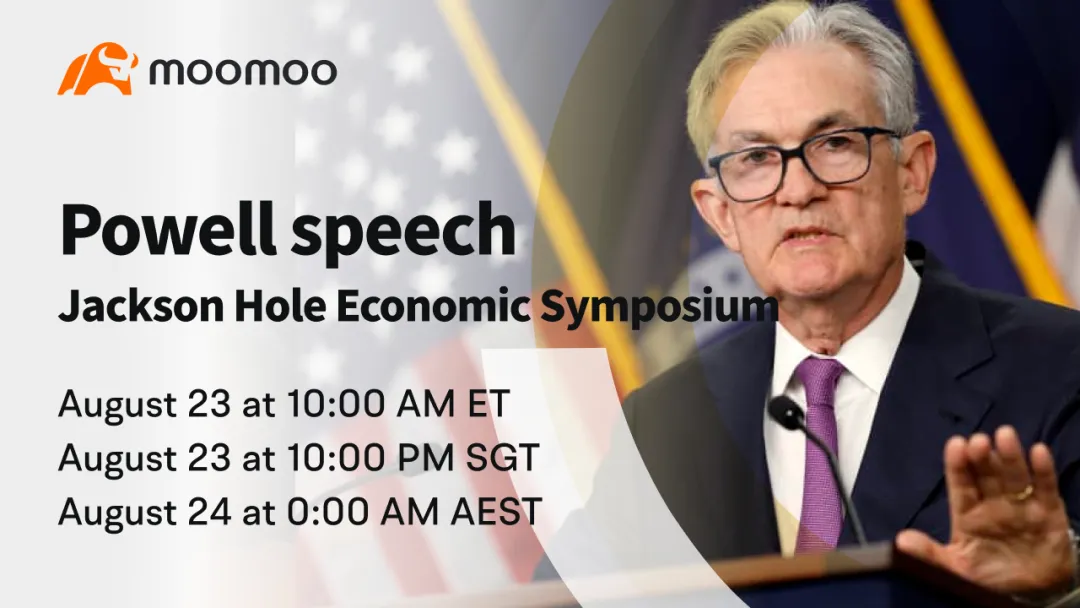
Next, Powell's speech at the Jackson Hole global central bank symposium.

(Source: Futu Moomoo)
Powell stated, "The time has come for policy to adjust. The direction of travel is clear, and the timing and pace of rate cuts will depend on incoming data, the evolving outlook, and the balance of risks." The economy continues to grow steadily, but inflation and labor market data show conditions are changing. Upside inflation risks have diminished, while downside employment risks have increased. With appropriate easing of policy restraint, the Fed has good reason to believe the economy will return to 2% inflation while maintaining a strong labor market. The current policy rate level gives the Fed ample room to address any risks, including further weakening in labor market conditions.
In addition to the above, Powell's speech also included:
"The direction of travel is clear, and the timing and pace of rate cuts will depend on incoming data, the evolving outlook, and the balance of risks." "The cooling in the labor market is 'unmistakable,' and we do not seek or welcome further cooling in labor market conditions." "We have gained greater confidence that inflation is on a 'sustainable path' back to the Fed's 2% target." "Upside risks to inflation have diminished, while downside risks to employment have increased." "I am optimistic about the Fed's ability to bring inflation back to 2% while maintaining a 'strong labor market.' The current level of interest rates provides 'ample room' for policymakers to address any risks they may face, including further weakness in the labor market." The market widely expected him to set the stage for a September rate cut. Goldman Sachs noted that the market might receive signals of 'rate-cut confidence' and 'data dependence,' expecting Powell's message and off-stage interviews to be similar to what has been heard in recent weeks: the Fed is close to cutting rates, but the extent of easing will depend on incoming data. Additionally, Powell may touch on academic topics such as potential growth, neutral rates, and medium-term inflation targets, possibly hinting that the US potential growth rate, neutral rate, and inflation center have all risen.
After the speech, the three major US stock indexes initially surged then pulled back.
The US dollar index quickly fell.
Spot gold in London surged then oscillated.
Offshore yuan rose nearly 300 basis points.
Reply with '0824' to get the bilingual Chinese-English transcript of Powell's Jackson Hole speech.
Risk Disclaimer: The views in this article are for reference only and do not represent any investment advice. Markets are risky; invest with caution.