Carry Trade
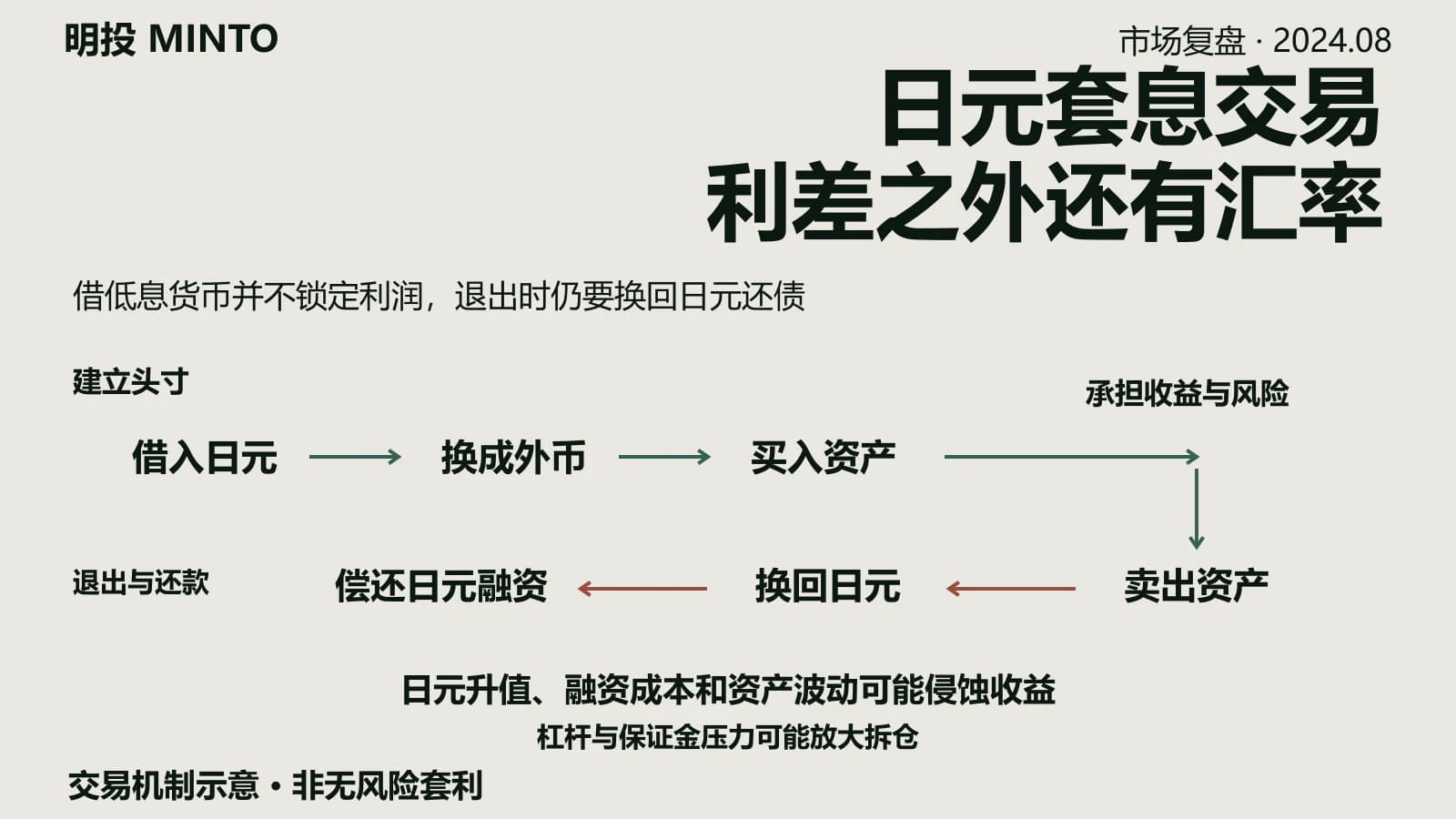
A carry trade is an investment strategy where investors borrow in a currency with low interest rates (the funding currency) and invest in a currency with higher interest rates (the target currency).
International speculators often exploit interest rate differentials between countries for arbitrage, a strategy that was particularly pronounced under Japan's long-standing negative interest rate policy. With Japan's negative rates, while US rates were low but not negative before the 2020 pandemic, and resource-rich countries like Australia and New Zealand offered even higher rates, speculators tended to borrow yen and convert it into US dollars.
This basic version of the carry trade, the so-called "USD-JPY carry trade," allowed investors to profit easily from the US-Japan interest rate differential. If these dollar-converted funds were not content with just earning low bank interest, they might further invest in US Treasuries or equities for higher returns, boosting the overall trade profit.
This operation kept the yen frequently shorted in forex markets, facing persistent depreciation pressure. Combined with Japan's long-term negative interest rate policy, the yen's weakness seemed entrenched. Thus, USD-JPY carry traders appeared to have little worry about significant yen appreciation, as the trade seemed profitable under the prevailing rate environment.
How large is the current yen carry trade position?
We examine the scale of yen short positions from three major trader groups: fast money, real money, and retail investors.
1. Fast Money: CFTC Yen Net Shorts Retreat from Historic Extremes
CFTC positioning data shows speculative yen net shorts hit an all-time high of 184,000 contracts in late June. However, following a cooler US CPI print and BOJ intervention, speculative yen shorts decreased by 31,000 contracts in the week ending July 16, the largest single-week change in recent years.
2. Real Money: Japanese Insurance Firms' Hedge Ratio at Record Low
According to fiscal year-end disclosures from nine major Japanese life insurers, the foreign exchange hedge ratio on foreign currency assets fell to 43.8% as of March 2024, near an all-time low (for comparison, China's June settlement rate was 58%).
With expectations of US rate cuts and BOJ rate hikes, these unhedged overseas assets may increase hedging, triggering yen appreciation.
3. Retail Investors: NISA-Driven Overseas Investment Surges This Year
Data from Japan's Ministry of Finance shows net overseas investment by domestic investment trust management companies exceeded JPY 6.7 trillion in January-June, mostly unhedged. In the first half, benefiting from US stock gains and yen depreciation, these retail investors enjoyed a double win.
As overseas stocks recently fell, some overseas investments flowed back to Japan, requiring USD selling and JPY buying. Hence, we often see the scenario of "European/US stocks down + yen up" during London and New York sessions.
Impact of Sustained Yen Strength
- Cooling of yen carry trades: The significant rebound in USD/JPY challenges strategies reliant on yen depreciation for carry profits. Yen appreciation lowers expected returns and increases risk exposure, prompting investors to adjust or unwind positions to avoid losses.
- Pressure on other currencies: Yen strength pressures other currencies, especially emerging market ones like the Mexican peso, Australian dollar, and New Zealand dollar, as funds flow into Japan, boosting the yen.
- Indirect global economic effects: Yen appreciation typically lowers import costs but also suppresses exports by making Japanese goods relatively more expensive internationally, potentially pressuring export-dependent economies.
- Policy responses: Facing a strong yen, market participants and policymakers, including the Japanese government and central bank, must adjust strategies. The BOJ's policy reaction becomes a focal point, with potential impacts on global financial markets.
- Risk management and investment strategies: In the current environment, investors need keen insight and timely strategy adjustments to navigate complex markets. Diversification, risk assessment, and a long-term perspective are key.
- Changes in yen carry trade scale: With the Fed's aggressive rate hikes raising USD funding costs, the profit margin of USD-JPY carry trades narrowed from Q2 2022 and turned negative from Q3 2022. The scale of yen carry trades is declining, potentially impacting global financial markets.
- Potential market impact: If the BOJ normalizes monetary policy, yen funding costs will rise, leading to yen carry trade unwinding. This could pressure high-yield assets like US Treasuries, pushing up yields, while the yen may appreciate.
Risk Disclosure: The views herein are for reference only and do not constitute investment advice. Market risk exists; invest with caution.

On investment analysis, market insight, and asset allocation — not chasing short-term noise, but understanding what truly drives long-term returns.