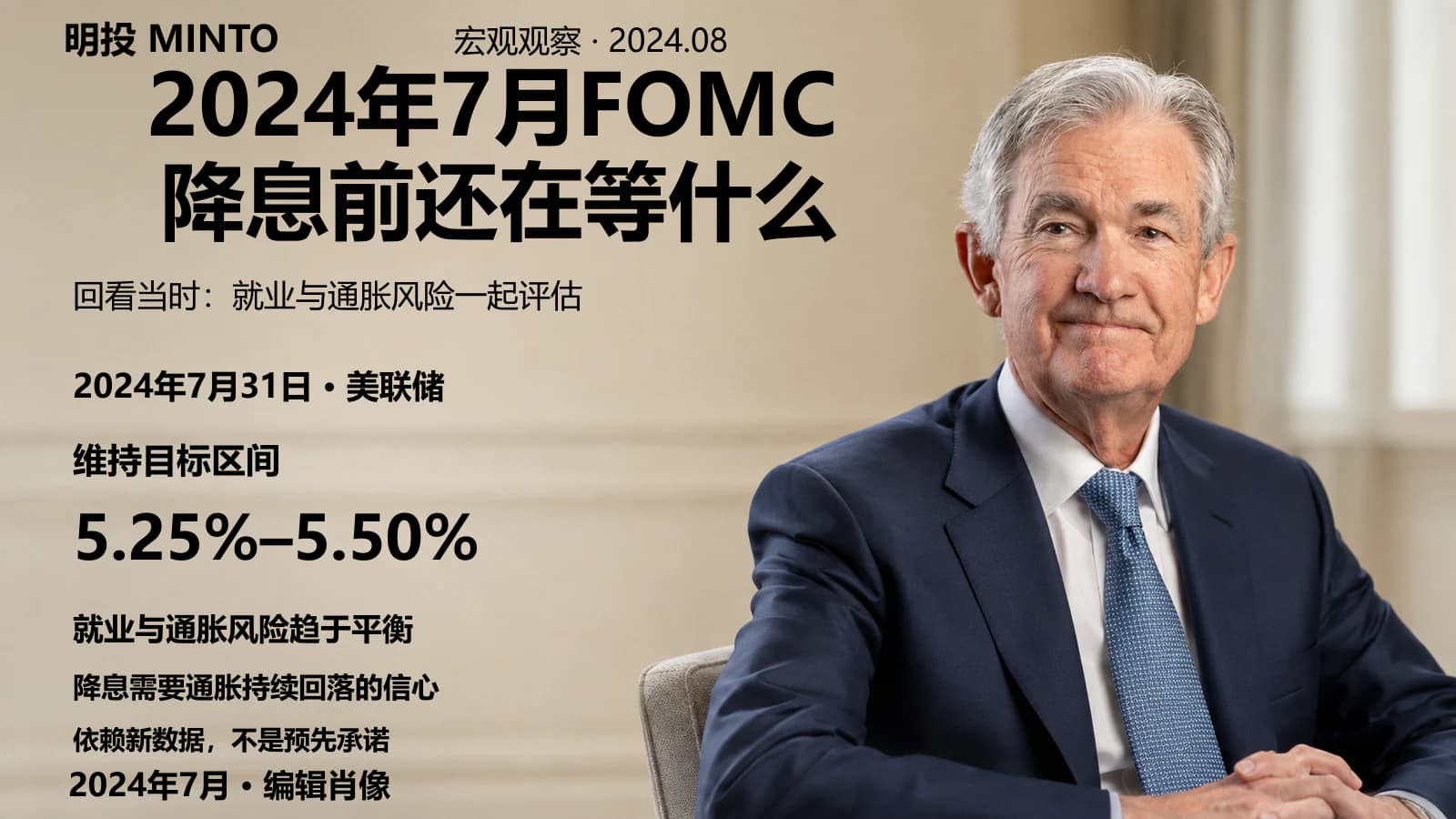
At this FOMC meeting, Powell said that with a cooling labor market and falling inflation, the risks to achieving employment and inflation goals continue to move into better balance. For the first time, the meeting made clear that labor market conditions will be as important as inflation data in shaping policy. He said that a rate cut could be an option at the September FOMC meeting, and if inflation data supports it, the FOMC could cut rates as soon as September. He revealed that the broad view of the FOMC is that the time for a rate cut is approaching, but not quite there yet.
Key takeaways from Powell's press conference:
-
Rate cut outlook: Market expectations of a September cut are reasonable, and the number of cuts could range from zero to several, depending on the data. The FOMC may discuss rate cuts in September, but the final decision depends on the aggregate data, not any single data point.
-
Inflation: The disinflation trend is good and broad-based, and confidence that inflation will return to the 2% target has increased. Core PCE components—goods, non-housing services, and housing services—have all shown clear progress. Q2 inflation data added to confidence.
-
Labor market: The labor market has returned to pre-pandemic levels, strong but not overheated. Q2 job growth was slightly slower than Q1, and the unemployment rate has ticked up, but overall conditions remain solid.
-
Political factors: Emphasized that a September cut has nothing to do with politics; Fed policy is not influenced by election outcomes.
-
Digital currency: The FOMC did not discuss a Fed digital currency; progress on CBDC is limited.
-
Monetary policy: The July FOMC meeting kept the federal funds rate target range at 5.25% to 5.5% and continued to reduce securities holdings.
Economic and market reaction:
-
Economic conditions: The economy is resilient, consumption is slowing but solid, equipment and intangible asset investment is recovering, real estate investment is volatile, and the probability of a hard landing is low.
-
Market reaction: Rate cut expectations boosted risk appetite, with broad asset gains. After the FOMC decision and Powell's remarks, Treasury yields fell, the dollar weakened, and gold, crude oil, and major equity indices all rose. Market expectations for rate cuts in September and November strengthened, with a 87.5% probability of a 25bp cut in September and a 66.4% probability of a 25bp cut in November.
This FOMC meeting's impact extends beyond the US, signaling that the global economic and financial landscape may be entering a new era. The Fed has held rates at 5.25% to 5.5% for eight consecutive meetings, suggesting the current tightening cycle may be nearing its end.
Markets reacted positively, with US stocks rebounding. But at the same time, the global economy is undergoing significant structural shifts, and central bank policy coordination faces more complex challenges. As global capital market liquidity may form a new pattern, some central banks have begun raising rates, complicating traditional carry trades and challenging the dollar's dominance.
Therefore, closely monitoring Fed policy, global economic trends, and geopolitical developments is crucial for investors and policymakers. This will help understand the direction of global financial markets and prepare for potential new scenarios.
Risk disclaimer: This content is for reference only and does not represent any investment advice. Markets are risky; invest with caution.

On investment analysis, market insight, and asset allocation — not chasing short-term noise, but understanding what truly drives long-term returns.