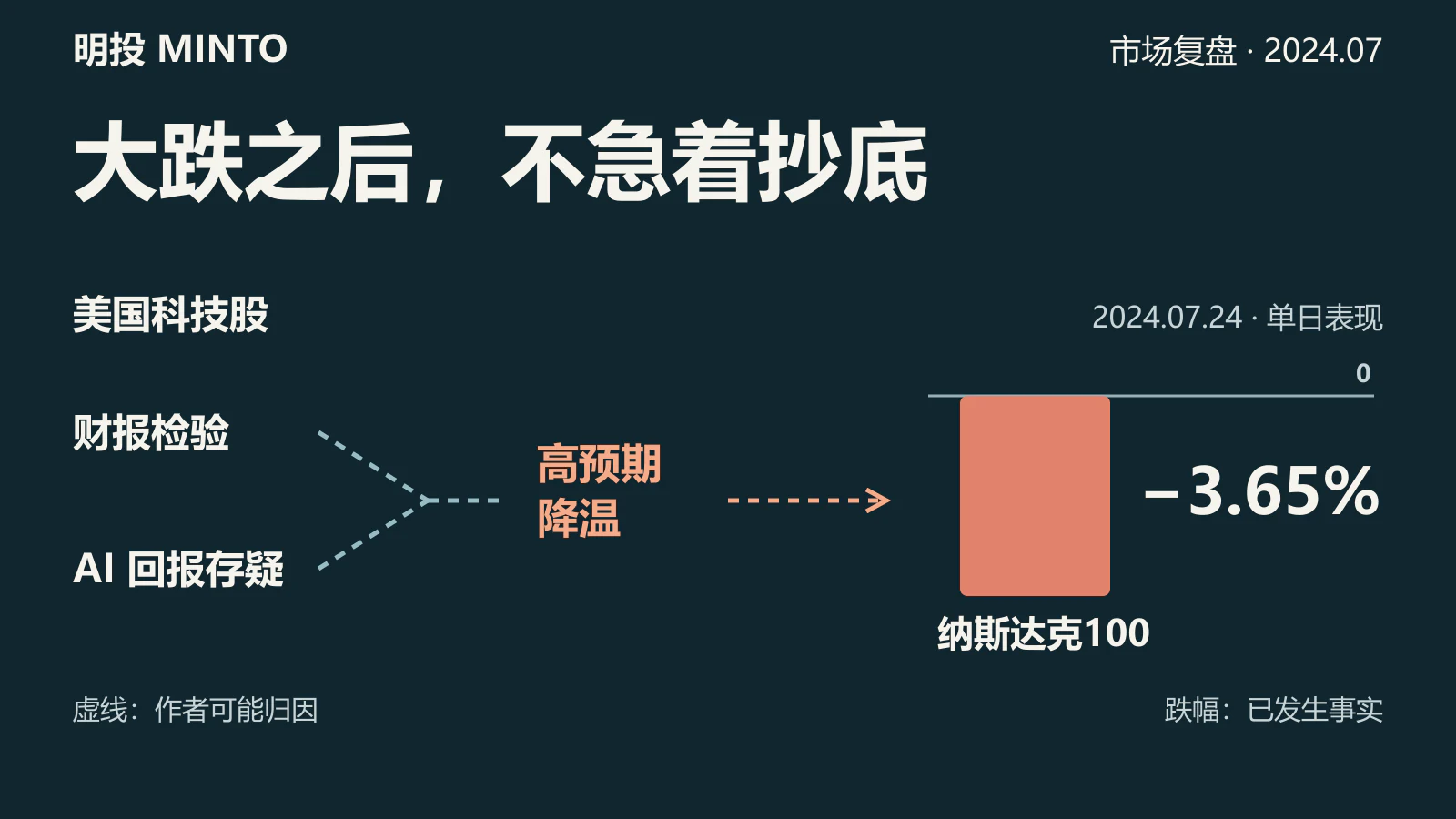
1. Market Recap On the 24th, the Nasdaq 100 fell 3.65%, the S&P 500 dropped 2.31%, the Dow lost 1.25%, and the previously strong Russell 2000 also gave up 2.13%. Tech stocks plunged 4%, consumer discretionary fell 3.89%, and communication services tumbled 3.76%. The selloff likely stems from two factors: first, disappointing earnings from some tech names created uncertainty; second, investors used the negative earnings news to take profits, as expectations for tech and AI had been overly optimistic in recent quarters. The "Big 7" trade and the "MAN" (Microsoft, Apple, Nvidia) trio had contributed disproportionately to the Nasdaq's gains.
2. Expectation Gap A large part of the selloff on the 24th may be attributed to Tesla's disappointing earnings. Tesla's Q2 report showed net profit down over 40% year-over-year, as the EV maker faces intensifying competition from legacy automakers at home and abroad, along with slowing EV sales growth. Alphabet also reported earnings on Tuesday, roughly in line with estimates. But CEO Sundar Pichai's comments raised doubts among AI stock investors. Pichai hinted during the earnings call that the tech industry's massive AI investments won't pay off quickly. Danny Hewson, head of financial analysis at AJ Bell, said Alphabet's huge AI spending made some investors question when the aggressive investment would end and when the long-awaited returns would materialize. Additionally, Alphabet's report showed YouTube ad revenue, which Google has held since 2006, came in below expectations, further dampening sentiment. Gregsek, investment strategy manager at Aspiriant, said the earnings from the two tech giants prompted investors to take profits and lock in gains. Investors are also worried about upcoming earnings reports. Starting next week, other major US tech companies will report: Microsoft on July 30 (key focus: Azure cloud performance), Meta on July 31 (ad business), Apple on August 1 (new product growth drivers), and Amazon on August 1 (whether it can revive the sluggish US retail sector). Nvidia reports on August 28.
3. Investment Uncertainty
Adam Crisafulli, analyst at Vital Knowledge, said: "Tech's problem isn't just disappointing earnings, but also the persistent sector rotation that began after the June CPI release. Many thought the rotation out of tech was temporary, but it's proven durable, heightening anxiety and adding selling pressure."
Yung-Yu Ma, chief investment officer at BMO Wealth Management, said: "We have a lot of uncertainty right now. At least in the near term, there's skepticism about AI's profitability and its contribution to productivity. The market is in a 'show me' state, wanting to see evidence sooner." He noted some healthy sectors like cruise lines and US infrastructure, but added that big tech will "struggle for a while" until they regain footing and provide more proof of AI-related results.
Homin Lee, senior macro strategist at Lombard Odier Singapore, said: "People seem to be reassessing the cost-benefit calculus of the AI ecosystem. Concerns about consumer demand persist amid signs of a US slowdown. These worries may be temporary, but after such a strong rally, a reassessment is natural."
Senior economists at Interactive Brokers believe the US stock correction is far from over and expect more severe downside pressure this quarter. They noted: "Despite the recent selloff, the S&P 500's P/E ratio is still near 22x, and investors are generally unsatisfied with the Q2 earnings season that began in mid-July." They added: "After multiple headwinds this year, the S&P 500 is still up about 14% year-to-date, reflecting irrational exuberance. We expect a 10-15% correction this quarter, historically the worst period of the year."
On Thursday, the US Bureau of Economic Analysis reported that Q2 real GDP grew at an annualized rate of 2.8%, above the 2% estimate and up from 1.4% in Q1. The core PCE price index rose 2.9% QoQ annualized, above the 2.7% estimate and down from 3.7% in Q1. The economy grew faster than expected, suggesting demand remains resilient despite higher borrowing costs.
Although the unemployment rate has risen to 4.1%, a 2.5-year high, the economy is still supported by a resilient labor market. Core PCE slowed to 2.9% from 3.7% in Q1, which is good news for the Fed next week.
Analysts believe the faster growth and cooling inflation leave rate-cut expectations intact. The closely watched core PCE rose 2.9%, slowing from Q1 but still above estimates. While growth accelerated from Q1, it has slowed from last year. Consumer spending and broader economic activity have cooled under high rates, helping to gradually curb inflation. This bodes well for the Fed's soft-landing effort, with a potential rate cut as early as September.
Markets fully expect a 25bp cut in September, with a risk of 50bp. For 2024, markets have priced in a total of 65bp of easing.
Andrew Lilley, chief rate strategist at Barrenjoey, said: "Rate-cut expectations are very high, similar to last year. I worry the market is getting ahead of the data, as the short-term decline in inflation we saw earlier didn't persist."
The Labor Department reported initial jobless claims for the week ending July 20 at 235,000, below the 238,000 estimate and down from 243,000 the prior week. The 4-week moving average was 235,500, versus 234,750 previously. Continuing claims for the week ending July 13 were 1.851 million, below the 1.86 million estimate and down from 1.867 million.
In summary: The uncertainty around buying the dip in US stocks is too high right now. Investors may need to approach this correction cautiously. Those with low positions can gradually accumulate on the dip, stretching out purchases and dollar-cost averaging until the picture clears.

On investment analysis, market insight, and asset allocation — not chasing short-term noise, but understanding what truly drives long-term returns.