跳到正文 · Skip to content
内容
关于与合作
订阅与会员
★ 查看会员权益
设置
主题色
版本 · 深色 / 减动搜索⌘K
草稿预览·这篇还没发布,不会出现在列表和 RSS 里。review 完后把 frontmatter 的 draft: true 改为 false 即可。

The UN's Role in Palestine's Humanitarian Crisis

2024.02.0510 min原创
The UN's Role in Palestine's Humanitarian Crisis

On October 7, 2023, Hamas-led Palestinian armed groups clashed with Israeli forces. The war began with Hamas's invasion of southern Israel, followed by Israeli airstrikes on Gaza and preparations for a ground invasion. In Gaza's already fragile environment, the sudden war tore away the veil covering the long-term systemic oppression of Palestinians. Over two million Gazans face existential threats, and the future of the Palestinian people hangs in the balance. An unprecedented humanitarian crisis is unfolding in this densely populated area. Fortunately, UN agencies are doing their utmost to safeguard Palestinians' right to survival and firmly defend Gaza's lifeline. Allow me to quote Geng Shuang, spokesperson for China's UN mission: "These red lines set by international humanitarian law must not be crossed; the bottom line of international morality and human conscience must not be breached."

Related Background

Territorial Disputes

1. UN Resolution 181

This resolution proposed the establishment of two temporary states: one Jewish and one Arab. It also suggested a framework for a regional economic community and proposed creating a separate entity for Jerusalem under UN administration. The resolution was put to a vote on November 29, 1947, requiring a two-thirds majority of the 57 UN member states (excluding absent and abstaining votes). It passed with 33 votes in favor (72%) and 13 against. The US and Western European countries, along with the Soviet-led Eastern Bloc, voted in favor; the UK, as the mandatory power, abstained; Islamic and Arab states opposed. Below is the partition plan proposed by the UN Special Committee on Palestine and the UN Ad Hoc Committee, submitted to the UN General Assembly.

(Source: Wikipedia)

Subsequently, the 1947-1948 Palestinian Civil War erupted. The UK ended its mandate over Palestine and withdrew without implementing Resolution 181's international regime for Jerusalem or the partition. Later, the Jewish National Council gathered at the Independence Hall (then Tel Aviv Museum of Art) and declared the establishment of the State of Israel, citing the UN resolution. The next day, Arab states launched an attack to destroy Israel, triggering the First Arab-Israeli War.

(Source: Wikipedia)

The war ended in 1949. Israel gained more territory than the UN partition plan allocated. Gaza and the West Bank came under Egyptian and Jordanian control, respectively. The West Bank was formally annexed by Jordan in 1950 after the Jericho Conference, until the 1967 Six-Day War.

2. Two-State Solution Based on 1967 Borders

The international community's "two-state solution" envisions an independent, sovereign Palestinian state with East Jerusalem as its capital.

3. Illegal Settlements (Source: Al Jazeera) Settlers are Israeli citizens living on private Palestinian land in the occupied West Bank and East Jerusalem. Most settlements are built entirely or partially on private Palestinian land. Over 700,000 settlers (10% of Israel's nearly 7 million population) currently live in 150 settlements and 128 outposts in the occupied West Bank and East Jerusalem. Settlements are authorized by the Israeli government; outposts are built without authorization, ranging from a few people in shacks to communities of up to 400.

UN Special Coordinator for the Middle East Peace Process, Tor Wennesland, told the Security Council: "The expansion of Israeli settlements further entrenches the illegal occupation, fuels violence, impedes Palestinian access to their land and resources, and systematically undermines the viability of a Palestinian state, a key component of the two-state solution."

He added: "I call on the Israeli government to immediately cease all settlement activity and dismantle outposts, in line with its obligations under international law."

Numerous illegal settlements are scattered across the territory, fragmenting Palestinian-controlled areas.

The UN's position is that Israel's maintenance and construction of settlements in the occupied West Bank and East Jerusalem violate international law, contradict Israel's obligations under the Roadmap, and pose a serious obstacle to peace. Article 49 of the Fourth Geneva Convention strictly prohibits such colonization, stating: "The Occupying Power shall not deport or transfer parts of its own civilian population into the territory it occupies."

4. Separation Wall

(Source: Al Jazeera)

The black line shows the wall's route, extending beyond the 1967 border (green line). Green areas represent Israeli-controlled zones, showing that most territory inside the border is under de facto Israeli control.

(Source: AFP)

(Israel's separation wall divides East Jerusalem from the West Bank town of Kalandia)

Israel built the wall and associated structures in the occupied Palestinian territory, including East Jerusalem, deviating from the pre-1967 border. It also destroyed and confiscated Palestinian land and property, displacing thousands of families. Israel cites security reasons, but the wall effectively annexes more Palestinian land, unilaterally defines the future Palestinian state's border, and prejudges final status negotiations. Israel has no right to build such structures on Palestinian land. (UN Committee)

(Source: AP)

(Source: Reuters)

5. Gaza's Dire Survival Crisis

5.1 Gaza Territory

Gaza is about 41 km long, from Israel to the Egyptian border—slightly shorter than a marathon. Its area is roughly 360 sq km, home to about 2.1 million people.

5.2 Gaza Demographics

According to the Palestinian Ministry of Health (2022), 47.3% of Gaza's population is under 18, with an average age below 18, far below the global average of 28.

(Source: Sina Finance)

Imagine what kind of environment leads to half the population being minors.

According to the WHO, Israeli airstrikes and ground fighting have killed, injured, or left missing an estimated 100,000 people in Gaza.

WHO reports that among the 27,019 deaths reported by Gaza health authorities, 60% are women and children. Over 66,000 people are injured and need medical care, which remains hard to access. UNICEF reports at least 17,000 children are orphaned or separated from their families.

WHO Representative in the Occupied Palestinian Territory, Rick Peeperkorn, stressed that resupplying hospitals across war-torn Gaza is extremely challenging. In January, only 3 of 15 planned missions to northern Gaza were executed; 4 were blocked by impassable roads, 1 delayed, and 8 denied. In the south, 4 of 11 missions proceeded smoothly, 2 were delayed, 2 were blocked by late or excessive delays at checkpoints, and 3 were denied.

Peeperkorn said from Jerusalem: "The lack of security and humanitarian corridors makes safe, rapid humanitarian operations increasingly challenging. But sustained inability to access hospitals could destroy the health system."

5.3 Water Resources

Palestinians cannot dig new wells, install pumps, or deepen existing wells, nor can they use the Jordan River or freshwater springs. Israel controls rainwater collection across most of the West Bank; Palestinian rainwater collection pools are often destroyed by Israeli forces. This echoes findings in a 2017 international human rights report titled "The Occupation of Water." According to the report, since 1967, Israeli military authorities have consolidated full control over all water resources and water-related infrastructure in the occupied Palestinian territory. Military Order 158 requires Palestinians to obtain Israeli military permission before building any new water facilities. The human rights group says this has had "devastating" consequences for Palestinians.

Below are screenshots from two UN reports to support this.

UN Actions

UN Secretary-General António Guterres at the Rafah Crossing

(Source: UN Photo)

On October 20, 2023, Guterres stood just meters from the Egyptian side of the crossing and delivered an impassioned speech. Pointing behind him, he spoke of 2 million people trapped for nearly two weeks without adequate supplies.

He said: "Before us is a paradox. Behind this wall, 2 million people are suffering immense hardship, with no water, no food, no medicine, no fuel, under bombardment, needing all kinds of aid to survive."

Pointing to trucks carrying life-saving supplies, he continued: "But on this side, we see many trucks loaded with water, food, and medicine—precisely what the people behind the wall need, their lifeline. For many in Gaza, these convoys are a matter of life and death."

He said the next step is obvious: "We need to get these trucks moving, get them behind the wall, as quickly and as many as possible."

He added that the UN is "actively engaging with all parties" on the terms for cross-border aid delivery as outlined in the US-Israel statement and related Egypt-Israel agreements.

"We must get these trucks moving as quickly and as many as possible. We're not expecting just one convoy. We want a meaningful number of trucks every day to provide adequate support for the people of Gaza."

Guterres stressed the need to resolve these issues quickly and reiterated his call for a humanitarian ceasefire. He thanked the Egyptian government and humanitarian partners for their efforts.

"Seeing all this, it's impossible not to feel heartbroken. I hope to see food aid and medicine delivered by plane reach those most in need, and one day achieve peace through a two-state solution, where Palestinians and Israelis can live together in peace." (Source: UN News)

(Source: UN Photo)

Hundreds of trucks are waiting at the Egyptian Rafah border for the "green light" to deliver life-saving aid to 2.3 million besieged Gazans.

Guterres inspected some of the cargo, including medical supplies, food, and water, near the Gaza border in Egypt. He told reporters the trucks urgently need to enter Gaza.

Aid agencies inside Gaza report that stocks of basic necessities like food and water have dropped to dangerous levels amid continuous airstrikes and shelling, with large amounts of aid stuck at the Rafah crossing awaiting delivery.

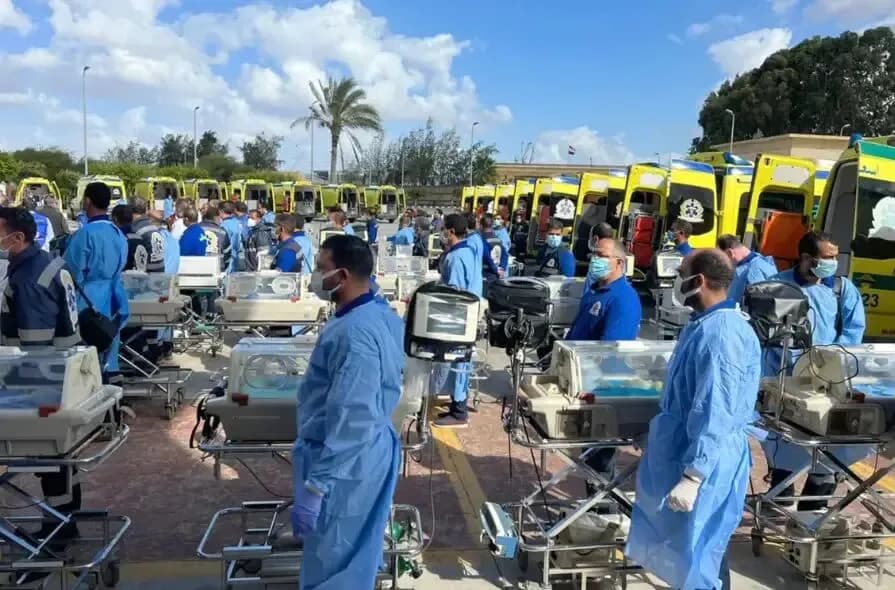
UN Special Task Force, WHO, Egyptian Ministry of Health (Source: UNICEF) (Source: WHO) Al-Shifa Hospital was accused by the IDF of being Hamas's "command center" and "headquarters." Amid shortages of medicine, electricity, and food, 31 premature babies were at risk of death.

On November 20, 2023, a special UN task force risked great danger to enter Al-Shifa Hospital and successfully evacuated these infants. According to Egyptian officials, only 29 babies arrived in Egypt, though 31 were planned. The discrepancy is unclear; some reports say two were left at the Emirati Hospital in Rafah for further treatment. Regardless, these little ones were fortunate. The UN Office for the Coordination of Humanitarian Affairs (OCHA) reported that five babies had died in the hospital due to power outages, and their bodies were removed. Hospital director Mohamed Zaqout said some babies suffered dehydration, hypothermia, and sepsis. He noted that four babies died just two days before the evacuation.

UNRWA: United Nations Relief and Works Agency for Palestine Refugees in the Near East

After the 1948 war, the UN General Assembly established UNRWA to provide direct relief and works programs for Palestinian refugees. Its services include education, healthcare, relief and social services, camp infrastructure and improvement, microfinance, and emergency assistance.

(Source: UNRWA/Ashraf Amra)

For Gazans, UNRWA is a lifeline and the backbone of humanitarian efforts. It is the main humanitarian agency in Gaza, on which over 2 million people depend for survival. The current war has lasted over three months; many are starving, and famine looms. UNRWA also provides shelter for over 1 million people, offering food and primary healthcare even during the most intense hostilities. Amid the prolonged humanitarian crisis, UNRWA continues to provide extensive aid, including food, education, and healthcare.

OCHA described Rafah as a "desperate pressure cooker."

(Source: UNRWA)

International Court of Justice (ICJ)

The ICJ is one of the six principal organs of the UN and its primary judicial organ, adjudicating disputes between sovereign states. Established in June 1945 under the UN Charter, it began operations in April 1946 and is based in The Hague.

(Source: ICJ/Frank van Beek)

On December 29, 2023, South Africa filed a case at the ICJ accusing Israel of violating the Genocide Convention by harming Palestinians in Gaza. Israel denied the allegations.

What is the Genocide Convention? Enacted after the Nazi Holocaust, the 1948 Convention defines genocide as "acts committed with intent to destroy, in whole or in part, a national, ethnical, racial or religious group." Acts include killing members of the group, causing serious bodily or mental harm, and deliberately inflicting conditions calculated to bring about the group's destruction.

Several Israeli ministers and senior officials have been found to have made genocidal statements.

The Lemkin Institute for Genocide Prevention stated on X that Israel's claim of "no intent" to destroy a group is hollow given "overwhelming evidence of genocidal rhetoric by Israeli senior officials, journalists, and the military and society."

(Source: Al Jazeera)

Polish-Jewish lawyer Raphael Lemkin coined the term "genocide" in the 1940s and made it an international crime.

(Source: Al Jazeera)

On January 26, the ICJ issued a preliminary ruling on South Africa's case, ordering Israel to "take all measures within its power" to prevent genocide. The court also demanded Israel "take immediate and effective measures to enable the provision of urgently needed basic services and humanitarian assistance to address the adverse conditions of life faced by Palestinians in Gaza."

UNRWA Commissioner-General Philippe Lazzarini noted: "These measures aim to prevent irreparable harm to Palestinians' rights."

He said: "The only way to achieve this is through cooperation with international partners, especially UNRWA, the largest humanitarian actor in Gaza. UNRWA's 13,000 staff in Gaza, including about 3,000 core staff, continue to work, providing a lifeline to their communities. But due to lack of funding, this lifeline could collapse at any time."

Lazzarini emphasized: "Sanctioning an agency and the entire community it serves because of allegations of criminal acts by a few is highly irresponsible, especially during a time of war, displacement, and political crisis in the region."

Along with the provisional measures, the ICJ ordered Israel to submit a report within one month on "all measures taken to give effect to this Order."

For more information, visit UN News: [object Object]

Minto
明投 Minto
投资分析 · 长期主义者
你读完了 · Colophon

The UN's Role in Palestine's Humanitarian Crisis

10
分钟
2024/02
期号
2024
年份
真正稀缺的,是一个不慌不忙的人。
明投 · MintoInvest Wisely
— From This Series
喜欢这篇?这类 宏观观察 的深度拆解会持续发到你邮箱。
无广告 · 随时退订
— Enjoyed the read?
如果这篇文章对你有用,把它分享给一个朋友,就是对我最好的支持。

口碑是独立创作者最稀缺的燃料。

— Discussion

说说你的想法

评论基于 GitHub Discussions(Giscus)。登录后即可留言、点赞、互相讨论。

评论还在准备中。

想说什么可以直接发我邮件,比在评论区更容易认真回复。

mingtaohuang617@gmail.com →
支持沉浸式阅读