I. The First Book of Taleb’s Trilogy
Fooled by Randomness, Taleb's 2001 book (six years before The Black Swan, eleven before Antifragile), is the starting point of his "uncertainty trilogy."
If The Black Swan is about extreme events being unpredictable, and Antifragile about how to benefit from volatility, this book tackles a more fundamental and painful question: how we mistake luck for skill.
Taleb was still an options trader when he wrote it. He watched every day as people around him made money purely from luck, then mistook that luck for genius, then, when their luck ran out, went to zero overnight. The book is his autopsy of those people.
II. The Most Painful Line: Every Success Story You See Is a Survivor
Taleb lays out a statistical truth: every successful person you see is a survivor.
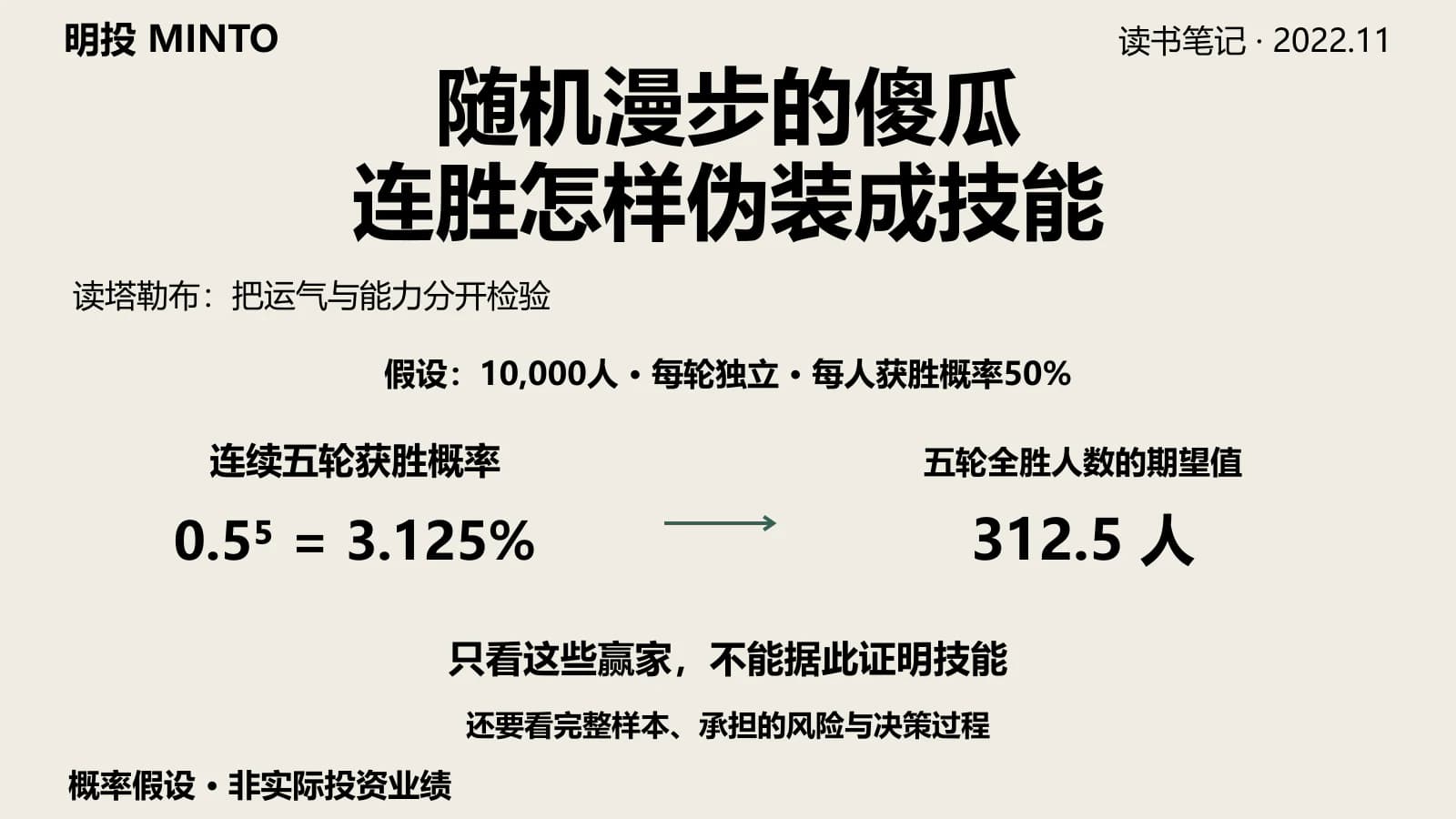
Imagine 10,000 traders. Each flips a coin each year to determine profit or loss. Purely by luck, after five years about 300 of them will have been profitable for five straight years. Those 300 will write books, go on TV, be called "investment gurus," and attract followers. But their streak is completely random.
The terrifying part is that those 300 people also believe they’re geniuses. They don’t know they’re just the luckiest ones among 10,000 coin flippers. They’ll invent a “methodology” that explains nothing.
This is a direct warning for investors. When you see someone who has beaten the market for five consecutive years, you can’t tell if they have real skill or are one of those 300 lucky survivors. Short-term performance contains almost no information about “skill”—it primarily contains luck.
Every time I see a fund manager / financial blogger / investment guru with “impressive returns,” I ask a Taleb-like question: If there were 10,000 people similar to him, purely relying on luck, how many would achieve the same result? If the answer is “quite a few,” then his track record doesn’t demonstrate skill.
III. The Second Concept: Ergodicity and “The Other History”
Taleb keeps hammering a philosophical concept: the history you see is just one of countless possible histories.
A Russian roulette player has a five-sixths chance of winning a big payout. If he wins, he feels “successful.” But if you could see “all parallel universes,” one-sixth of him is dead. Judging a decision by a single outcome is a fundamental error.
Taleb calls this the ergodicity problem—for an individual, one catastrophic failure means you’re out, with no do-overs. So you can’t evaluate a strategy that risks bankruptcy using “average returns.”
This directly explains why “high leverage + high win rate” strategies are dangerous. Even if they work 95% of the time, the 5% bankruptcy is irreversible—you don’t get a second chance. Over the long term, what determines your fate isn’t your average return, but whether you get wiped out at some point.
IV. Where I Disagree with Taleb
1. He almost denies that skill exists at all.
Taleb attributes so much success to luck that readers can easily conclude “investing is all luck, effort doesn’t matter”—a nihilistic take. But skill does exist—it just takes a long enough sample (20–30 years, multiple cycles) to separate from luck. Buffett’s 60-year record can’t be luck; someone who 10x’d in five years, probably is luck. Taleb doesn’t acknowledge the former enough.
2. His own “process vs. result” argument is inconsistently applied.
Taleb tells us to judge ourselves by decision quality, not outcomes. But when evaluating others (especially the economists he disdains), he often uses outcomes—”See, they were wrong in 2008.” Using outcomes to prove others wrong while defending yourself by process is a double standard.
3. He underestimates that luck also requires preparation.
Taleb treats luck as pure randomness. But in reality, much of “luck” is actually “the prepared person bumping into an opportunity.” Buffett swooping in to buy Goldman Sachs at the bottom in 2008? Yes, luck that the crisis happened, but he could act because he constantly kept cash, credit, and judgment ready. The boundary between “luck” and “preparation” is fuzzier than Taleb draws it.
4. The book’s tone is too cynical.
Taleb is dripping with superiority and sarcasm towards “lucky fools.” That posture feels satisfying to read, but it’s toxic—it easily turns readers into cynics who dismiss everything and attribute everything to luck. True humility isn’t mocking other people’s luck—it’s acknowledging your own success contains luck too. Taleb says it more than he does it.
V. Taleb vs. Howard Marks: Two Ways to Talk About Luck
When reading about luck and skill, you can’t avoid Howard Marks—he dedicated a chapter to this in The Most Important Thing.
But their postures differ. Taleb is aggressive—he uses luck to debunk others’ fake skill. Marks is reflective—he uses luck to stay humble himself.
Taleb says “your money was luck” to tear others down; Marks says “my money might be luck” to keep himself in check.
The same truth, one uses to attack, the other to self-reflect. I prefer Marks’s approach—the real value of a luck framework isn’t to judge others, but to constrain yourself: don’t get arrogant when you win, don’t whine when you lose, because both contain plenty of luck.
VI. On the Abuse of the “It’s All Luck” Idea
Final note—“It’s all luck” has become an excuse.
After reading Taleb, many go to the other extreme: attribute everything to luck, then give up on effort. “Why bother researching companies if it’s all luck?” That’s the most complete misreading of Taleb.
Taleb never said “effort is useless.” He said “effort has huge randomness in its payoff, so you should exert effort in a way that can withstand randomness.” Acknowledging luck isn’t an excuse to lie down; it’s a reason to leave margin while you work hard.
Using the luck argument as an excuse not to try is the flip side of the lucky fool—the “resigned fool.” Neither understood Taleb.
VII. In Closing
This book is my personal favorite in Taleb’s trilogy. Because it’s the most down-to-earth and the most painful.
It doesn’t have the grandiosity of The Black Swan or the systematic heft of Antifragile. But it asks the most direct question—You think you know, but do you really? Or were you just lucky?
Every investor who has ever made money should ask themselves that question repeatedly. Especially during a streak—because that’s exactly when luck is most easily disguised as skill.
Every time my account surges, I force myself to re-read certain pages of this book. Not to negate my judgment, but to remind myself—how much of this gain is due to me actually being right, and how much is just the market happening to move in the direction I bet?
Anyone who can’t tell the difference will eventually, when that luck runs out, give back everything they earned.
Taleb uses an entire book to hammer home that one lesson. It’s worth it.

On investment analysis, market insight, and asset allocation — not chasing short-term noise, but understanding what truly drives long-term returns.